Optical Architecture and the Photographic Image
Howard Harris approaches photography less as a fixed record of appearances than as a constructed optical event. Across his practice, recognizable subjects and abstract configurations are subjected to an intensive reorganization of line, color, depth, and spatial rhythm, producing images that appear simultaneously photographic and engineered. Vivid cyan, electric blue, red, yellow, green, and white frequently emerge against deep black grounds, giving contours the radiance of illuminated circuitry or energized drawing. In other works, amber figures seem almost translucent, while monochromatic structures are reduced to luminous networks of ribs, loops, and cellular openings. The formal vocabulary is remarkably consistent even when the subject changes from human bodies to urban architecture, a light bulb, a street-food cart, an animal form, or near-total abstraction. That consistency gives Harris a recognizable visual language. His BFA training at the Kansas City Art Institute, subsequent Master of Industrial Design studies at Pratt Institute, and broader experience in architectural design, space planning, technology, and industrial design all find visible counterparts in compositions that treat the image as a system of forces rather than merely a surface.
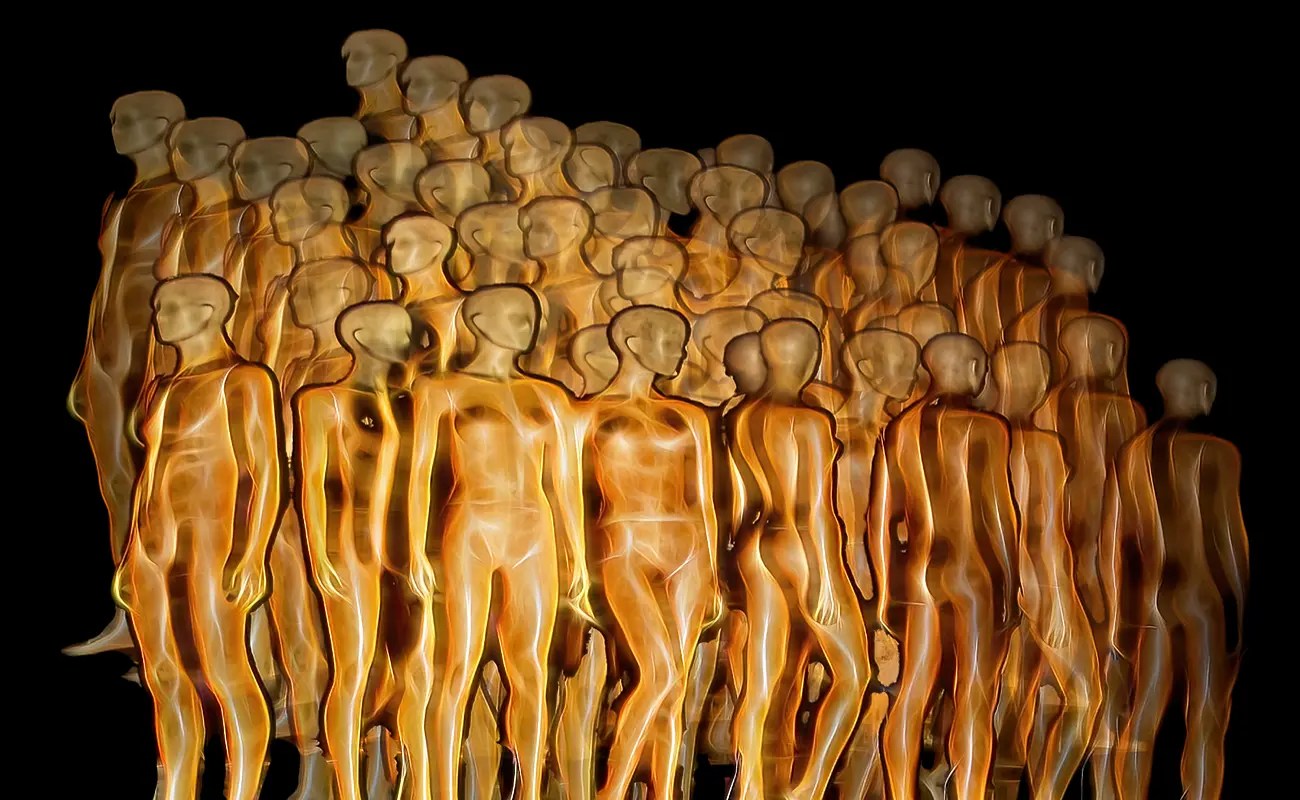
Structure is central to that system. Harris begins with a high-resolution digital photograph and selectively emphasizes or excludes pixels in order to sharpen relationships among line, plane, volume, form, and color. The resulting images often behave like diagrams that have become sensuous. A spherical abstraction built from arcs and luminous vectors suggests rotational energy without settling into a literal object. Elsewhere, repeated human forms accumulate into a densely packed amber crowd whose overlapping contours dissolve distinctions between individual bodies. An architectural image constructed from scaffold-like verticals and horizontals turns built space into a vibrating field of chromatic intersections. Even the more descriptive urban scenes resist ordinary photographic transparency. A street-food cart remains immediately recognizable, yet it appears suspended within an environment translated into intersecting luminous traces, while a Paris Métropolitain entrance is intensified through sharpened colored contours until architecture begins to resemble an energized graphic skeleton. Harris therefore retains photography’s indexical relation to the visible world while making that relation unstable, subjecting observation to a second order of technological seeing.
That instability becomes more consequential through the physical construction of the finished objects. Harris sublimation-prints photographic imagery onto aluminum and positions an acrylic grid overlay at an offset from the base image, producing negative-positive relationships that change according to parallax. Movement by the viewer is consequently incorporated into the work rather than remaining external to it. A shift in position alters alignments, separations, and apparent depths; changes in lighting modify reflections and visual emphasis; surrounding conditions become secondary agents within the image. Such effects differentiate the works from photographs whose decisive organization is completed before exhibition. Harris instead designs an interval between components and allows perception to operate inside that interval. His United States patent for the layered process establishes the technical specificity of the method, although the artistic importance of the process lies less in legal novelty than in the degree to which it makes perception physically consequential. The strongest works are not simply digitally transformed photographs mounted through an unusual system. They are images whose subject, structure, and presentation converge around the question of how seeing changes when the supposedly stable picture refuses to remain visually still.

Howard Harris: Perception as Material
Harris identifies his practice with a lineage running through Josef Albers and Victor Vasarely, and that association is most persuasive when understood as a shared concern with perception rather than as stylistic inheritance alone. Albers made relational color a central problem, showing that chromatic experience depends upon adjacency and context rather than isolated hue. Vasarely developed geometric systems capable of producing optical vibration and perceptual instability. Harris extends those concerns through photography, digital intervention, and materially separated image layers. Color remains relational, and geometry remains activating, yet neither is confined to pigment or autonomous pattern. Photographic references continually introduce recognizable bodies, objects, buildings, and environments into the optical field. The effect complicates the modernist pursuit of perceptual purity because visual ambiguity is attached to things that already carry cultural, social, or bodily associations. A glowing bulb remains an emblematically familiar object even when its filament and contours dissolve into colored traces. Two facing heads can be read as mirrored anatomical presences while also functioning as symmetrical masses of amber illumination. Harris uses this oscillation between recognition and visual destabilization to shift perceptual experimentation away from a purely formal exercise.
The childhood accident in which a model rocket engine temporarily deprived Harris of sight provides an important biographical key to that sustained attention to vision. It need not become an explanatory myth for the entire practice, yet it clarifies why perception appears in the work as an active and vulnerable process rather than an automatic function. Sight, within these images, is repeatedly shown to be constructed. Edges separate, colors migrate, volumes become transparent, figures merge into networks, and black space acquires as much compositional authority as illuminated form. A dense field resembling intertwined organic filaments makes the distinction between object and surrounding space almost impossible to stabilize, while a black-and-white composition of repeated ribbed forms converts bodies or body-like structures into a continuous system of openings and connective tissue. These works encourage the eye to alternate between local detail and global pattern, between recognition and dissolution. Harris therefore places perceptual uncertainty at the center of aesthetic experience. The brain searches for coherence while the image keeps generating competing structures, creating a productive tension between the desire to identify what is seen and the awareness that seeing itself is conditional.
This concern also differentiates Harris from the slick optical certainty that can accompany digitally enhanced photography. High chromatic intensity and computational effects can easily become ends in themselves, particularly when bright contours, sharpened edges, and radiant color provide immediate visual spectacle. Harris is most convincing when technological intervention performs conceptual work rather than simply increasing impact. The crowd of glowing figures, for example, gains force because repetition and transparency transform social presence into an ambiguous condition between individuality and collectivity. The symmetrical paired heads carry psychological tension precisely because their mirroring suggests confrontation, reflection, duplication, or self-recognition without fixing a single narrative. The radiating oval forms surrounded by explosive linear structures similarly hover between eyes, apertures, mechanical portals, and abstract centers of force. Such works demonstrate how Harris can move beyond decorative luminosity by making visual effects serve perceptual and symbolic ambiguity. The principal challenge across the practice is therefore one of calibration. When every contour is equally electrified, hierarchy can diminish; when modulation is stronger, the digital intensity becomes more persuasive because it guides attention rather than overwhelming it.

Bodies, Cities, and Systems of Connection
The recurring human figure provides one of the clearest bridges between Harris’s optical investigations and broader cultural meaning. Bodies rarely appear as conventionally individuated portraits. They are duplicated, layered, simplified, partially dissolved, or converted into linear systems. The amber crowd is particularly revealing in this respect. Although its figures retain heads, torsos, limbs, and differences of posture, their translucency causes one body to pass visually into another. The crowd reads at once as a gathering of separate persons and as a collective organism composed of repeated units. Such a construction resonates with contemporary experiences of social life in which individuals continually enter larger technological, institutional, and urban systems. Harris does not need to impose a literal sociological message for that resonance to arise. Formal compression carries much of the conceptual burden. The black background removes geographic specificity, while repeated golden figures create a fluctuating boundary between anonymity and presence. Another predominantly black-and-white composition pushes this principle further, transforming a cluster of upright forms into webbed structural membranes. Human identity becomes inseparable from the networks that organize, support, and sometimes constrain it.
A more solitary figure surrounded by sweeping white linear forms suggests a contrasting relation between body and environment. The figure appears less absorbed into a crowd than generated by an expanding system of curved bands, striations, and connective strands. Bodily form and surrounding space share the same visual grammar, making it difficult to determine where one ends and the other begins. Harris frequently uses this collapse of boundaries to suggest that perception is environmental rather than detached. The same proposition emerges in the urban works, where architecture is stripped of conventional solidity and redrawn as luminous edges. Buildings, scaffolding, façades, and transit structures become networks through which the eye travels. The city is no longer presented simply as location; it becomes an optical infrastructure. Harris’s background in architectural design and space planning is particularly evident here, because the compositions privilege circulation, interval, framing, and spatial relation. The viewer is asked to navigate images rather than merely inspect them. Streets, buildings, bodies, and objects are integrated into a continuous logic of structural connectivity, giving the practice coherence across subjects that might otherwise seem unusually diverse.
The street-food cart image offers an especially productive example because it maintains a strong connection to ordinary visual culture. The cart, covered in menus, signs, photographs of food, and commercial graphics, is already an object saturated with competing information before Harris transforms its surrounding architecture. Its dense, literal detail sits against a cityscape reconstructed through luminous linear perspective. This juxtaposition allows the work to operate between documentary photography and technological abstraction. The human figure standing beside the cart anchors scale and social use, while the altered environment makes familiar metropolitan space appear provisional, almost diagrammatic. Harris achieves something comparable in the Métropolitain image, where an iconic entrance sign remains materially legible even as surrounding buildings are fragmented into colored edges. These photographs suggest a valuable direction within the practice because they preserve friction between photographic evidence and digital intervention. Completely abstracted works can achieve powerful visual density, but recognizable urban subjects introduce cultural specificity and temporal texture. They remind the viewer that Harris’s perceptual systems are not detached experiments. They operate upon the shared environments through which contemporary vision, commerce, mobility, architecture, and technology are already intertwined.

Howard Harris: Techspressionism and the Moving Viewer
Harris’s description of his practice as Techspressionist becomes most meaningful when technology is understood not simply as a toolset but as an expressive condition. The digital selection and alteration of pixels, sublimation printing, aluminum support, acrylic overlay, and parallax structure establish a chain in which technological decisions affect both image formation and bodily experience. Expression enters through choices of exaggeration, suppression, color, rhythm, and spatial tension rather than through traditional gestural brushwork. This distinction is important because several compositions possess an unmistakably gestural character despite emerging from photographic and digital procedures. The sweeping cyan strands of the spherical abstraction resemble arcs drawn at speed; the vivid crustacean-like form is animated by muscular ribbons of orange, red, blue, and yellow; linear bursts surrounding paired apertures create a visual pressure closer to energetic mark-making than cool digital geometry. Harris therefore complicates the assumption that computational image construction must produce impersonal surfaces. His strongest images retain evidence of selection and intensity, allowing technological precision to coexist with subjective emphasis. Techspressionism, in this context, describes a productive tension between system and impulse rather than an uncomplicated celebration of digital novelty.
For galleries and institutions, the practice possesses an unusual relationship to reproduction. Photographic documentation can communicate subject, palette, and broad compositional structure, but it cannot fully transmit the layered parallax on which Harris places significant conceptual weight. That limitation is not incidental. It distinguishes the physical object from the infinitely circulating digital image at a moment when photographic work is often first encountered through screens. Harris’s constructions insist that presence matters. Aluminum, acrylic, spatial separation, reflected light, and spectator movement make each encounter dependent upon circumstances that a flat reproduction cannot standardize. This quality gives the work particular relevance to exhibition contexts in which sightlines, illumination, and movement can become curatorial components. It also creates a productive demand on collectors, since possession concerns an interactive optical object rather than a conventional photographic print alone. At the same time, physical dependence raises the standard of installation and documentation. The conceptual claim of variable perception becomes convincing only when material behavior is sufficiently pronounced to exceed what viewers might attribute to surface gloss or graphic treatment. Harris’s process is strongest when physical construction visibly changes the logic of the image.
Within contemporary photographic practice, Harris occupies an interesting position between image-maker, designer, and constructor of perceptual situations. His industrial design education and technological experimentation prevent the work from fitting comfortably within conventional categories of documentary, abstract, or digitally manipulated photography. The patent reinforces the systematic nature of the process, yet the broader significance of the practice depends on something more culturally durable than invention alone. Its critical strength lies in joining an established history of perceptual art to the conditions of technologically mediated seeing. Harris inherits from Albers the instability of relational perception and from Vasarely the activation of optical response, then redirects those concerns through photographic source material, layered fabrication, changing environments, and bodily movement. The most compelling works resist becoming demonstrations of technique because their formal devices open questions about individuality, urban systems, embodiment, technological vision, and the unreliability of stable appearance. That combination gives the practice a credible institutional and market identity. Harris does not merely digitize the optical strategies of earlier art; he recasts perception as an encounter among image, material, technology, architecture, light, and moving human presence.