Paint as Event, Surface as Conversation
Georgina Stone has built a striking contemporary practice in which painting is not treated as a finished picture planned in advance, but as a living encounter that unfolds through action, revision, and response. Based in London and born in the United Kingdom in 1996, she belongs to a generation of painters who understand the canvas as a place where thought can take physical form. Her works carry an immediate sense of movement, yet they also reveal patience, reconsideration, and sustained attention. Every mark appears connected to a larger sequence of decisions, pauses, and renewed attempts. Rather than presenting a static image, Stone offers evidence of a process in motion, allowing viewers to sense the passage of time embedded within the surface. This approach gives her paintings unusual vitality, because they feel discovered rather than imposed. They hold the energy of something found through making, where uncertainty is not hidden but transformed into visual force. In this way, Stone positions painting as both action and reflection, merging instinct with careful looking.
Her academic path helped strengthen that commitment. Stone studied Painting at the University of Brighton, completing a BA in 2018, before later earning an MA in Painting from the Royal College of Art in 2024. These formative years appear significant not simply as credentials, but as periods in which painting became central to her identity and way of understanding the world. She has spoken of the medium as a language and as a mode of thought, suggesting that the studio is also a place of personal clarity. That perspective can be felt in the seriousness of her engagement with materials. She does not use paint merely to illustrate ideas already formed elsewhere. Instead, the act of painting becomes the method through which ideas emerge. Such an outlook places her within a lineage of artists who trust visual thinking as fully as written or spoken expression. For Stone, making a painting is inseparable from learning what the painting wants to become.
This philosophy is visible in the layered complexity of her canvases. Surfaces are repeatedly built, interrupted, and remade, so traces of earlier moments remain present beneath later gestures. Scraped passages, dense accumulations, translucent veils, and sudden directional marks create an atmosphere where confidence and hesitation coexist. The viewer can sense previous decisions that were challenged or redirected rather than erased. That accumulated history gives the paintings emotional depth, because they register persistence, doubt, desire, and resilience all at once. Stone’s work therefore resists the polished illusion of effortless creation. Instead, it values struggle as part of beauty. The image that finally emerges carries memory within its structure, making each canvas feel like a record of negotiations between artist and material. This tension between control and spontaneity is one of the defining strengths of her practice, allowing the paintings to remain open, restless, and psychologically alive long after they leave the studio.

Georgina Stone: The Body Writes Across the Canvas
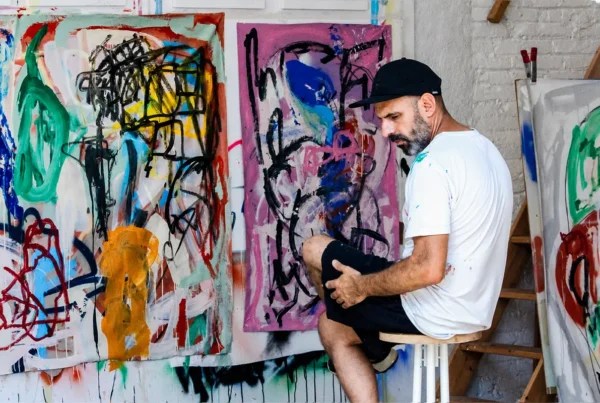
Stone’s method is intensely physical, and that physicality is essential to the impact of her work. She paints with far more than conventional brushes, employing nails, sticks, pens, and her own hands to produce an expansive vocabulary of marks. Scratches may cut through soft passages, smeared pigment can collide with sharp lines, and broad gestures may sit beside intimate details that reward close viewing. Because so many tools are involved, the surface becomes varied and animated, filled with shifts in pressure, speed, and texture. The viewer can almost reconstruct movement from the marks themselves. A dragged line suggests resistance, while a sudden burst of color feels like acceleration. In this sense, Stone’s paintings preserve bodily action without becoming mere performance relics. They remain rigorous visual objects, yet they carry unmistakable traces of touch. The body is not separate from the image in her practice. It becomes one of the instruments through which the image comes into being.
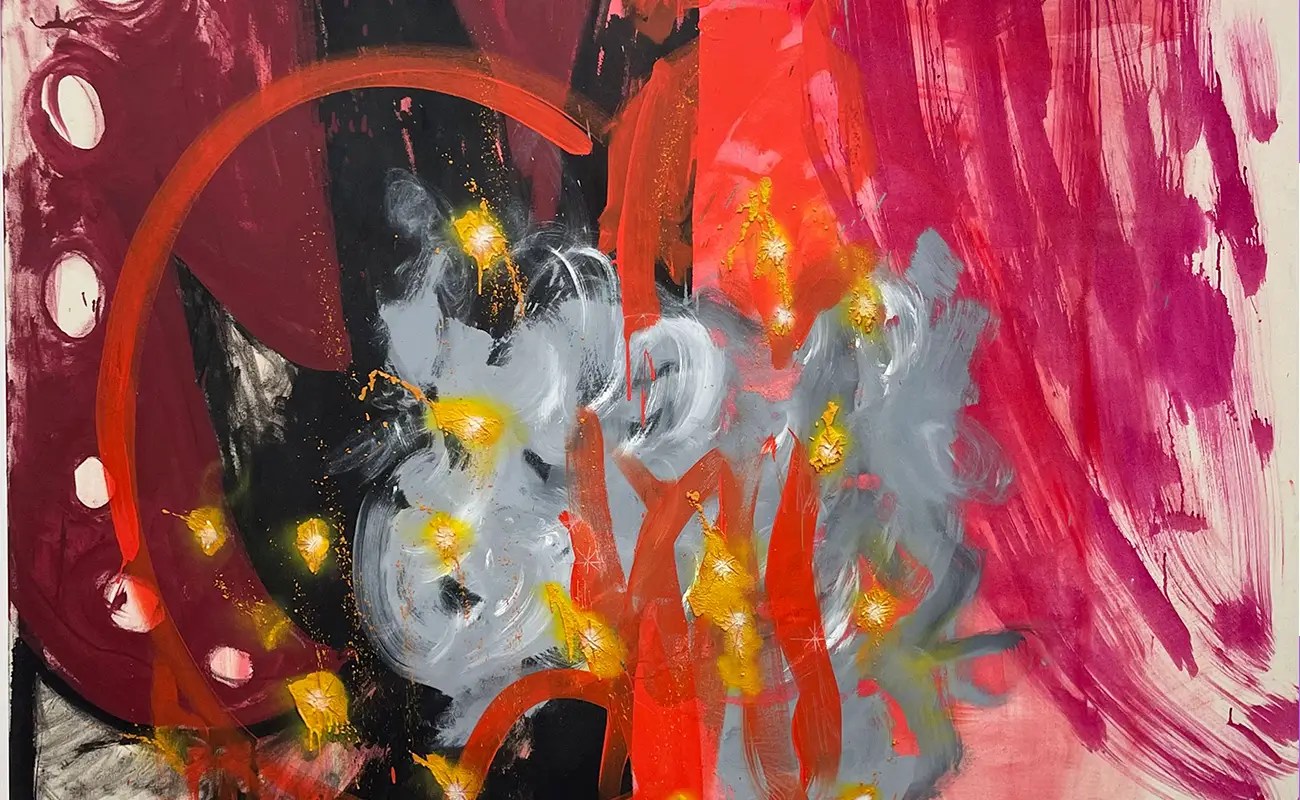
That bodily engagement gives her canvases a choreographic quality. Looking at them can feel like witnessing sequences of motion translated into pigment. Sweeping arcs, abrupt interruptions, looping forms, and dense clusters imply changing rhythms rather than singular gestures. Some areas seem rushed with urgency, while others appear cautiously adjusted over time. This contrast creates a dynamic tempo across the picture plane. Stone’s use of acrylic, spray paint, pearlescent pigment, glitter, and mixed media expands that sense of movement further, since each material behaves differently. Some substances spread quickly and stain, others sit on top of the surface, while reflective elements catch changing light as the viewer moves nearby. The result is not only visual complexity but a heightened awareness of duration and encounter. Her paintings ask to be experienced in person because they shift with angle, distance, and attention. They do not simply depict energy. They generate it through material means.
Yet for all their force, these works also preserve moments of delicacy and restraint. Stone balances expansive gestures with quieter incidents that prevent spectacle from becoming empty drama. A thin drawn line may counter a dense black form. A translucent wash can soften a field of aggressive marks. Areas left partially unresolved create breathing space amid more assertive passages. This measured contrast reveals discipline beneath apparent spontaneity. It also supports the emotional range of the paintings, allowing vulnerability to stand beside confidence. Many artists can create movement, but fewer can sustain tension between momentum and pause with such sensitivity. Stone’s achievement lies in making force feel intelligent rather than chaotic. Her paintings invite prolonged looking because they continue to disclose small negotiations within larger gestures. What first appears explosive often proves carefully modulated. Through that balance, she transforms physical process into nuanced visual language that remains compelling at multiple scales of attention.

Memory, Femininity, and the Strange Familiar
Although abstraction grounds Stone’s practice, her canvases frequently contain suggestive imagery that hovers near recognition. Creature-like presences, anthropomorphic silhouettes, and ambiguous characters emerge from fields of color and layered marks, then retreat before becoming fully legible. This uncertainty is central to their fascination. Viewers may sense personalities or narratives without being given fixed stories. Titles borrowed from human names intensify that effect by granting agency to forms that might otherwise remain anonymous. A shape becomes less a shape and more a presence with attitude, mood, or history. Stone thereby complicates the traditional divide between abstraction and figuration. She allows painting to remain materially free while still inviting emotional projection. Such imagery can feel playful one moment and unsettling the next, producing a charged atmosphere where humor and unease coexist. Rather than resolving these tensions, Stone cultivates them, trusting ambiguity as a source of depth and sustained curiosity.
References to childhood nostalgia and popular imagery further enrich that atmosphere. Elements recalling stickers, street iconography, vintage animation, and youthful visual culture can surface unexpectedly within her compositions. These associations are subtle rather than literal, appearing as echoes of remembered forms rather than direct quotation. Their presence matters because memory rarely returns in complete images. It arrives in fragments, flashes, and moods. Stone’s paintings capture that psychological truth through visual means. Innocent references are often placed within more complex surroundings, creating friction between delight and disturbance. A whimsical contour may sit beside a brooding mass of black paint. Bright color can interrupt a darker emotional register. Through these contrasts, she examines how early pleasures remain entangled with later experience. The paintings therefore speak not only about childhood but about how adulthood carries childhood within it, transformed by time, desire, and uncertainty.
Femininity also moves through her work in layered ways. Stone does not present identity through simple symbols or declarations. Instead, she explores how ideas of glamour, awkwardness, seduction, vulnerability, and self-invention circulate through color, texture, and form. Pearlescent passages may suggest allure, while scratched surfaces imply resistance to polished expectations. Decorative associations appear only to be complicated by rough handling or structural tension. This strategy prevents femininity from being reduced to style. It becomes a field of competing pressures shaped by culture, memory, and lived feeling. Her paintings can be seductive at first glance, yet sustained viewing reveals emotional complexity beneath their surface appeal. That doubleness is one reason the work feels contemporary. It acknowledges that identity is rarely stable or singular. Instead, it is assembled from inherited images, personal sensations, and contradictory desires. Stone gives those conditions visual presence without simplifying them into slogans or fixed narratives.

Georgina Stone: Influences Recast into a Distinct Voice
Stone’s influences range across major figures in abstraction, including Frank Bowling, Joan Mitchell, Willem de Kooning, and Helen Frankenthaler. From such predecessors, one can sense an affinity with expansive gesture, chromatic confidence, and the understanding that paint itself can carry emotional meaning. Yet influence in her case does not result in imitation. She draws lessons from these artists while redirecting them through her own concerns with memory, femininity, and contemporary image culture. The assertive handling of material associated with twentieth-century abstraction becomes, in her hands, more porous and psychologically unstable. Instead of heroic certainty, she often offers vulnerability and shifting identity. Instead of pure formalism, she introduces hints of character and narrative. This transformation is important because it demonstrates how historical languages remain alive when artists challenge them rather than repeat them. Stone engages art history as an active conversation, using inherited tools to ask present-day questions about selfhood, desire, and visual experience.
Equally significant is her connection to classic animation aesthetics, especially artists such as Mary Blair and Eyvind Earle. Their stylized worlds, bold shapes, and heightened color sensibilities provide a compelling counterpoint to the traditions of high modernist painting. Stone’s willingness to place these references beside painterly intensity broadens the cultural field in which her work operates. It suggests that serious painting need not isolate itself from popular memory or mass imagery. Instead, visual experiences formed through childhood media can become fertile material for sophisticated studio practice. This crossing of categories helps explain the immediate appeal of her paintings. They can feel familiar without becoming obvious, and refined without becoming distant. By allowing animation echoes to meet expressive abstraction, Stone creates a language that is culturally open and emotionally layered. She acknowledges that contemporary vision is shaped by museums, screens, streets, and personal recollection all at once.
Across exhibitions, residencies, and public presentations in the United Kingdom and internationally, Stone has continued to expand a practice marked by openness and ambition. Her paintings stand out because they reconcile qualities often treated as opposites: seriousness with play, structure with instinct, beauty with disruption, and sensuous surfaces with psychological weight. Few artists manage these balances while maintaining such strong material presence. Each canvas feels capable of change even after completion, as if the dialogue between order and possibility remains active. That sense of unresolved life is a major strength. It keeps the work from becoming merely decorative or purely theoretical. Instead, it speaks through sensation, memory, and accumulated gesture. Stone’s trajectory suggests an artist committed to pushing painting beyond formula while remaining loyal to the medium’s physical pleasures. In an era saturated with quick images, her work insists on slower attention and rewards it with depth, surprise, and lasting resonance.