
“It is in moments such as these that the intention behind my work finds its fullest expression, not as concept, but as lived experience, and that touches my heart.”
A Journey from Curiosity to Carved Conviction
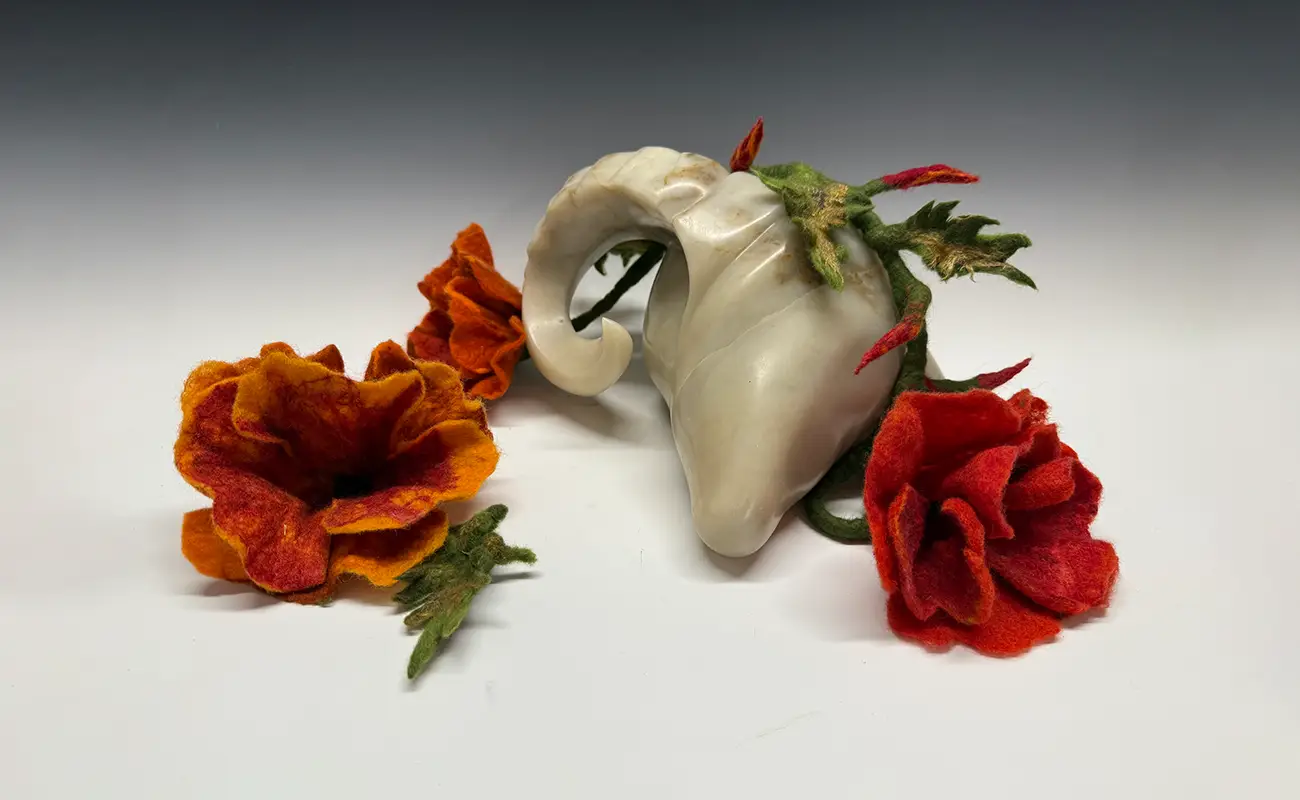
Elisa Adams, a sculptor based in the Greater Boston area, has shaped a distinctive artistic path rooted in exploration, intuition, and a deep sensitivity to human experience. Her entry into stone sculpting began in 2004, when she enrolled in a course at a nearby museum school despite having no prior familiarity with the medium. What initially appeared to be a simple act of creative curiosity soon revealed a more profound resonance. The act of carving into stone awakened an instinctive recognition, a sense that she had encountered a form of expression capable of articulating thoughts and feelings that existed beyond language. This discovery marked the beginning of an enduring artistic commitment that continues to evolve. Over time, her work has become synonymous with quiet transformation, inviting viewers into a contemplative encounter with form that feels both intimate and expansive.
Working with stone introduced Adams to a dynamic interplay between resistance and possibility. The material’s inherent hardness and weight might suggest immobility, yet through her hands it becomes something unexpectedly supple and animated. Her sculptures often appear softened or fluid, suggesting motion or breath where none should exist. This paradox lies at the heart of her creative philosophy. She approaches sculpture not as a means of domination over matter, but as a collaborative dialogue in which form gradually reveals itself. Within each piece, she seeks to express the idea that change is always present, even within structures that seem fixed. This perspective resonates throughout her body of work, encouraging viewers to reconsider assumptions about permanence and transformation in both art and life.
Before fully embracing sculpture, Adams spent more than forty years practicing as a doctor of chiropractic. This professional background cultivated an acute awareness of the body’s capacity for balance, resilience, and healing. Such insights continue to shape her artistic process. Rather than imposing rigid narratives, her sculptures offer experiences that feel gently restorative, encouraging a subtle recalibration of perception. She often speaks of her work as an invitation rather than a declaration. The viewer is encouraged to engage physically and emotionally, sensing shifts in posture, breath, and attention while encountering her forms. This synthesis of medical knowledge and artistic intuition gives her sculptures a distinctive presence, one that bridges the tangible and the experiential in ways that feel deeply human.

Elisa Adams: Dialogues with Form, Influence, and Interpretation
Adams draws inspiration from artists whose work embodies clarity and reduction, including Constantin Brancusi, Georgia O’Keeffe, and Barbara Hepworth. Their ability to suggest meaning through simplicity has had a lasting impact on her approach. She admires how their forms often appear distilled to essential gestures, allowing viewers to complete the experience through memory and imagination. This sensibility informs her own practice, where suggestion frequently carries more power than explicit representation. Her sculptures rarely prescribe a single interpretation. Instead, they function as catalysts for personal reflection, encouraging audiences to engage with their own perceptions. This openness aligns with her broader belief that art can serve as a meeting place between inner and outer worlds, where meaning arises through participation rather than instruction.
In recent years, Adams has revisited a lifelong interest in the Tarot, engaging with it as a dynamic symbolic language rather than a rigid system of definitions. This renewed exploration culminated in the creation of Formed by the Fates, a series of twenty two sculptures developed over three and a half years. Presented at Three Stones Gallery in Concord, Massachusetts, the exhibition drew an enthusiastic and deeply engaged response from visitors. Each work interprets an archetype from the Major Arcana, translating symbolic imagery into three dimensional form. Accompanying texts articulate Adams’s intuitive reflections on these archetypes, providing additional layers of meaning while preserving space for individual interpretation. The installation functioned as an immersive environment, inviting viewers to slow their pace and enter a reflective state.
Through Formed by the Fates, Adams demonstrated how sculpture can operate as both visual and experiential language. The arrangement of the works created what she describes as a contemplative field, where relationships between pieces encouraged movement, pause, and inward attention. Visitors often reported feeling drawn into a quieter mode of awareness as they navigated the exhibition. This response affirmed her conviction that art can influence perception in subtle yet profound ways. By transforming symbolic concepts into tactile forms, she expanded the possibilities of sculptural storytelling. The project stands as a testament to her dedication to integrating intuition, cultural symbolism, and material practice into a cohesive artistic vision that continues to evolve.

Encounters with Scale, Challenge, and Human Connection
A defining milestone in Adams’s artistic journey occurred in 2019 when she was selected by jury to participate in the Symposium International de Sculpture in Morges, Switzerland. The invitation presented a formidable challenge. Until that moment, she had never worked on such a large scale, nor had she undertaken an intensive project within a strict timeframe. Motivated by both curiosity and courage, she accepted the opportunity. Alongside twenty four artists from across the globe, she spent ten demanding days transforming a five hundred pound block of limestone into a finished sculpture. The work was executed entirely by hand, without the assistance of power tools. This process required not only physical endurance but also unwavering concentration and adaptability, reinforcing her belief that creative breakthroughs often arise from stepping into unfamiliar territory.
The resulting piece, titled Indomitable Spirit, embodies a sense of quiet determination. Rather than dramatizing struggle, the sculpture conveys resilience through subtle shifts in form and balance. Its presence suggests an inner steadiness that persists despite external pressures. Shortly after the symposium concluded, the work was acquired by a collector. Adams had already returned to the United States and did not meet the buyer in person. Their later correspondence, however, revealed an unexpected and deeply moving connection. The collector, who has spent her life using a wheelchair, shared that the sculpture now resides in her garden. On difficult days, she looks to it as a reminder of her own strength, drawing comfort from the affirmation it offers.
Moments like this illustrate how Adams’s intentions extend beyond aesthetic achievement. She views such encounters as evidence that sculpture can function as lived experience rather than abstract concept. Knowing that her work has become a source of encouragement for someone navigating daily challenges reinforces her commitment to creating pieces that resonate on emotional and psychological levels. The story of Indomitable Spirit highlights the transformative potential of art when it intersects with personal narratives. For Adams, these connections represent the fullest realization of her practice, demonstrating that form, when shaped with care and purpose, can carry meaning that continues to unfold long after the carving is complete.

Elisa Adams: Healing Landscapes and the Interior Origins of Creation
In 2022, Adams received a commission to create a series of fourteen sculptures for Boston Children’s Hospital. Modest in scale, each measuring six inches square, the works were designed to inhabit the hospital’s garden spaces in unexpected ways. Rather than placing them in obvious locations, she chose to embed them partially among flower beds and natural elements. This decision transformed the installation into an interactive experience. Children encountering the sculptures must search, explore, and engage through movement and curiosity. Within a medical environment often associated with anxiety or discomfort, these moments of discovery offer a gentle reprieve. The project reflects Adams’s commitment to integrating art into everyday settings, where it can provide quiet joy and foster emotional resilience.
The hospital installation also represents a synthesis of her varied sensibilities. Her understanding of the body’s vulnerability and capacity for healing informs the tactile presence of each piece. At the same time, her contemplative process imbues the sculptures with an emotional undercurrent that feels both calming and energizing. Visitors and staff alike have responded to the subtle sense of wonder the works evoke. By positioning sculpture as both presence and invitation, Adams encourages individuals to pause, reflect, and reconnect with their surroundings. These small interventions demonstrate how artistic gestures can influence atmosphere, transforming spaces of stress into environments that support reflection and renewal.
Adams continues to divide her time between her chiropractic practice and her studio, maintaining a steady rhythm of creative engagement several days each week. Her current explorations include small scale abstract interpretations of the Major Arcana, as well as an emerging body of work inspired by her Albanian heritage. Drawing from early pagan mythology and ancestral narratives, she seeks to uncover connections between personal history and universal themes. For Adams, the act of sculpting begins long before stone meets chisel. Ideas take shape through reflection, intuition, and sustained attention to what she describes as unseen dimensions of experience. The physical process becomes a final translation of insights that have been forming quietly over time, continuing to guide her artistic evolution.