
Where Stillness Becomes Image
Within the contemporary German art scene, Anett Frey has cultivated a practice defined by quiet intensity and sustained observation. Her work first gained institutional visibility with her participation in KULT-Kunst 2020 at the Mittelschwäbisches Heimatmuseum Krumbach, followed by her inclusion in Kunst Reutlingen 2022 at the Kunstmuseum Reutlingen Galerie. She was also represented with several etchings of found objects in the exhibition “Interior & Still Life” at the Albstadt Art Museum, and last year at the KONSUM Gallery in Munich with works depicting evocative moods. Exhibited exclusively in Germany and featured in group presentations alongside artists such as David Baur and Wolf Nkole Helzle, Frey’s presence has steadily developed through carefully selected contexts.
In addition to these group exhibitions, she has presented several very special solo exhibitions that further underline her artistic position. Solo exhibitions, such as those in Dresden at the Kunstgehaeuse, in the Kleine Galerie in Bad Waldsee, or at Peripherie in Tübingen, often unfold like a scientific laboratory of found objects, fragments, and structures that work together as a whole. Her contributions to these notable shows have established her as an artist committed to depth rather than spectacle.
At the core of Frey’s practice lies a sustained meditation on transience. Her series Findlings centers on encounters with deceased animals discovered during solitary walks through nature. These found beings, often birds or small creatures, arrest her attention and become the starting point for an extended artistic engagement. She collects them, secures them onto paper, and approaches their lifeless forms through drypoint. The act is neither sensational nor sentimental. Instead, it is guided by an attentive curiosity toward the frozen instant in which life has just withdrawn. The moment of discovery becomes inseparable from the image that follows.
Silence, solitude, and concentrated perception shape these works profoundly. Frey translates the experience of finding the animal into a visual language that conveys vulnerability and dignity in equal measure. Her compositions do not merely document a body; they construct a space of meaning through perspective and placement. Lines sometimes disperse lightly across the surface, suggesting fragility and impermanence, while in other passages they accumulate densely, granting the form weight and tangibility. Through this interplay, the lifeless figure transcends its material condition. It becomes a bearer of memory, a visual reminder that what appears inert still carries traces of what once existed.

Anett Frey: The Search for the Essential Line
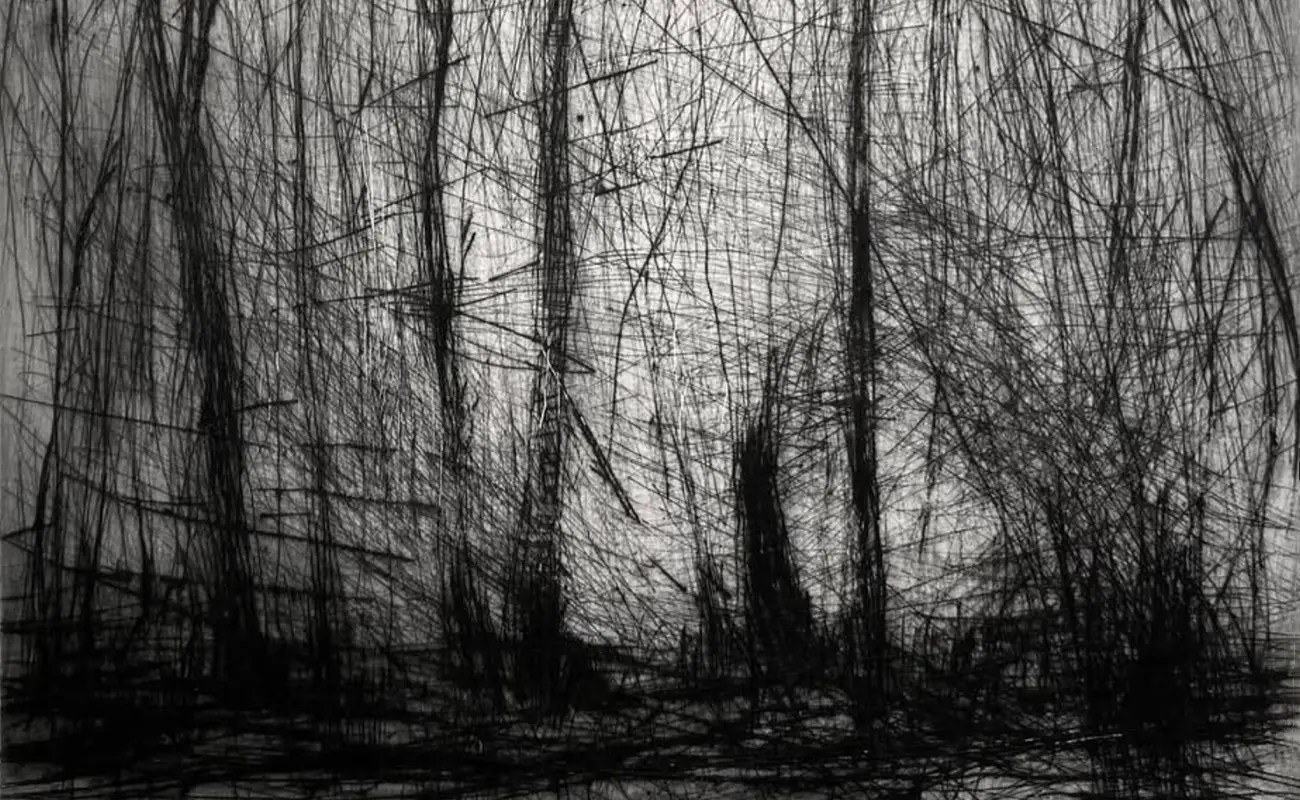
Drypoint serves as the primary vehicle through which Frey articulates her vision. Her process begins with a searching incision into the surface when working with zinc plates. The needle cuts into the metal with varying degrees of pressure, producing networks of lines that oscillate between delicacy and force. These incisions are acts of both creation and violation. Through them, she builds structures, textures, and emotional surfaces that mirror her internal state. The gesture can be restrained and sensitive or abrupt and unyielding, depending on what the motif demands.
In many works, especially in her portrait series Mr. M. and her depictions of places constructed from pigments bound with beeswax, the layered approach results in relief-like surfaces with a pronounced tactile quality. The burrs and indentations of printing plates become visible in the final print, almost like miniature terrains pressed onto paper. At times the line asserts itself with uncompromising sharpness, dominating the composition. At other moments, the subject seems to dissolve into a fine mesh of strokes, hovering between presence and disappearance. This tension between solidity and dissolution forms a defining characteristic of her visual language.
The working process continues until an inner quiet is achieved. Whether she is working in drypoint or occasionally applying oil paint, the repetition of gestures creates a rhythm akin to meditation. Lines accumulate, are scraped back, and layered again. Surfaces are wounded and then smoothed, yet the traces of intervention remain visible. These marks resemble scars that testify to the labor of formation. Through this sustained engagement, Frey seeks to penetrate beyond external appearance and reveal something interior. The finished image carries not only the presence of its subject but also the record of an encounter that unfolded slowly and intensely.

Encounters with Nature and the Human Condition
Nature, animals, and human figures constitute the recurring motifs of Frey’s artistic inquiry. Her daily paths provide the material that she transforms into images, often focusing on elements others might overlook. Dead birds found by the roadside or in fields, stones shaped by weather, leaves caught in seasonal transition all become catalysts for reflection. These subjects are not treated as neutral objects. Instead, they are approached as counterparts in a relationship that unfolds over the duration of the creative act. Each print represents an attempt to comprehend the complexity of this encounter.
The theme of transience functions as a guiding thread throughout her oeuvre. The bird, in particular, carries layered symbolic resonances. Historically associated with air, soul, and resurrection, it also appears in still life traditions as an emblem of mortality. Frey chooses to depict the animal not in flight or animated movement but in stillness after death, as though asleep. This decision redirects attention from vitality to vulnerability. The resulting images recall the tradition of memento mori, yet they avoid theatrical drama. Instead, they invite contemplation of the fragile boundary between being and non-being.
Her works titled “Landscape” extend this exploration into more abstract territory. Although grounded in specific points of reference, these compositions appear less representational and more introspective. Informal structures and layered lines suggest internal terrains as much as external views. Searching and finding remain central, yet the search now unfolds within the artist herself. Through line, form, and the interplay of light and shadow, Frey demonstrates that observation cannot be separated from the observer. The subject retains its significance, but it is inseparable from the consciousness that perceives and records it.

Anett Frey: Process, Influence, and Artistic Conviction
Frey’s reflections on art reveal a deep respect for perseverance and inner necessity. She expresses admiration for figures such as Louise Bourgeois, Françoise Gilot, and Alberto Giacometti, artists whose strength lay in their refusal to abandon their path. Their resilience and willingness to confront difficulty resonate with her own understanding of artistic labor. At the same time, she resists aligning herself too closely with specific personalities. Inspiration, for her, arises more from an atmosphere or attitude, such as the quiet intensity associated with Giorgio Morandi or the structural clarity found in Sean Scully.
Reading artists’ biographies and watching films about creative processes further nourish her perspective. She values insight into how artistic languages originate and evolve, and she emphasizes that each practitioner must undergo an individual journey marked by progress and setback alike. No shortcut can replace the accumulation of small steps, including failures and reversals. The creative path involves constant questioning and endurance. Yet within this ongoing oscillation between doubt and confidence, she finds a profound sense of vitality. Artistic activity offers moments of peace even amid uncertainty.
Beyond her studio practice, Frey works as a lecturer, sharing her experience and opening spaces for others to engage with art. This role brings fulfillment, though it also demands time and energy that could otherwise be devoted to her own production. She speaks candidly about the modest financial conditions under which she operates and expresses a desire for broader structural support, fair compensation, and accessible funding opportunities for artists. Despite these challenges, her commitment remains unwavering. Each day requires renewed effort, yet each day also affirms the necessity of continuing to search, to observe, and to inscribe fleeting existence into enduring form.