“The color is allowed to determine the direction. Giving myself this approach is the greatest form of freedom.”

Painting Beyond the Visible
Chris Kamprad is a Berlin-based, self-taught painter whose abstract works explore emotion, rhythm, energy, and the invisible connections that shape human experience. Born in the Spreewald in 1969, she has developed an independent artistic practice in which color, gesture, and layered surfaces transform inner experience into expressive visual form. Working from her studio in Berlin’s Prenzlauer Berg since 2020, Kamprad creates paintings that invite personal interpretation while exploring the relationship between spirit, inner depth, and outward presence.
Her artistic path reflects both independent exploration and creative experience across multiple disciplines. After growing up in the Spreewald, she studied Theatre Set Design and Make-up Artistry at the Dresden Academy of Fine Arts before working in theatre, film, and television. Between 1999 and 2002, she also attended a free painting class led by Berlin artists Astrid Albers and Jürgen Sage, an experience that broadened her understanding of painting while preserving the independence that continues to define her practice. Over time, painting became her primary means of expression, offering the freedom to translate intangible experiences into visual form.
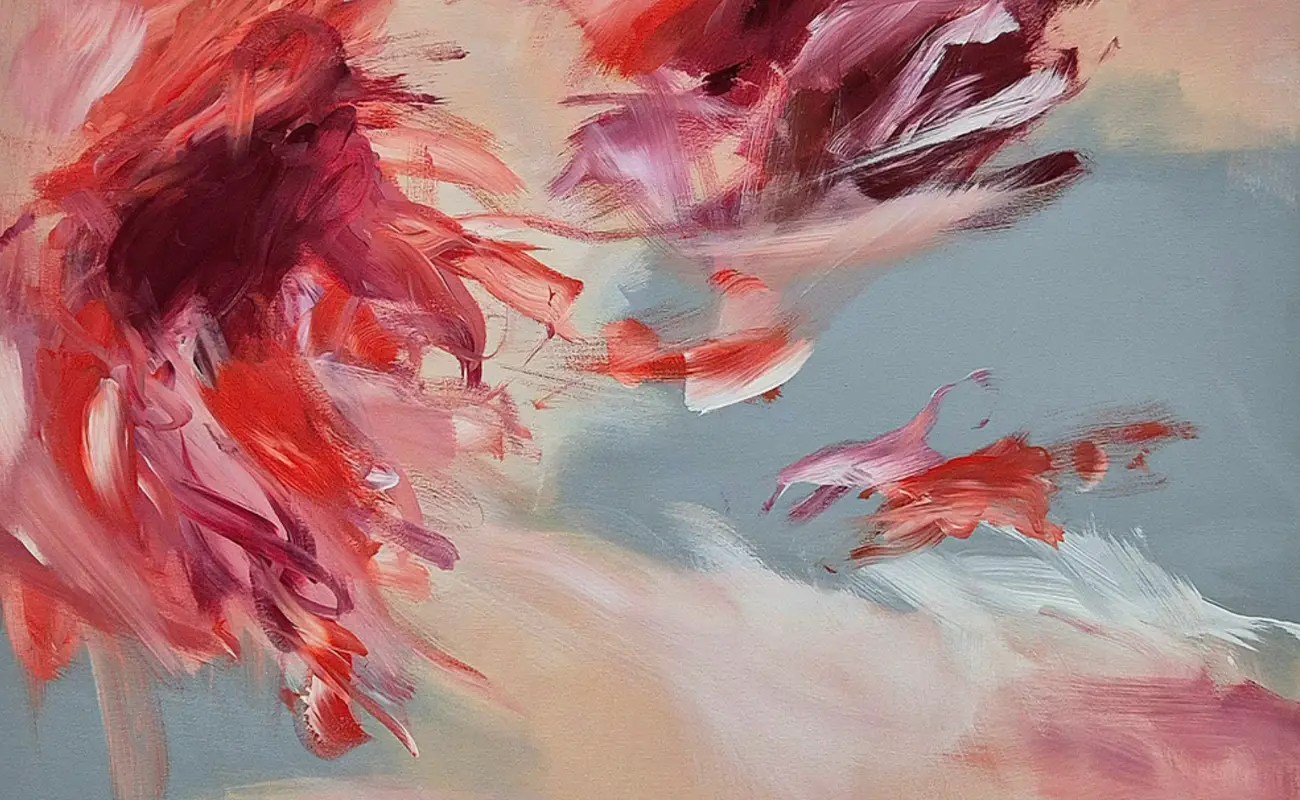
Kamprad is fascinated by rhythms, energies, and the invisible connections between people, life, and its underlying forces. Rather than depicting recognizable places or narratives, her paintings emerge from these internal landscapes, creating expressive compositions in which color, movement, and texture communicate beyond words. The openness of her work encourages viewers to bring their own experiences to each painting, allowing every encounter to become personal and unique.

Chris Kamprad: Letting Color Lead the Creative Journey
Kamprad approaches each painting without a predetermined outcome. Remaining open to the character of the moment, she allows intuition to guide the creative process while color determines the direction of the work. Rather than controlling every stage of a composition, she embraces uncertainty, believing that surrendering to the painting is one of the greatest forms of artistic freedom. Through this process, gesture, texture, and layered applications gradually establish each work’s atmosphere.
Her paintings are shaped by a wide range of influences, from nature, architecture, music, and everyday experiences to artists including Cy Twombly, the Cobra group, Willem de Kooning, Hilma af Klint, and Helen Frankenthaler. Positive experiences and personal challenges alike become part of her creative vocabulary, reinforcing her belief that artistic expression grows from living attentively and remaining open to what cannot always be explained.
Working primarily with acrylic on canvas, Kamprad often begins long before the first brushstroke. She selects and stretches her own canvases, responding to the texture of coarse or fine weaves before building compositions through successive layers of paint. These layered surfaces preserve the energy of the creative process while creating depth, movement, and atmosphere. Rather than illustrating specific places or stories, her paintings become visual spaces where emotion, memory, and imagination intersect.

From Studio Practice to International Visibility
Kamprad’s commitment to abstraction has steadily expanded her presence within contemporary art through exhibitions, collaborations, and international presentations. Her paintings have been exhibited in Berlin, Munich, Milan, Miami, and Frankfurt, as well as through online exhibitions that have introduced her work to audiences across diverse cultural contexts. Recent appearances include Affordable Art Fair Berlin with New & Abstract, BAAM Berlin Artist Art Market, and group exhibitions at New & Abstract and konsum163.
Earlier exhibitions include projects with GEDOK Berlin, Artspring Berlin, Galeria Azur Berlin, MADS Milano, Scope Miami, and Discovery Art Fair Frankfurt. Together, these exhibitions reflect the growing recognition of a practice that continues to evolve through experimentation, intuition, and emotional authenticity rather than stylistic repetition.
Recognition has also extended beyond the gallery. In November 2022, Kamprad’s work appeared in the print edition of British Vogue as part of “Vogue’s Gallery,” introducing her paintings to an international readership. She also collaborated with ARTinRUG, translating one of her abstract works into a rug design that demonstrated how her visual language could move naturally between fine art and contemporary design while preserving its expressive character.

Chris Kamprad: Expanding the Emotional Landscape of Abstraction
Movement remains central to Kamprad’s artistic vision. Her paintings balance spontaneity with thoughtful structure, allowing forms to emerge, dissolve, and reappear across the canvas. Color, texture, and gesture remain in constant dialogue, creating compositions that invite prolonged engagement without prescribing a single interpretation. This openness reflects her conviction that abstraction offers a direct way of communicating emotions and experiences beyond literal representation.
At the heart of her work is an ongoing exploration of the relationship between the visible and the invisible. Rather than presenting fixed narratives, Kamprad creates atmospheric spaces where viewers are encouraged to discover their own emotional connections. Each painting remains open, evolving through the perspectives and memories brought to it by those who encounter it.
Looking ahead, Kamprad intends to continue exploring these ideas through larger formats and new series that investigate emotion, space, and abstraction. She is particularly interested in what she describes as the freedom of emptiness surrounding intensity, extending her exploration of color, gesture, and layered surfaces into increasingly immersive works. As her practice continues to evolve, Chris Kamprad remains committed to creating paintings that transform invisible forces into compelling visual experiences while inviting viewers to slow down, reflect, and engage with the emotional possibilities of abstraction.