The Epic Hidden Within Ordinary Life
Bo Bartlett has established himself as one of the leading voices in contemporary American realism by combining classical technical skill with an unmistakably modern sensibility. Born James William Bartlett III in Columbus, Georgia, in 1955, he creates paintings that transform familiar moments into emotionally layered narratives. While his work draws inspiration from the traditions of Thomas Eakins, Andrew Wyeth, Edward Hopper, Grant Wood, and Norman Rockwell, Bartlett extends that lineage through imagery filled with psychological complexity, symbolism, and unresolved stories. Everyday scenes become spaces where memory, identity, and universal human experience quietly intersect, inviting viewers to look beyond appearances and discover unexpected emotional depth.
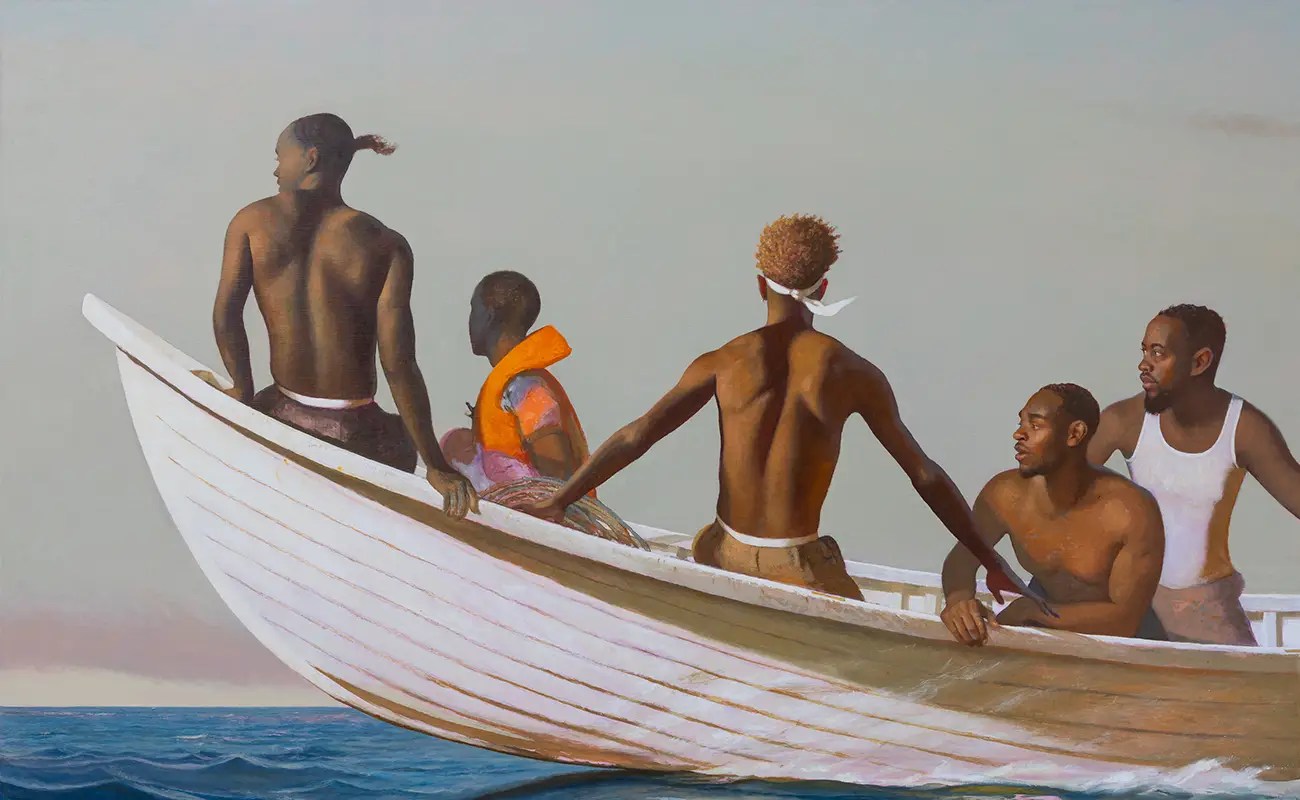
His fascination with ordinary American life does not result in straightforward documentation. Instead, Bartlett presents recognizable people, landscapes, and domestic settings in ways that encourage reflection rather than certainty. Children celebrating Halloween, cyclists, figures gathered outdoors, or solitary individuals on the water all appear grounded in reality, yet each painting carries an atmosphere of mystery. The familiar becomes subtly uncanny through careful staging, nuanced lighting, and symbolic relationships between figures and their surroundings. Family members and close friends frequently serve as models, reinforcing the personal origins of his imagery while allowing each composition to speak to broader experiences shared across cultures and generations.
Many of Bartlett’s paintings originate in locations that have shaped his life, particularly his childhood environment in Georgia and his home on Wheaton Island, Maine. Rather than functioning simply as autobiographical settings, these places evolve into timeless landscapes that represent ideas of belonging, inheritance, and home itself. His paintings suggest that personal geography can become universal, turning individual memories into stories with wider emotional resonance. This balance between intimate observation and mythic significance gives his work its enduring power and distinguishes his contribution to contemporary realism.

Bo Bartlett: A Foundation Built on Discipline and Observation
Bartlett’s artistic development reflects years of rigorous study rooted in traditional techniques. At eighteen, he traveled to Florence, Italy, where he studied mural painting with Ben Long IV before returning to the United States and continuing his education in Philadelphia. He attended the Pennsylvania Academy of the Fine Arts, earning a Certificate of Fine Arts in 1981 while embracing the demanding academic approach associated with the institution. His commitment to anatomical accuracy extended to studies at the Philadelphia College of Osteopathic Medicine, echoing the methods employed by Thomas Eakins. During this formative period, he also apprenticed with renowned realist painter Nelson Shanks and pursued liberal arts studies at the University of Pennsylvania.
Another defining influence arrived through filmmaking. Bartlett earned a Certificate in Filmmaking from New York University in 1986, introducing cinematic thinking into his artistic vocabulary. This background can be seen throughout his paintings, which often resemble carefully composed film stills. Dramatic lighting, expansive scale, carefully orchestrated compositions, and suspended moments all contribute to a narrative quality that encourages viewers to imagine events beyond the canvas. Rather than providing complete stories, his paintings invite interpretation by presenting emotionally charged moments filled with possibility and ambiguity.
Bartlett’s philosophy is closely tied to the words of author Robertson Davies, whose advice, “Let your root feed your crown,” became a guiding principle throughout his career. Bartlett interprets the phrase as an encouragement to remain faithful to personal experience and artistic temperament. This belief explains his sustained focus on places, people, and memories that have shaped his own life while allowing those experiences to expand into broader reflections on humanity. His realism is therefore neither nostalgic nor purely descriptive. Instead, it becomes a means of exploring emotional truth through disciplined observation and deeply personal storytelling.

History, Memory, and the Language of Symbolism
Although Bartlett works firmly within the realist tradition, his paintings frequently engage with art history while introducing fresh contemporary interpretations. His compositions integrate portraiture, landscape, still life, and figure painting into ambitious scenes reminiscent of historical narrative painting. Rather than recreating historical events, he adapts their visual language to explore modern questions about identity, family, and American experience. This combination of technical mastery and conceptual openness allows his paintings to function simultaneously as intimate personal narratives and expansive cultural reflections.
Several important works illustrate this distinctive approach. Young Life draws inspiration from Grant Wood’s American Gothic while reshaping familiar imagery into a psychologically layered portrait of contemporary America. Homeland references monumental works including Washington Crossing the Delaware, The Raft of the Medusa, and Liberty Leading the People, using the scale and ambition of history painting to examine national identity through a modern lens. Lifeboat, inspired by Winslow Homer’s The Fog Warning, transforms the seemingly simple image of a man rowing beneath bright daylight into a scene charged with underlying danger and emotional tension. Each painting demonstrates Bartlett’s ability to unite everyday experience with historical and symbolic meaning.
Surrealist influences also contribute to the distinctive atmosphere of Bartlett’s work. While remaining rooted in carefully observed reality, his paintings often possess the dreamlike quality associated with René Magritte, Salvador Dalí, and Giorgio de Chirico. Improbable situations appear entirely believable because of his exceptional control of anatomy, light, perspective, and surface. The result is a visual language where realism becomes a vehicle for exploring uncertainty, memory, mortality, confrontation, innocence, and endurance. Rather than separating reality from imagination, Bartlett reveals how closely the two can coexist.

Bo Bartlett: A Lasting Presence in Contemporary American Realism
Over several decades, Bartlett has earned widespread recognition through an extensive exhibition history across museums and galleries in the United States. Solo exhibitions have been presented at institutions including The Bo Bartlett Center, Flint Institute of Arts, Gibbes Museum of Art, Orlando Museum of Art, MOCA Jacksonville, Lyme Academy of Fine Arts, The Florence Academy of Art, and Miles McEnery Gallery, among many others. His paintings have also appeared in important group exhibitions at venues such as the National Portrait Gallery, the Philadelphia Museum of Art, the Georgia Museum of Art, the National Arts Club, the Rhode Island School of Design, and numerous additional institutions.
His work has entered the permanent collections of respected museums including Crystal Bridges Museum of American Art, the Denver Museum of Art, the Franklin Institute, the Frye Art Museum, the Columbus Museum of Art, the Greenville County Museum of Art, the Morris Museum of Art, the Asheville Art Museum, and many others. Recognition has continued through honors including the 2026 Portrait Society of America Gold Medal, the South Arts Fellowship, the Pew Fellowship in the Arts, the 1858 Prize for Contemporary Southern Art, multiple museum merit awards, and honorary distinctions from both the New York Academy of Art and the Lyme Academy of Fine Arts. These achievements reflect the enduring significance of his contribution to contemporary figurative painting.
Film remains an important companion to Bartlett’s painting practice. His documentary Snow Hill, centered on Andrew Wyeth, received multiple awards, and he later directed additional documentary projects as well as the feature film Things Don’t Stay Fixed. Both painting and filmmaking reveal a shared interest in memory, place, narrative, and emotional complexity. Today, Bartlett lives and works between Columbus, Georgia, and Wheaton Island, Maine, while the Bo Bartlett Center preserves hundreds of paintings, drawings, journals, photographs, recordings, and archival materials. Beyond safeguarding his artistic legacy, the center also supports educational and community initiatives that bring art to schoolchildren, incarcerated individuals, homeless communities, adults with disabilities, and children living in shelters.