The Body at the Threshold
Artiste Lys Blanc’s paintings create a charged meeting point between bodily exposure and psychic enclosure. Across this body of work, which the artist describes as “surreal erotic dreamscapes,” the feminine figure appears suspended, reclined, kneeling, enclosed within portals, or placed at the edge of an expansive symbolic landscape. Her recurring use of her own body as the model gives these images a self-portrait dimension, although likeness is less important than embodiment. The figure becomes an emotional instrument through which vulnerability, desire, transition, and interior experience are made visible. Watery acrylic passages establish blue, turquoise, copper, gold, coral, and muted green environments that appear fluid even when they resemble architecture or terrain. Pools, bridges, elevated platforms, chambers, cliffs, candles, shells, and reflective surfaces resist ordinary spatial logic. They are not settings in a conventional narrative sense, but psychological structures. Blanc’s significance lies in her effort to make inner change tangible without reducing it to a fixed allegory. Her paintings invite recognition before explanation, encouraging viewers to respond to atmosphere, bodily posture, and color before attempting to decode the symbolic content.
The compositions repeatedly establish tension between an isolated central body and a surrounding field that seems both protective and unstable. In one painting, a corseted figure stands in shallow blue water before a vast pale sphere, her reflected form extending toward the viewer like a dark, wavering path. The enormous circular shape resembles a moon, portal, halo, or illuminated void, yet its meaning remains open. Orange slopes rise around the body, while greenish rivulets descend from the upper edges, producing an environment that seems to melt, weep, or dissolve. Elsewhere, a reclining nude occupies an organic gold platform beside a dark oval pool, while slender candle stands rise from a shadowed architectural zone. The perspective is deliberately uncertain. Floor, wall, water, altar, and landscape merge into one another. Blanc’s uneven edges, exposed drips, translucent veils, and shifting densities reinforce this instability. Rather than concealing the movement of the paint, she allows liquid behavior to participate in the image. The resulting spaces appear to be forming while they are being viewed, which closely reflects her intuitive method of beginning with a blank canvas and allowing figures and symbols to emerge through process.
Eroticism in these works is neither simply celebratory nor conventionally seductive. Lingerie, nudity, exposed backs, elongated limbs, and reclining poses introduce the visual language of desire, yet the figures rarely perform for an implied spectator. Faces are often obscured, turned away, simplified, or absorbed into shadow. This refusal of direct address shifts attention from outward display toward interior states. The female body is visible, but it is not entirely available. In the vertical composition featuring a darkly dressed figure enclosed within an orange flame-shaped portal, the body appears simultaneously revealed and sealed away. Two striped organic forms stand beside her like sentinels, while watery blue reflections spread across the lower portion. The image converts sexuality into a condition of passage, containment, and self-possession. Blanc’s use of herself as the model strengthens this reading because the repeated body is not an anonymous decorative nude. It becomes a recurring symbolic self, altered by each environment. Her strongest paintings treat eroticism as a threshold between physical presence and psychological transformation, allowing sensuality to coexist with solitude, uncertainty, and spiritual searching.

Lys Blanc: Painting Through Water, Light, and Accumulation
Blanc’s process-led approach is central to the character of the work. Her watery acrylic technique produces translucent layers that behave less like stable blocks of pigment than accumulations of sensation. Color pools, thins, stains, and descends in vertical streams, generating forms that feel discovered rather than fully predetermined. This method is especially effective in the landscapes where bridges, platforms, or overhanging structures seem to liquefy into the space below. Turquoise frequently serves as both atmosphere and substance. It can suggest water, air, dream, distance, or emotional suspension without being restricted to one material identity. Gold and copper introduce a contrasting register, lending certain outlines and surfaces an almost ceremonial intensity. In several compositions, dark contours hold these luminous fields together, preventing the imagery from dissolving completely. The tension between fluid paint and graphic enclosure creates Blanc’s most recognizable formal language. Her images move between drawing and staining, opacity and transparency, bodily description and atmospheric abstraction. This visual instability is not an incidental effect. It is the technical equivalent of her interest in transitions, translucent states, and the uncertain border between conscious recognition and subconscious association.
The paintings often gain depth through repetition rather than conventional perspective. Rows of candles, flame-like markers, arches, droplets, striped vessels, and descending lines create rhythmic pathways across the surface. One work presents a pale figure enclosed within a blue vertical capsule, surrounded by a long procession of small flames that curve over an elevated structure. The flames appear ceremonial, yet their scale and repetition also make them resemble a procession of witnesses, protective signs, or stages within an inner journey. Another painting places an immense shell-like form beside a narrow bridge illuminated by a sequence of delicate lights. The shell dominates the foreground through its spiral structure and layered brown, white, and gold bands, while the bridge recedes into a luminous turquoise distance. Blanc does not resolve the relationship between these elements through literal storytelling. Instead, she lets scale, rhythm, and proximity create psychological pressure. The spiral suggests inward movement, while the bridge implies passage. Such pairings demonstrate her ability to convert familiar forms into emotional architecture. The compositions are most persuasive when repetition guides the eye while preserving the dream’s refusal to explain itself.
The award received by Translucent State, the International Prize Leonardo Da Vinci granted by Effetto Arte in Milan in June 2025, is particularly relevant to the technical and conceptual direction of Blanc’s practice. Translucence is not merely a surface effect in these paintings. It describes the condition of bodies, environments, and meanings that remain partially visible while resisting complete definition. Figures seem to float between sleep and waking, presence and disappearance, self-protection and exposure. Paint layers similarly allow earlier marks to remain active beneath later decisions. This continuity gives the work a sense of memory, since no stage is entirely erased. The strength of Blanc’s process lies in this visible accumulation. At times, however, the contrast between fluid grounds and firmly outlined symbols can become abrupt, making certain figures or objects appear placed upon the atmosphere rather than generated from within it. The most resolved works overcome this divide by allowing contour, staining, and reflection to interact across the entire surface. In those paintings, technique and meaning become inseparable, and the canvas feels less like an illustration of a dream than a material enactment of dreaming itself.

Dream Architecture and Feminine Self-Mythology
Blanc’s symbolic vocabulary connects her practice to Surrealism, particularly its use of dream logic, bodily transformation, irrational scale, and psychologically charged architecture. Yet her paintings are not primarily concerned with Surrealism as historical style. They extend its strategies into a contemporary language shaped by feminine self-representation, spirituality, and personal transition. The enclosed bodies, portals, spirals, bridges, candles, and flowing passages recall the self-generated mythologies associated with artists such as Leonora Carrington, Remedios Varo, and Dorothea Tanning, whose figures often inhabit spaces where identity is tested or transformed. Blanc’s work remains visually distinct through its watery acrylic handling and repeated use of her own body. Her settings are less densely narrative than those historical precedents, and more dependent on elemental atmosphere. Water is especially important because it permits physical and psychological interpretations to overlap. It can carry, reflect, isolate, cleanse, conceal, or dissolve. The body’s recurring proximity to water therefore becomes an image of consciousness encountering its own instability. These scenes do not describe a single dream; they construct an evolving personal mythology in which feminine presence moves through successive states of exposure, rest, passage, and renewal.
The meaning of the artist’s chosen name, Lys Blanc, or “white lily” in French, introduces another layer to this mythology. The associations she identifies with purity and rebirth resonate with the recurring pale spheres, luminous openings, reflective pools, and bodies positioned at transitional points. Purity here should not be understood as innocence or moral idealization. The paintings present it more productively as a condition of renewal, a temporary clearing in which the self may be reconfigured. Blanc’s Swiss and French background, followed by her migration to New Zealand in 2002, also gives the persistent imagery of pathways and crossings a biographical resonance, though the works do not illustrate migration directly. Bridges, thresholds, capsules, elevated roads, and separated landforms can be read as structures of psychological relocation. Her life and practice in Mangawhai, together with her work at The Healing Studio, further inform the paintings’ concern with guidance, reflection, spirituality, and change. These elements are strongest when they remain embedded within image and process rather than functioning as fixed spiritual signs. Ambiguity protects the paintings from becoming prescriptive, leaving viewers free to form their own emotional associations.
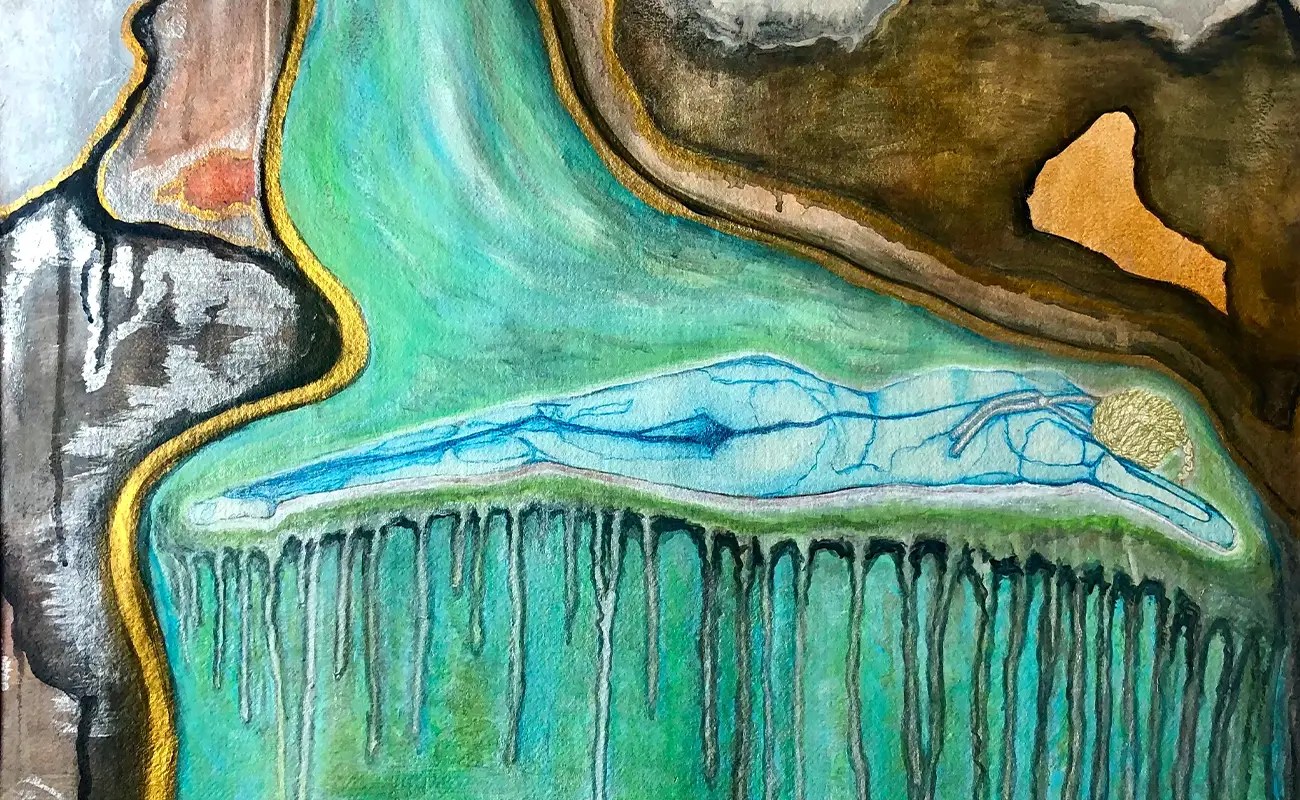
Several works focus on the horizontal body, transforming rest into a complex state between surrender and suspension. A nude figure floating against an unmodulated blue field appears almost weightless, supported by a narrow fringed textile whose wavering contour resembles a small island or current. The surrounding emptiness removes social context and concentrates attention on the body’s quiet vulnerability. A related red painting renders a reclining figure through fine gold lines, exchanging modeled flesh for an exposed network of marks. The body becomes less corporeal and more energetic, as though physical form has been translated into memory, pulse, or trace. In another composition, a pale blue figure lies on a dripping green platform framed by sweeping black, bronze, and gold landforms. Here the sleeper is integrated into a larger flow of organic curves, yet remains distinct through her cool linear treatment. These variations reveal Blanc’s sustained interest in the resting female body as an active psychological motif. Reclining does not signify passivity. It becomes withdrawal, incubation, healing, exhaustion, erotic self-containment, or preparation for change. Repetition allows the figure to develop the force of an archetype without losing its autobiographical basis.

Lys Blanc: Position, Potential, and Contemporary Relevance
Within contemporary painting, Blanc’s work occupies an intersection between Surrealist figuration, visionary art, symbolic self-portraiture, and spiritually informed practice. Her exhibition history in New Zealand and international presentations in New York, Paris, Miami, Turkey, and England demonstrate that the imagery can communicate across geographic contexts. This accessibility partly arises from her use of recognizable forms. The nude body, bridge, candle, shell, pool, pathway, and sphere are immediately legible, while their relationships remain uncertain. Such imagery gives the paintings a dual appeal. Private collectors may respond to their saturated color, intimate scale, and dreamlike sensuality, while curatorial audiences can approach them through questions of embodiment, feminine authorship, subconscious imagery, migration, ritual, and alternative spiritual practices. Blanc’s participation in local art trails and exhibitions also places her within a community-based model of artistic circulation, one that exists alongside international exposure rather than beneath it. Her ability to present work through galleries, businesses, private viewings, and her own studio reflects a practice that moves between institutional, independent, and direct-to-collector settings without abandoning its central visual concerns.
Originality in Blanc’s paintings is found less in individual symbols than in the consistency with which she binds body, liquid paint, and transitional architecture into a personal system. Portals and candles are familiar spiritual motifs, just as reclining nudes carry a long art historical inheritance. Blanc renews these forms by placing her own repeated body within environments governed by flow, reflection, enclosure, and unstable scale. The challenge for the practice is to ensure that recurring signs remain psychologically active rather than becoming a predictable vocabulary. Her most compelling images resist immediate translation. They allow a candle to be both light and witness, a bridge to be both route and barrier, a pool to be both mirror and void. Less resolved passages occur when symbolic content becomes too clearly separated into illustrative components or when outlining limits the atmospheric complexity established by the washes. Continued tension between recognition and uncertainty will remain crucial to the work’s impact. The figures should not merely inhabit the dreamscape; their contours, weight, reflections, and surrounding pigments need to feel transformed by it. When this integration occurs, the paintings possess a haunting coherence that lingers beyond their narrative cues.
Blanc’s wider contribution rests in her insistence that introspection, erotic embodiment, and spirituality can coexist without apology. Contemporary art institutions have often approached spiritual imagery cautiously, particularly when its language is personal, intuitive, or connected to healing practices. Blanc’s work offers a productive case for reconsidering that separation. Her paintings do not present spirituality as doctrine. They treat it as a visual process involving repetition, uncertainty, bodily knowledge, emotional memory, and material change. This position gives the work relevance to current discussions around care, self-representation, feminine agency, and the renewed visibility of visionary practices. Strong curatorial framing would emphasize the long duration of her “surreal erotic dreamscapes” as an ongoing inquiry rather than presenting individual canvases as isolated fantasies. Seen together, the paintings reveal a sustained movement between concealment and revelation, solidity and dissolution, physical desire and symbolic rebirth. Lys Blanc’s practice is most convincing when it trusts the strangeness already present in her process. Her flowing acrylic surfaces, recurring self-image, and enigmatic architectures form a distinctive visual language in which transformation is not depicted as a completed event, but experienced as a continuous and unsettled state.