“My paintings are defined by the tension between figuration, dissolution and distortion.”
Between Presence and Disappearance
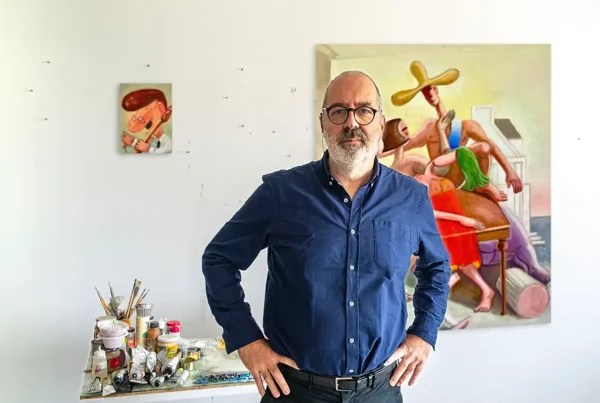
Andy Denzler has built a distinctive artistic practice around a question that remains increasingly relevant in contemporary culture: how do images change as they pass through memory, time, and perception? Born in Zurich in 1965 and continuing to live and work there today, the Swiss painter has developed a visual language that exists between clarity and disruption. His paintings are immediately recognizable for their blurred horizontal shifts, dense surfaces, and fragmented figures that seem caught between emergence and dissolution. Rather than presenting fixed representations, Denzler constructs images that feel unstable, as though they are being remembered rather than directly observed. This tension between visibility and uncertainty has become a defining characteristic of his work, placing him within an ongoing conversation about the future of figurative painting while maintaining a deep awareness of its history.
The foundations of this approach were shaped by an international personal and educational journey. Before returning to Switzerland, Denzler spent time living in South Africa, New York, Los Angeles, and London, experiences that broadened his understanding of culture and image making. His studies culminated in a Master of Fine Arts from Chelsea College of Art and Design in London in 2006, a period that strengthened his engagement with both contemporary painting and historical traditions. Visits to the National Gallery left a lasting impression, particularly his repeated encounters with Titian’s The Death of Acteon. These experiences contributed to an artistic outlook that values painting as both a material practice and an intellectual investigation. Zurich provided focus and continuity, while London encouraged a wider dialogue with abstraction, figuration, and art history.
Long before painting became his primary means of expression, Denzler was immersed in other creative disciplines. During the early 1980s, while photographing works by Jean Michel Basquiat for exhibition catalogues associated with Bruno Bischofberger, he encountered contemporary art in a transformative way. Later, work in graphic design, photography, and music production expanded his sensitivity to composition, rhythm, and atmosphere. These experiences continue to inform his paintings, which often begin with photographic references, found imagery, or technologically generated source material. Rather than reproducing these images, he subjects them to a process of transformation that challenges assumptions about authenticity, recollection, and visual truth.

Andy Denzler: Reconstructing the Human Figure
At the center of Denzler’s artistic practice stands the human figure. Faces, bodies, and groups of people occupy his compositions not as stable portraits but as sites of psychological and emotional inquiry. He frequently begins with a carefully rendered image before introducing disruption through horizontal displacement, painterly intervention, and deliberate distortion. Recognition remains possible, yet certainty is continually undermined. This balance between realism and fragmentation creates a visual experience that encourages prolonged looking. The viewer encounters figures that seem familiar but elusive, grounded yet transient, as though suspended between different moments in time. Through this approach, Denzler explores the fragile nature of identity and the ways in which perception is shaped by memory.
His paintings draw upon a wide range of influences extending across painting, film, photography, fashion, and design. Francis Bacon remains an important reference point, particularly through the expressive treatment of the body and the psychological intensity embedded within distorted forms. Historical painters also play a crucial role in his thinking. Titian and Tintoretto, in particular, have become increasingly significant within his recent work. Their treatment of movement, light, and human drama offers a rich foundation for reinterpretation. Rather than treating historical masterpieces as distant artifacts, Denzler engages them as active visual material capable of generating new meanings within a contemporary context.
This dialogue between past and present reflects a broader fascination with the way images survive and evolve. Denzler is especially interested in how visual information becomes altered through recollection, repetition, and cultural transmission. His figures often appear partially erased, interrupted, or reconstructed, suggesting the imperfect nature of remembrance itself. The resulting works resist straightforward narratives, encouraging viewers to bring their own experiences and associations to the encounter. By positioning the human figure within this shifting space between recognition and uncertainty, he transforms portraiture and figuration into investigations of memory, perception, and emotional resonance.

Spectral Histories and Contemporary Reflections
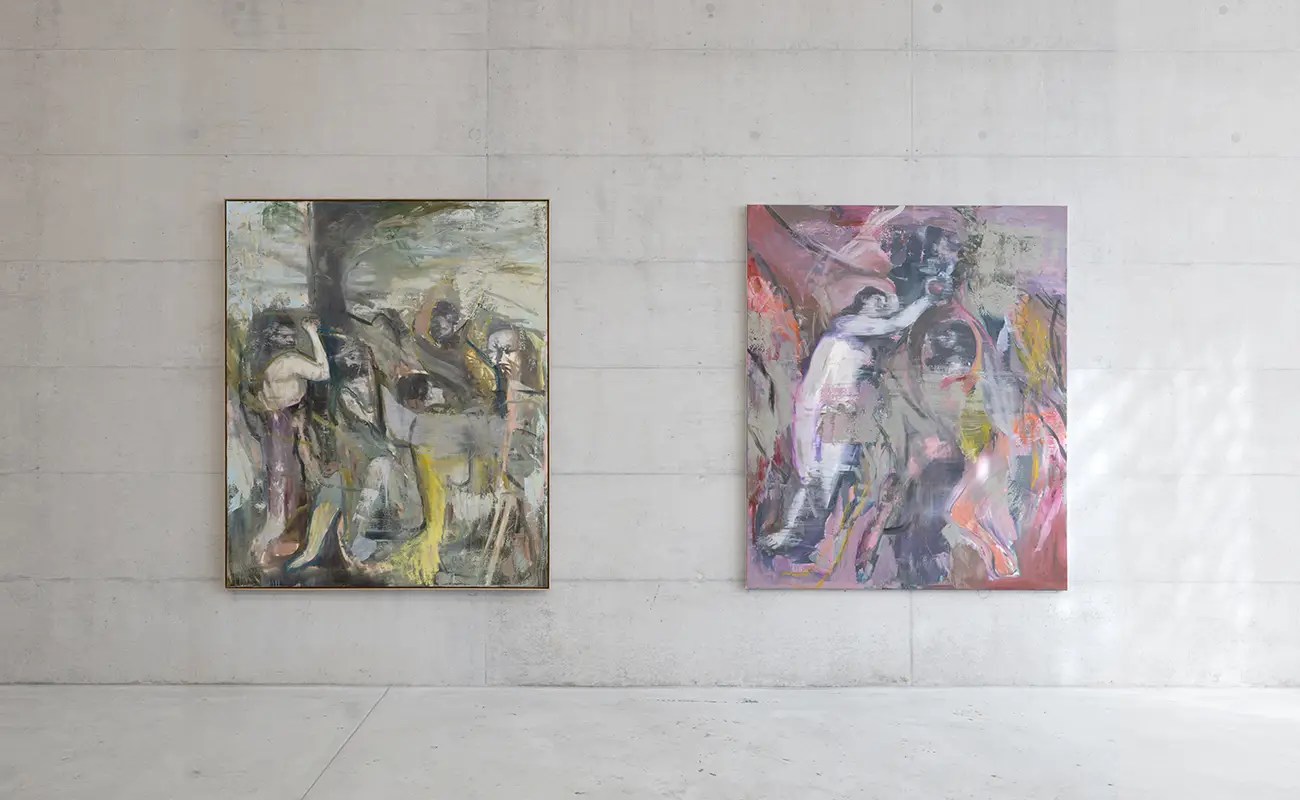
Among Denzler’s recent achievements, the Spectral Paintings series occupies a particularly important position. This body of work brings together many of the concerns that have shaped his artistic trajectory, including emotional experience, image memory, and the continuing relevance of historical painting. In these works, figures appear fragmented and partially reconstructed, as though filtered through layers of time. The paintings suggest images emerging from collective consciousness rather than direct observation. Their spectral quality reflects Denzler’s interest in how visual culture accumulates meaning across generations, transforming familiar references into new forms of experience.
The series also demonstrates the depth of his engagement with Renaissance painting. Through contemporary techniques of disruption and reconstruction, Denzler revisits historical imagery while preserving its emotional force. The dramatic compositions, theatrical lighting, and complex human interactions found in Renaissance masterpieces become starting points for new explorations of contemporary existence. Rather than reproducing historical scenes, he reimagines them through a visual language shaped by fragmentation, painterly movement, and psychological ambiguity. This process allows him to establish a conversation between centuries, revealing unexpected connections between historical concerns and present realities.
A particularly meaningful work within this series is Rescue (After Titian), completed in 2026. Created in oil on canvas and measuring 210 by 180 centimeters, the painting reconstructs imagery derived from Tintoretto’s St Mark Rescues a Saracen from Shipwreck. Denzler was drawn to the original painting’s dramatic movement, twisting figures, and powerful use of light, all of which communicate themes of faith, salvation, and transformation amid danger. By revisiting this historical subject, he establishes parallels between the crises of Tintoretto’s era and those confronting contemporary society. Religious conflict, plague, war, and perilous journeys once shaped daily life; today, political instability, climate challenges, migration, warfare, and technological disruption generate new forms of uncertainty. Through this reinterpretation, historical painting becomes a lens through which present anxieties can be examined and understood.

Andy Denzler: Painting Through Distortion and Time
The physical process of painting remains fundamental to Denzler’s practice. His daily routine revolves around sustained studio work, often directed toward exhibitions that occur approximately every six months. Each painting develops through extensive research, construction, disruption, revision, and repainting. Layers accumulate over time, recording decisions, corrections, and discoveries. This commitment to process ensures that the final image retains visible traces of its own creation. Rather than concealing change, Denzler embraces it, allowing the painting to function as both an image and a record of its evolution.
Oil paint remains his primary medium, though recent works increasingly incorporate mixed media elements. Heavy impasto surfaces establish a strong material presence, while sweeping horizontal brushstrokes introduce movement and instability. He manipulates paint through dragging, scraping, and displacement, creating visual interruptions that resemble cinematic motion blur, damaged film frames, or digital interference. These effects contribute to the distinctive atmosphere of his paintings, where physical substance and visual uncertainty coexist. The result is a compelling balance between tactile immediacy and conceptual depth, reinforcing his ongoing interest in how images are constructed and perceived.
Looking ahead, Denzler continues to expand the possibilities of the Spectral Paintings series and its engagement with collective memory, figurative painting, and art history. His upcoming exhibition with Galerie Peter Kilchmann in Zurich, scheduled for September 2026, will present this evolving direction through a renewed examination of Renaissance imagery. By reloading historical paintings into a contemporary visual framework, he demonstrates that the past remains an active participant in present cultural conversations. Through distortion, reconstruction, and painterly intensity, Denzler creates works that bridge centuries while addressing the complexities of modern perception, ensuring that his paintings remain both historically informed and unmistakably contemporary.