“Rather than seeing an exhibition as a container for finished artworks, I see it as a structure through which relationships between people, technologies, spaces and different forms of knowledge can be tested.”
When the Exhibition Becomes an Interface
Can an exhibition behave like an interface rather than a room? For independent curator and researcher Forrest Lin Wu, that question informs a practice connecting contemporary art, education, and digital culture. He considers an exhibition not simply a place where artworks are presented, but an arrangement that directs attention, movement, and participation. The ways visitors enter a space, encounter information, and gain access to knowledge become part of the curatorial work itself. This approach places the relationships generated by an exhibition alongside the objects it contains, making the design of an experience inseparable from its intellectual purpose.
Wu graduated from the Academy of Arts & Design at Tsinghua University and subsequently studied at the Royal College of Art. His work there developed around user interface and user experience design, interaction, and the ways people navigate systems. Those concerns have remained influential even as his focus shifted toward curating. Interface design asks how choices are presented, how a person moves through a structure, and how participation is enabled or restricted. In an exhibition, similar decisions may be expressed through spatial arrangements, routes, forms of mediation, and the order in which visitors encounter ideas.
The pandemic gave these questions new urgency. With access to physical cultural venues suddenly interrupted, Wu began exploring virtual exhibitions more seriously. He was less interested in reproducing a familiar white cube on a screen than in considering what digital environments might make possible on their own terms. The loss of the physical gallery prompted him to reassess presence, accessibility, and what remains essential to an exhibition when its architecture changes. Among the curatorial references he identifies is Tina Sauerlaender and her work with peer to space, particularly its attention to the distinct possibilities of online exhibitions and virtual art environments.

Forrest Lin Wu: Connecting Systems Through Curating
Wu’s response to the divide between physical and digital presentation developed into PDCP, or Physical-Digital Curatorial Practice. The methodology treats these environments as connected elements of a single curatorial system rather than separate options for displaying the same material. A virtual exhibition, for example, need not follow the restrictions of gravity, conventional architecture, or physical scale. For Wu, those differences are not incidental technical advantages. They create opportunities to rethink how people encounter work, what kinds of movement are possible, and how knowledge can be structured across environments.
An important step toward this approach can be seen in Coupling, which Wu curated at Luan Gallery in Beijing from 23 September to 20 October 2023. The exhibition brought his interest in interfaces into a wider consideration of relationships between systems. Technology and the body, media and perception, space and institution, and individual and collective experience were treated as interacting conditions rather than isolated categories. The title suggests a process of connection, but the exhibition’s curatorial premise also involved the possibility that those connections might alter the systems taking part.
Coupling marked a shift in how Wu understood the exhibition itself. Instead of treating the gallery as a neutral frame around completed artworks, he began to approach curating as the temporary organisation of encounters between different structures and forms of experience. This was consistent with his training in interaction, while extending that training beyond the design of an interface in the conventional sense. The visitor’s relationship to a work became one component of a larger situation involving institutions, technologies, and other people. That systems-based thinking established a foundation for his subsequent investigation of exhibitions as places where learning can occur.

Education Beyond the Classroom
The educational implications of this method came into sharper focus in Invisible Classroom, curated by Wu at SFZY Gallery in Beijing from 4 to 24 March 2024. The exhibition asked what a classroom becomes when teachers and learners no longer occupy one shared room. Australia’s historical School of the Air offered a point of departure for considering how education has moved through communication technologies. Radio, distance learning, and contemporary digital platforms entered the discussion as infrastructures that can reorganise who participates in learning, where it happens, and how people remain connected across distance.
For Wu, these questions connect exhibition design to broader issues of access and public knowledge. A classroom is more than a physical arrangement of desks, just as a gallery is more than a collection of walls. Both are systems that distribute information, establish expectations, and shape people’s relationships with one another. Invisible Classroom brought his interest in physical and digital environments into closer contact with the history of educational formats. It also offered a way of thinking about an exhibition as a temporary learning structure outside the routines and boundaries of a conventional educational institution.
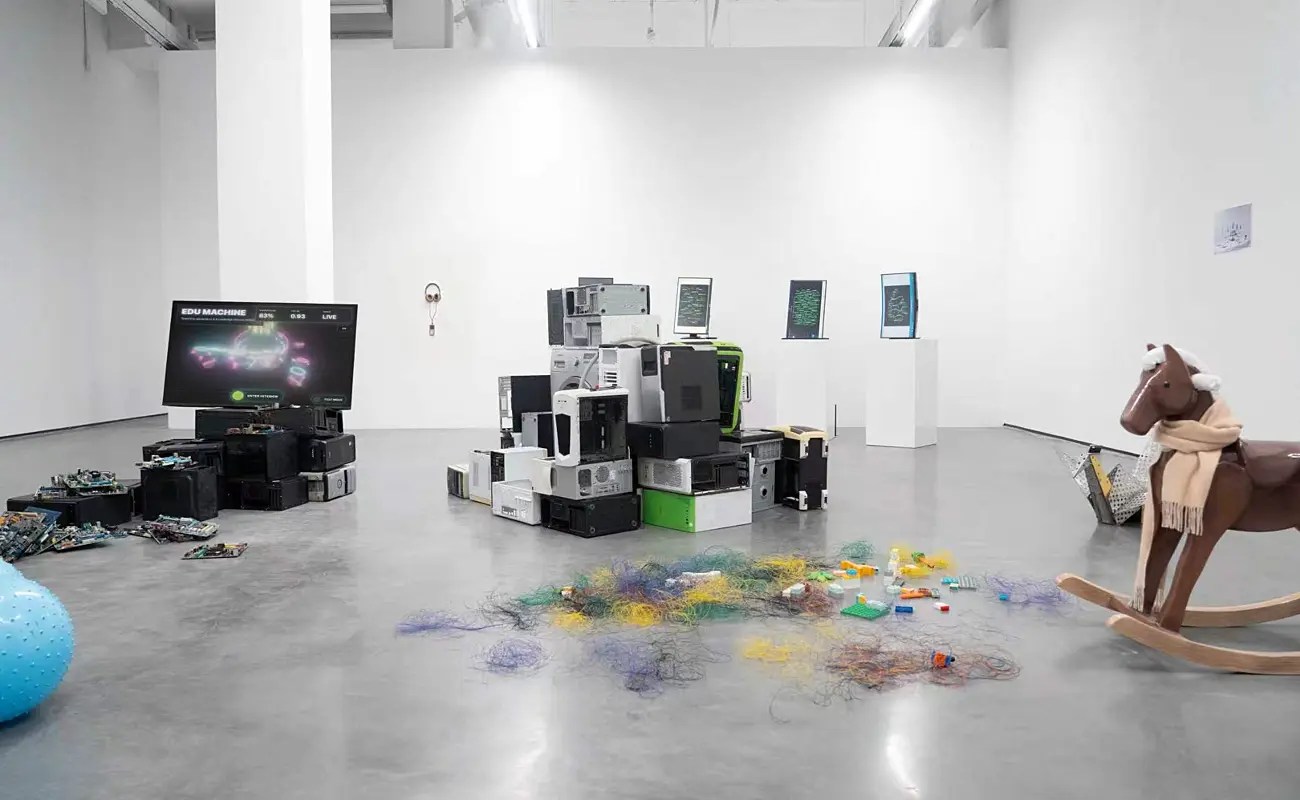
That inquiry continued in The Education Machine, presented in Beijing from 21 January to 6 February 2025. Where Invisible Classroom examined the spatial and technological conditions of learning, this project turned toward the mechanisms by which learning is organised and assessed. Feedback, calibration, technological mediation, and optimisation became central concerns. The exhibition considered what might happen when attention, behaviour, and progress are increasingly rendered measurable. It also raised a more difficult question: when education is made to operate efficiently, which forms of uncertainty, divergence, or unplanned discovery risk being excluded from the process?

Forrest Lin Wu: From Public Learning to Cultural Exchange
Wu’s curatorial work also extends into international and institutional settings. In 2025, he served as a curator of the eighth International Art Exhibition at Kurume City Art Museum in Fukuoka, Japan. The exhibition brought together artists, educators, researchers, and cultural practitioners across generations and regions. Organised around the theme “Exchange, Inheritance and Generation,” it addressed cultural transmission as an active process of reinterpretation rather than a fixed inheritance passed unchanged from one person to another. Its wider public setting offered a different scale for concerns that had previously emerged in Wu’s more focused curatorial projects.
The eighth edition was supported by governmental and cultural organisations in Japan, including Fukuoka Prefecture, Fukuoka City, and Kurume City. Former Japanese Prime Minister Yukio Hatoyama contributed to the exhibition catalogue and sent congratulatory flowers, while Fukuoka Governor Seitaro Hattori provided a congratulatory message. The opening brought together participants from cultural, academic, and diplomatic circles. Wu’s involvement was also listed for the ninth edition in 2026, extending his engagement with this cross-cultural exhibition platform and its emphasis on knowledge moving between generations and communities.
Seen alongside Coupling, Invisible Classroom, and The Education Machine, the International Art Exhibition makes visible the expanding social scope of Wu’s curatorial questions. His projects move from systems and interfaces to the organisation of public learning, then toward exchanges between communities and cultural institutions. The physical and digital remain connected within this thinking, but technology is no longer the sole point of emphasis. What matters is how an exhibition can make different kinds of knowledge accessible, bring participants into relation, and create conditions in which inherited ideas may be examined and transformed.