“My vision through art is to express my feelings and thoughts and to connect with other people.”
Color as a Language of Feeling
Alexandra Corina Irimia has built a painting practice around the meeting point of observation, emotion, and imaginative freedom. Born in Bucharest, Romania, on July 27, 1991, she began painting in October 2017 with only a small selection of materials, initially exploring abstract compositions and landscapes. What started with limited means developed into a broad visual practice in which watercolor and acrylic remain central, supported by tempera, drawing, digital art, and video editing. Across these forms, she treats art as a direct way to make thoughts and feelings visible and to establish a connection with other people.
Her development has combined experimentation with instruction. After beginning independently, Irimia took painting lessons at an art studio near her home and continued learning through both studio and online contexts. Rather than using that education to pursue strict naturalism or a single fixed method, she gradually formed a style that leaves room for instinct. Abstracts, landscapes, and flowers became recurring subjects, while portraits and figures expanded her interest in recognizable imagery. The resulting work moves comfortably between depiction and transformation, allowing the familiar to become subjective without losing its identity.
That openness is closely connected to Irimia’s background in psychology, expressive psychotherapy, and art therapy. Her work does not present creativity as an academic demonstration of technique. Instead, painting functions as a process through which personal perception can remain visible. Irregularities, shifts in scale, simplified forms, and unexpected colors are not concealed in pursuit of polished illusion. They contribute to an unguarded visual language that places emotional clarity and individual interpretation at the center of the image.

Alexandra Corina Irimia: Building Form Through Color
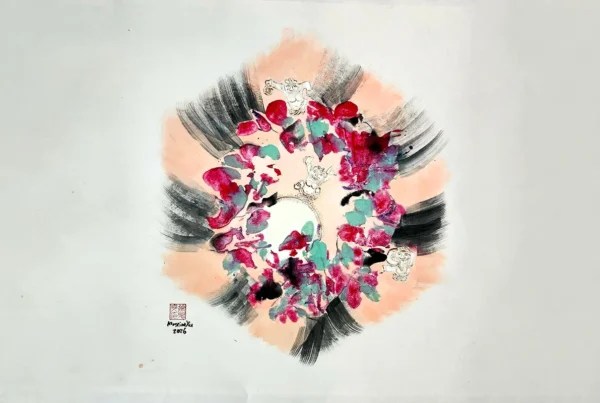
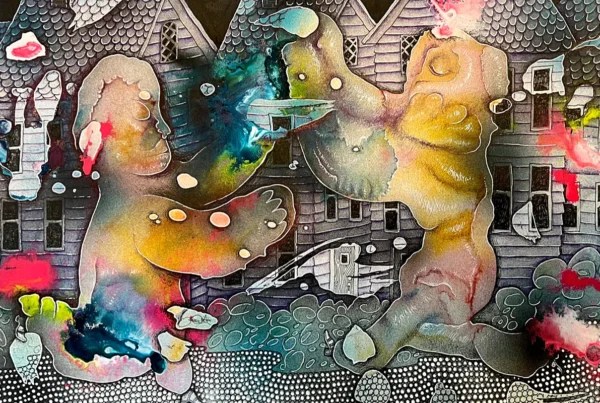
Color carries much of the expressive force in Irimia’s paintings. Vivid reds, greens, oranges, turquoise, and deep blues often depart from descriptive reality, shaping atmosphere according to feeling rather than optical accuracy. This approach gives ordinary motifs a heightened presence. Flowers can become concentrated fields of color, while figures and landscapes gain an emotional temperature through chromatic choices that are not restricted by what the eye would literally observe. Saturation becomes a structural tool as much as an expressive one.
Her quieter palette studies reveal another side of this interest. Tonal explorations in blue or earth colors focus attention on small changes of hue and the way those changes can suggest volume, distance, and mood. The contrast between these restrained works and her more saturated compositions shows that color is not simply decorative within her practice. It is a flexible means of organizing an image. Whether a painting is bright or limited in range, hue establishes relationships between forms and helps determine how a viewer encounters the subject.
Material also changes the character of that encounter. Watercolor, one of Irimia’s favorite mediums, offers translucency and delicacy, while acrylic permits denser passages and visible brushwork. Tempera and drawing add further possibilities, yet a sense of immediacy remains consistent. She does not force every medium toward the same finish. Instead, different materials are allowed to retain their particular qualities, giving her practice stylistic breadth while preserving the directness that first drew her to painting.

Between Recognition and Abstraction
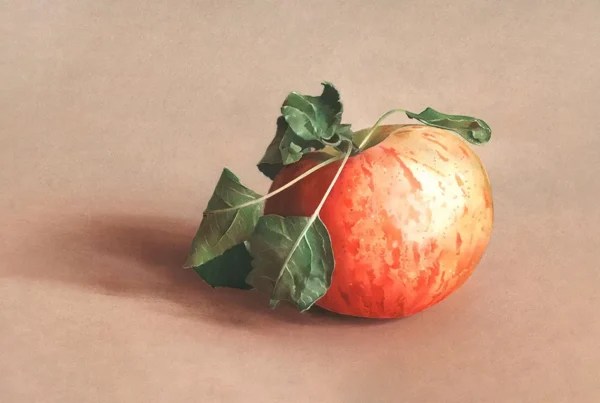
A recurring tension between representation and abstraction gives Irimia’s imagery its distinctive movement. She paints landscapes, flowers, figures, still lifes, domestic objects, animals, and rural environments, but recognizable subjects rarely remain straightforward descriptions. Forms may be reduced to broad silhouettes or rhythmic contours, and perspective can shift away from conventional spatial logic. Familiar scenes therefore acquire a dreamlike quality, not because their subjects disappear, but because observation is filtered through memory, emotion, and association.
This transformation is particularly evident when individual motifs begin to approach abstraction. A bouquet can break into a dense arrangement of colored marks. A landscape may become a sequence of horizontal bands punctuated by simplified architectural shapes. An isolated hand or domestic object can assume an unexpectedly monumental presence. In fully abstract works, the same instinct toward reduction continues through interlocking areas of strong color whose relationships create an almost topographical rhythm. The difference between her figurative and abstract work is therefore less absolute than it first appears.
Her visual language has affinities with modernist and expressionist approaches, especially through flattened pictorial space, non naturalistic color, and an emphasis on subjective interpretation rather than academic finish. Irimia nevertheless keeps the focus personal rather than programmatic. She does not restrict herself to one polished idiom, and different subjects invite different responses. That willingness to change modes gives her work flexibility while recurring choices in color, simplification, and emotional projection provide continuity across the variety.

Alexandra Corina Irimia: From Private Experiment to Public Presence
Irimia’s path from beginning painter to publicly presented artist has unfolded gradually. Since 2020, she has shown and shared her work through online platforms and exhibitions, extending the audience for a practice that began close to home. In 2025, that visibility expanded through online art galleries including ArtGallery, ArtMajeur, and Joseartgallery. The same year, she launched her own website, creating a dedicated space for viewers to encounter her work and follow its development.
She also participated in online art contests including Dali’s Moustache and World Art Games, receiving second prize in 2025. These activities reflect a growing international presence built through digital channels as well as continued artistic production. Her involvement with online exhibitions, galleries, competitions, and her own website places the work within a wider network without changing the personal motivation behind it. Public presentation becomes an extension of her stated desire to communicate feelings and thoughts through art.
That desire for connection remains the clearest thread across Irimia’s varied practice. Painting began with a few materials and an interest in abstracts and landscapes, then expanded through lessons, experimentation, additional media, and a wider range of subjects. Her current work continues to favor sincerity, bold chromatic decisions, and stylistic openness over rigid consistency. By allowing everyday motifs and abstract structures to carry personal perception, she keeps the act of making closely tied to discovery, using color and form to translate an inner response into something another person can encounter.