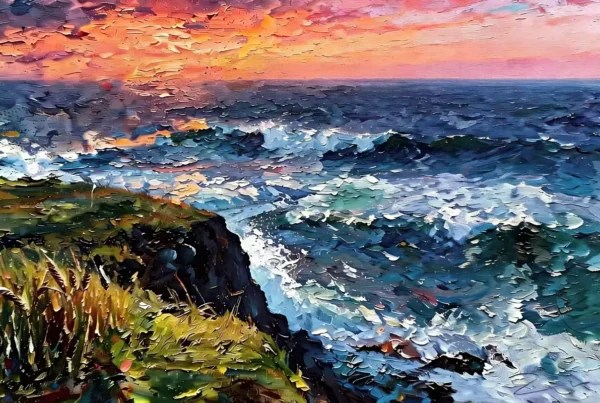
“After some composition and color research, I try to visually capture harmony, mystery and balance, looking for a certain feeling of well-being which I hope to share with others.”
Watercolor Between Memory and Observation
Marie Pascal has spent decades building a practice around watercolor, mixed media on paper, and the quiet intensity of looking closely. Her paintings are figurative and realistic, often small in scale and precise in their handling, yet they are not attempts to reproduce photographs. Instead, Pascal uses observation as a starting point for shaping atmosphere. Streets, cafés, landscapes, gardens, and interior spaces become places where light, recollection, and visual order can meet. Her aim is not simply to describe what was there, but to recover the particular feeling that made a place worth remembering.
Her relationship with watercolor began after a visit to England, and the medium has remained central to her work ever since. Its speed makes it practical for painting on location, especially when changing light determines how long a scene can be observed. In the studio, however, watercolor offers a different kind of freedom. Pascal can slow down, build transparent and opaque passages, and satisfy the attention to detail that developed during her earlier career as an illustrator. Fine brushes, smooth paper, and carefully prepared drawings allow her to work with precision while preserving areas of softness and uncertainty.
That balance between definition and suggestion is important to Pascal. Her images may be descriptive, but she does not pursue photorealism. Light and shadow, transparency and opacity, sharply rendered passages and more open areas all coexist within the same composition. These contrasts keep the image from becoming purely documentary. A scene remains recognizable, yet something is held back. For Pascal, that small degree of ambiguity is what allows a painting to retain mystery and to suggest more than the visible facts of its subject.

Marie Pascal: From Illustration to Independent Painting
Pascal trained in Paris as a graphic artist, studying drawing, composition, and visual communication before working for years as a commercial illustrator. Advertising agencies, publishers, and magazines provided a demanding professional environment in which images had to answer specific briefs. The discipline of that period never disappeared from her painting. Her classical sense of composition, respect for draftsmanship, and concern for clarity all remain visible, even after she left commercial work behind and began pursuing an independent practice in California.
The change gave her something she had wanted for a long time: the ability to decide for herself what to paint, which colors to use, and how to approach the image. Clients had once imposed subjects and practical restrictions. Painting removed those constraints. Pascal could follow the subjects that genuinely held her attention, from San Francisco streets and café scenes to the landscapes of Northern California. More recently, parks, gardens, and green spaces within cities or close to home have become increasingly important. She sees them as refuges, places associated with rest, meditation, and the possibility of a kind of paradise within everyday life.
Her visual references reach across several periods. She admires painters such as Vermeer, Rembrandt, Corot, Innes, and Redon for their command of drawing, composition, technique, and the less tangible quality that carries an image beyond simple representation. Contemporary figures including Peter Doig and Isabelle Sauvageot have also influenced her, along with illustrators Yann Nascimbene and Joanna Concejo. What connects these sources for Pascal is not a single style, but the presence of knowledge joined to feeling. Technical control matters, yet technique becomes meaningful only when it supports something that cannot be reduced to accuracy alone.

When a Landscape Waits in Memory
Many of Pascal’s paintings begin long before brush touches paper. A place may remain with her after a walk, a trip, or an ordinary encounter, preserved partly in memory and partly in photographs. Time and distance then alter the relationship to the subject. Rather than treating the photograph as a fixed model, she returns to the experience and considers what made it significant. Composition and color studies help her identify the structure she wants, while the final painting tries to recover harmony, mystery, balance, and the sense of well-being she first associated with the scene.
That process is especially clear in Heron of the Marshes, a watercolor connected to a semi-wild marsh Pascal sees during her morning walks. The area becomes very dry in summer and is often nearly empty, apart from birds and the occasional deer. She had photographed the landscape many times and felt drawn to it, but while imagining the composition she decided that a heron should stand in the middle of the image. The bird was not present in her reference material. It belonged, at first, only to the picture she was forming in her mind.
The following day, Pascal returned to the marsh and found a heron standing almost exactly where she had imagined placing it. She had never seen one there before and did not have a camera with her, so the encounter survived only in memory. The coincidence became the reason to make the painting. Rather than rendering every feature of the marsh precisely, she allowed the image to remain more elusive. The work matters not only because of its subject, but because observation, imagination, and chance briefly aligned, turning a familiar landscape into something unexpected.

Marie Pascal: Precision, Experiment, and a Looser Line
Pascal’s daily process is careful and demanding. Planning often takes longer than the painting itself. She sorts through photographs, prints possible references, and sometimes combines several images in a collage until the composition feels convincing. Precise drawing and color research follow before the final work begins. By resolving many decisions in advance, she can concentrate during painting without becoming distracted by detail. The method requires sustained attention, and she has learned to stop when fatigue begins to interfere rather than continue and risk damaging a passage that already works.
At the same time, Pascal has become interested in working with greater speed and freedom. An exhibition in Paris of drawings by seventeenth-century Dutch artists made during their travels suggested a new direction. The works led her to imagine an “imaginary sketch pad” connected to places revisited through memory. She began experimenting with watercolor washes as prepared backgrounds, followed by pencil drawing and a limited range of colors. The method preserves her interest in structure while allowing the drawing itself to remain lighter, more immediate, and less fully predetermined.
That experiment is likely to shape her next project, a still life built around blue-green vases placed against an ochre wall, with dried flowers casting shadows across the surface. Pascal sees the combination of pencil over a prepared watercolor wash as potentially well suited to the subject. The project also reflects the productive tension that has run through her work for years: control and openness, exact drawing and atmospheric suggestion, careful preparation and the wish to move more freely. Her practice continues to grow inside that tension, using familiar tools to find new ways of seeing.