Strangers Suspended Between Destinations
AATONAU has previously followed Kip Harris through the development of his photographic practice and his long engagement with labor, craftsmanship, and the dignity of work. Earlier features moved from studies of atmosphere, light, and place to the enduring At Work series, where people are understood through the environments and tasks that shape them. Between U-Bahn Stations changes those terms. The workplace gives way to public transit, and known occupations give way to anonymous passengers encountered in Berlin’s underground system. Harris remains concerned with character, but here it must be read from brief, unguarded fragments rather than from the visible context of a life or profession.
Raised in Idaho and educated in literature, humanities, and architecture, Harris spent nearly three decades working as an architect before photography became increasingly central to his creative life. That background helps explain the structural discipline in his images. Even when the subject is spontaneous, he remains alert to space, proportion, placement, and the relation between a figure and its surroundings. In his black and white street and documentary photography, this discipline is balanced by curiosity about ordinary encounters. Faces, gestures, and posture become ways of observing how people inhabit public space without theatrical direction from the photographer.
The series grew from a practical obstacle. Harris arrived in Berlin for a residency at Ping Pong expecting to continue the environmental portrait process he had developed after a series of workshops with street photographer Harvey Stein, but found photographing strangers there unusually difficult. During August 2026, he began making anonymous portraits of passengers seated opposite him or standing nearby on the U-Bahn. He worked with a silenced iPhone 16 in Portrait Mode using Stage Light Mono, then refined the images in Photoshop and Silver Efex Pro. The method stripped away much of the carriage and concentrated attention on the passengers. Because the subjects were unaware of the camera, their expressions and gestures remained undirected.

Kip Harris: Building a Theater of Solitude
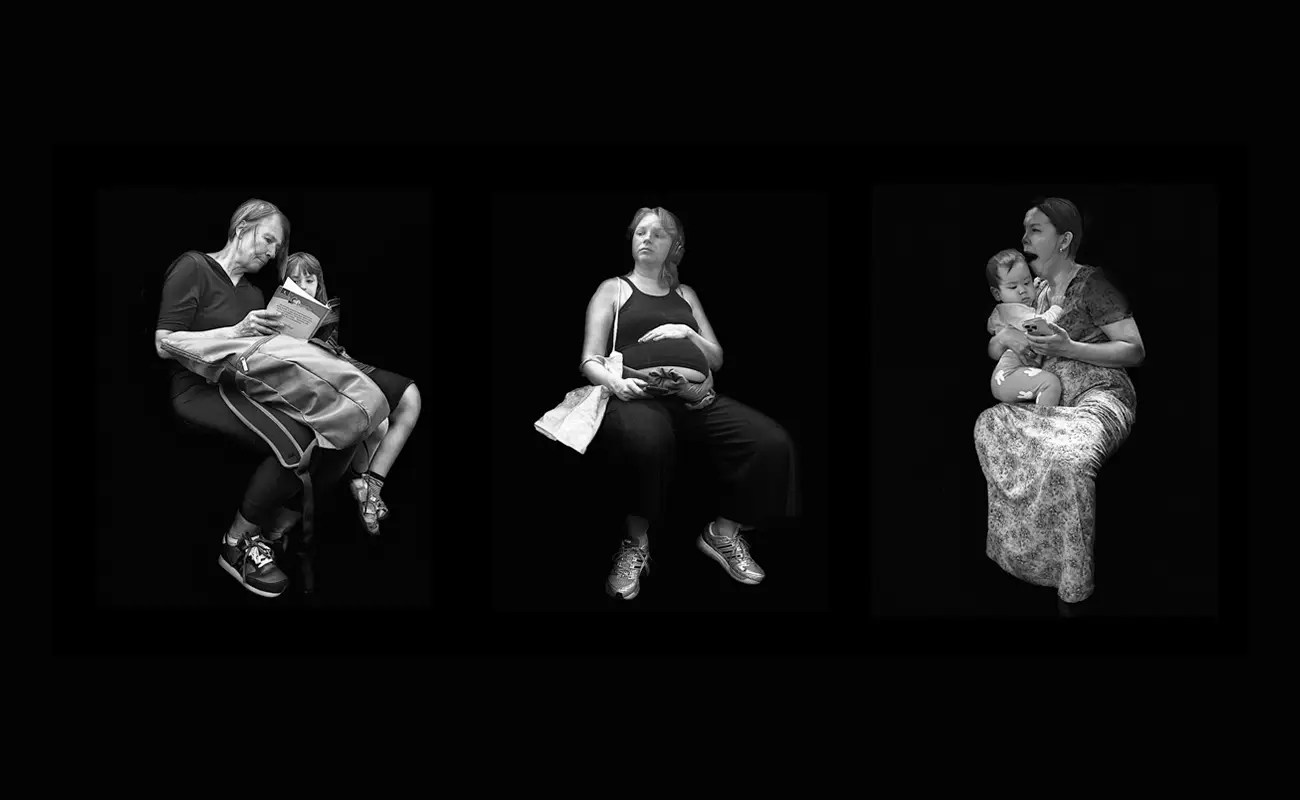
The most decisive visual move in Between U-Bahn Stations is the near disappearance of the subway. Harris does not present the carriage as a descriptive environment filled with signs, windows, advertisements, and architecture. Instead, passengers emerge from broad fields of black. A bowed head, folded hands, a raised arm, a shopping bag, a phone, or the angle of a seated body carries greater weight once surrounding information is removed. Public transport is usually understood through density and movement, yet Harris turns it into an image of suspension. People who are clearly traveling appear momentarily detached from destination, route, and crowd.
That reduction was encouraged by a Mark Rothko retrospective Harris visited in Florence shortly before Berlin. He was particularly interested in Rothko’s late, nearly monochromatic works on paper and in the possibility of building intensity through restricted contrast. Harris does not imitate those paintings, but the encounter strengthened his willingness to remove descriptive material and let tonal relationships carry the picture. Black becomes more than a backdrop. It presses around the subjects, separates one body from another, and creates a visual interval in which ordinary gestures gain prominence. The simplification also gives the portraits a mock theatrical quality, as though each passenger has entered a stage without realizing it.
This effect complicates the documentary origin of the photographs. The moments are candid, but the final images are highly controlled. Harris begins with unposed observation and then uses digital isolation, monochrome processing, cropping, and sequencing to construct a visual argument about solitude. The passengers are not presented simply as records of Berlin commuters. They become protagonists in a system that emphasizes separateness, inward attention, and the coexistence of physical proximity with psychological distance. They remain specific enough to feel individual, yet the removal of context limits what can be known beyond clothing, posture, expression, and gesture.

Triptychs and the Grammar of Gesture
Harris, with the help of his wife, a former ballet dancer, modern dance choreographer, and animator, organized the portraits into triptychs as a way of making the individual images complement or comment on the whole. The structure changes how each portrait is read. A single image may encourage the viewer to build a story around one face, but three images placed together create comparison and interruption. One passenger’s stillness can sharpen another person’s movement. Bent heads answer one another across separate frames. Hands become a vocabulary of holding, scrolling, clasping, supporting, or resting, while changes of scale and cropping prevent the groups from becoming simple sets of matching portraits.
The triptych also makes anonymity relational. Harris does not identify the passengers, yet they acquire meaning through the company of strangers. A person absorbed in a phone may appear self-contained in one grouping and defensive in another. A parent with a child introduces a different emotional register from a solitary commuter, while two people sitting close together may still seem visually detached. These variations keep the project from reducing urban isolation to one expression. Fatigue, alertness, curiosity, distraction, care, and private concentration can all exist within the same visual system. The series observes how many forms of inwardness can occupy one shared public environment.
Consistency gives the project coherence, but it also creates a compositional challenge. The black ground, monochrome palette, frontal distance, and isolated figures recur so strongly that sequencing must carry much of the variation. Harris’s most effective groupings use posture, scale, crop, and interpersonal relation to create pressure between images. A standing figure can disrupt two seated bodies. A tightly cropped torso can interrupt more complete portraits. A pair can complicate a group otherwise dominated by solitary passengers. Harris is therefore not simply collecting faces. He is working with the spaces between images, testing how separate encounters can form a collective without becoming a literal narrative. He is working with both the figure and the ground.

Kip Harris: Looking, Privacy, and Public Space
The candor of Between U-Bahn Stations introduces an ethical tension that Harris addresses directly. The portraits were made without the subjects’ knowledge, and he acknowledges that their public display in Germany may raise legal questions. He also questions the contrast between restrictions on portrait photography and the routine presence of surveillance cameras in public space. His position is provocative because the images depend on unguarded behavior. The value he places on spontaneity is inseparable from the fact that the passengers did not participate in the decision to make or present their portraits.
The surveillance comparison does not settle the issue because the two forms of image making operate differently. A security camera records for an institutional purpose, while an artist selects, edits, enlarges, sequences, exhibits, and interprets a person’s image. Harris’s photographs make this distinction especially visible because the passengers are not incidental figures buried in a street scene. The dark background gives each person pictorial authority. Clothing, shoes, bags, head coverings, devices, and small bodily adjustments receive concentrated attention. The same process that can dignify an overlooked commuter also increases the force of the photographer’s authorship over how that stranger will be seen.
Harris frames the series with Alfred Noyes’s image of people crowded together yet remaining alone in his 1904 poem “The Barrel-Organ,” and the photographs translate that contradiction without showing the crowd itself. Congestion survives as an unseen condition while the finished pictures isolate one person at a time. That gap between original setting and final image gives Between U-Bahn Stations much of its tension. The project sits between street photography and constructed portraiture, between recognition and appropriation, and between the individual and the collective. Its passengers are anonymous but never generic. Each is briefly separated from the flow of the city, held against darkness, and asked to carry the emotional weight of public life lived beside strangers.