“I wanted to reveal these structures in my forms.”
The Spirit Held in Wood
Jeannette M Rein approaches wood as a material already alive with information. The Western Australian sculptor works mainly with local and indigenous timbers, drawing attention to grain, bark, natural imperfections, light and the structural possibilities concealed inside each piece. Her forms can initially suggest botanical or marine organisms, yet their unfamiliar silhouettes emerge from sustained technical investigation rather than imitation. Across sculpture, contemporary jewellery and public art, Rein has built a practice around stretching what wood can physically and visually become, allowing the material’s previous life to remain present even as it assumes a new identity.
That sensitivity began early. Born to Swiss parents with a strong interest in nature, Rein grew up observing how they adapted to Australia and learned from their willingness to meet unfamiliar experiences. Family holidays along Australia’s eastern coast sharpened her attention to changing landscapes, variations in light and texture, and the scale of open space. The rugged environment became more than scenery. It trained her to look closely, notice difference and remain receptive to the character of place, habits that would later become central to her sculptural thinking.
Her mother, Johanna, provided another formative influence. A skilled knitter, dressmaker and gardener, she introduced Rein to making through everyday acts of patience and skill. Rein remembers pushing a threaded needle through fabric at the age of two, trying to keep her stitches even. She also worked beside her mother in the garden, learned plant names and helped build a water garden with ponds and a walkover bridge. Those experiences joined handwork and natural observation at an unusually early age, establishing interests that Rein would later carry across clothing, metalwork, jewellery and sculpture.

Jeannette M Rein: Learning Through Material Change
Rein’s education reflects the breadth of that curiosity. She studied biology as well as clothing design and construction at university, then moved into teaching while maintaining an active interest in ceramics, drawing, sculpture and printmaking. A later degree in jewellery and 3D design expanded her technical vocabulary, and she subsequently completed a Master of Fine Art by research at Federation University, alongside earlier visual arts and education qualifications from Curtin University and SCV Rusden. Rather than separating these disciplines, Rein treats acquired skills as transferable knowledge, moving ideas between processes and scales.
A decisive encounter occurred during the final year of her jewellery and 3D design degree, when visiting artist and lecturer Helmut Lueckenhausen demonstrated the lamination of wooden forms. Watching his process prompted Rein to test different woods and glues for herself. She began slicing timber into wafers around four millimetres thick and discovered grain structures that remained hidden in conventional thick planks. The discovery changed the role of surface in her work. Grain was no longer simply a visible characteristic of timber but a structural and expressive element that could be exposed, layered and composed within the form.
This experimental approach became a foundation for Rein’s mature practice. Indigenous timbers are carved, pierced, layered and extended into intricate constructions, while bark and imperfections are retained rather than erased. Her understanding of wood has developed over decades of work across sculpture, jewellery and public commissions. The resulting objects balance technical control with responsiveness to the material. Instead of forcing timber toward a predetermined appearance, Rein allows its grain, density and behaviour to influence the direction of each sculpture, producing forms that can feel simultaneously engineered and organic.

Making Light Part of the Form
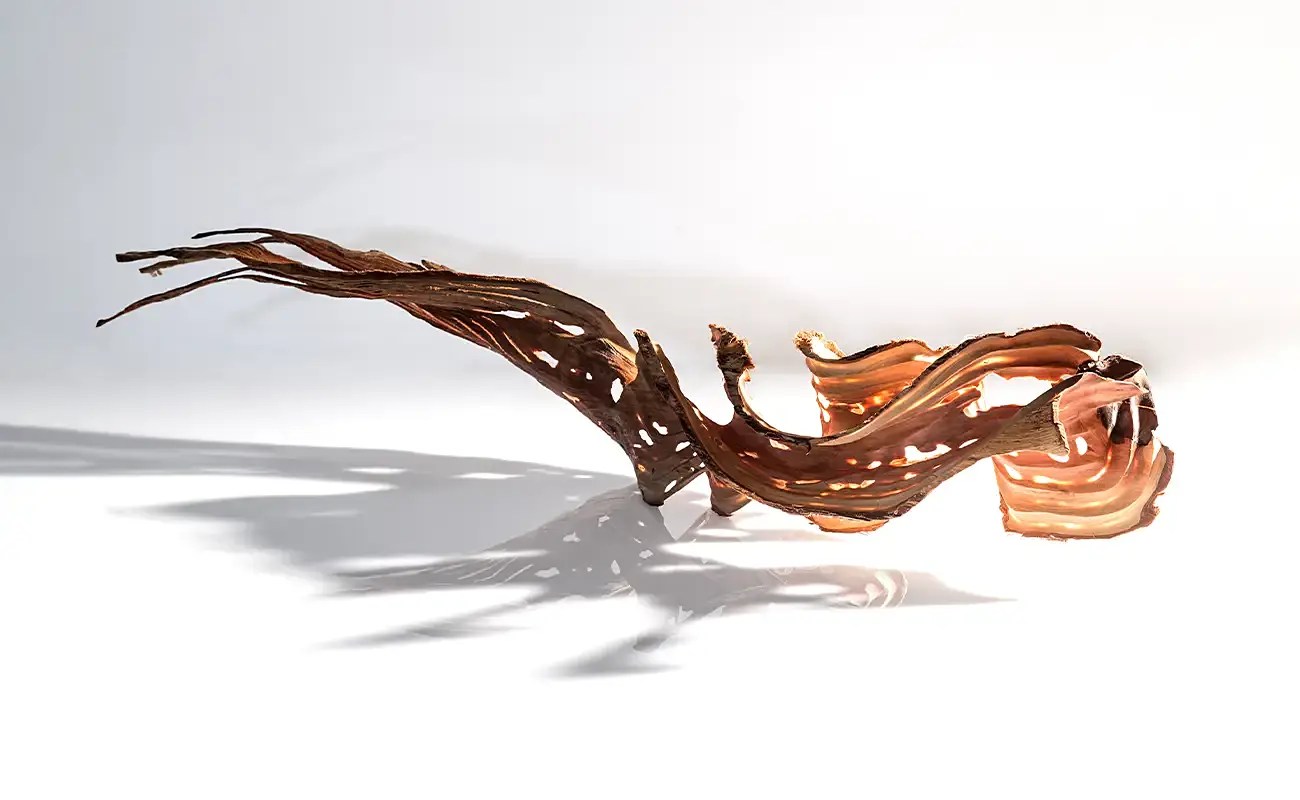
Rein’s next challenge was to make light function as an active component of sculpture. She began drilling holes of different sizes through timber before laminating the sections together. When illumination struck the completed form, the perforations generated a dappled effect that recalled light filtering onto a forest floor. The technique translated an environmental memory into a physical event. Light did not merely reveal the sculpture’s exterior. It passed through the object, changing its presence and giving shadow a compositional role alongside surface and mass.
The work of Hawaiian wood turner Ron Kent encouraged Rein to push this investigation further. Kent’s paper thin forms demonstrated the translucency wood could achieve when taken toward its physical limits. Rein progressively reduced the thickness of her own sculptural walls, but greater thinness introduced the problem of warping. Her solution was to build a supporting superstructure within the walls. This internal framework gave tissue thin sections enough strength to retain their intended shape, allowing the sculptures to combine apparent delicacy with structural stability.
This relationship between vulnerability and engineering is especially clear in Threshold, one of Rein’s most personally meaningful sculptures. The work tested whether she could create a mid sized form capable of maintaining its structure while achieving translucency through tissue thin walls. It succeeded not only as a technical experiment but also as a way of introducing another visual dimension. Light moving through the reduced timber generated evolving shadows, extending the sculpture beyond its physical boundary. Threshold therefore marks a significant point in Rein’s pursuit of wood that can appear substantial and almost immaterial at once.

Jeannette M Rein: An Ongoing Practice of Resolution
Rein rarely treats a technique as settled. She continuously researches and designs new possibilities, whether to improve the resolution of a sculpture or to identify another medium or process that can help a form reach greater clarity. She typically keeps two or three sculptures in progress simultaneously. Some are set aside until she feels prepared to return to them. Work on another piece may reveal a better solution to a technical difficulty, allowing knowledge gained through one experiment to reshape another. The studio becomes a place of parallel investigation rather than a linear production sequence.
That patience is reflected in the slow evolution of her wooden forms, which can develop over months as she responds to what the material reveals. Her stated aim is to stretch the known and imagine new possibilities for wood while communicating the enduring, intangible vitality of living things. Light, shadow, surface and mass remain central to that effort. When timber is refined to near paper thinness, illumination exposes qualities usually associated with more translucent materials, while the visible grain continues to insist on the object’s origin in a living structure.
Rein’s work has reached audiences well beyond Western Australia. Her exhibitions have included presentations in the United States, Canada, Germany, Taiwan and New Zealand, alongside Australian projects, and her work is represented in collections including the Art Gallery of Western Australia, The Center for Art in Wood in the United States, Mialoli Wood Sculpture Museum in Taiwan and Artbank in Sydney. She has also completed commissions for schools, churches and civic spaces across Western Australia. Across these contexts, the consistent thread is her sustained inquiry into timber itself: how far it can be thinned, layered, pierced and illuminated without losing the material character that first drew her attention.