“The boat is the time body. The water is the connecting line.”
Where Movement Becomes Material
For Nadja Haas, the borders between visual art and dance are permeable. The Berlin-based interdisciplinary artist, performer and choreographer works across performance, installation, drawing, writing, textiles, sound and photography, treating each medium as part of a larger inquiry into how bodies encounter space and material. Her practice is rooted in both fine art and dance, with studies in London that included an MA at the Slade School of Fine Art alongside training in dance and choreography. That dual foundation continues to shape a practice concerned with embodiment, memory, ritual, ecology and the physical and emotional influence of place. Rather than separating movement from visual production, Haas approaches them as languages capable of changing into one another. Movement can function as drawing, a gesture can take on sculptural qualities, and a space can be understood choreographically. This way of thinking allows image, sound, material and physical presence to meet without one discipline becoming subordinate to another. Collaboration is especially important within that structure, giving different artistic languages room to affect the direction and form of a work. Her early relationship with drawing began through artist Marc van den Broek, her first art teacher, who introduced her to contemporary art and art history and taught her to observe closely. Haas remembers his encouragement to develop an individual way of seeing. That lesson remains active in her work, where careful attention often precedes making. Drawing became an early method for interpreting the world, while openness to materials and disciplines grew into a defining principle of her later practice.

The Isolated (Some)body, Pampelone, France, 2022. Self-portrait by Nadja Haas. The work explores the idea of representing a performance through a single-image NFT.
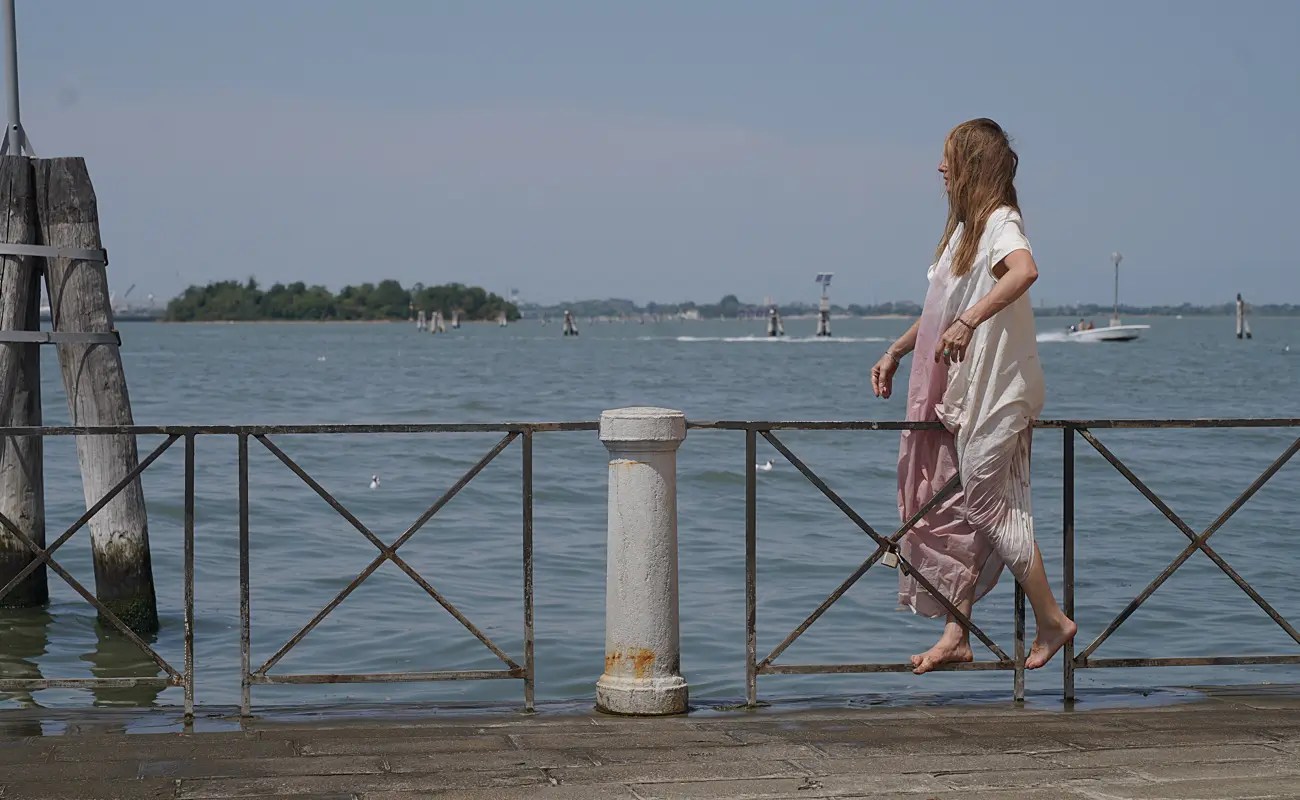
Nadja Haas, Venice Corpus Migrante: Performatica #2,
performance What the Water Remembers, Venice Biennale, 2026.
Photo: Istvan Kovacs.
Nadja Haas: Listening Before Form
Haas describes her work as interdisciplinary, process-based and relational. Fine art developed her sensitivity to image, material and spatial thought, while choreography brought time, presence and the body into the equation. Instead of choosing between those fields, she gradually understood that her work required their intersection. Sound, dance, sculpture, image and installation can therefore operate together, with meaning emerging through their contact rather than from a predetermined hierarchy. This attitude is concentrated in Listening Movement, a methodology Haas has developed through years of movement and choreographic practice. Built around attention, listening, somatic awareness and shared presence, it informs more than performance. Haas carries the same responsiveness into visual art, remaining attentive to what a material, site or situation offers before deciding what it should become. The process resists imposing a fixed result at the outset and instead makes receptivity part of artistic authorship. Her daily practice reflects that flexibility. A working day might begin with drawing or writing and shift into movement, sound or direct engagement with materials. She collects fragments, records sounds, photographs details and notices gestures, surfaces and places, sometimes holding onto these observations for long periods before they find an appropriate form. Rivers, wind, water, textiles and changing light recur as sources of information, while experiences across different cultural and geographical environments have sharpened her attention to movement, belonging and displacement.

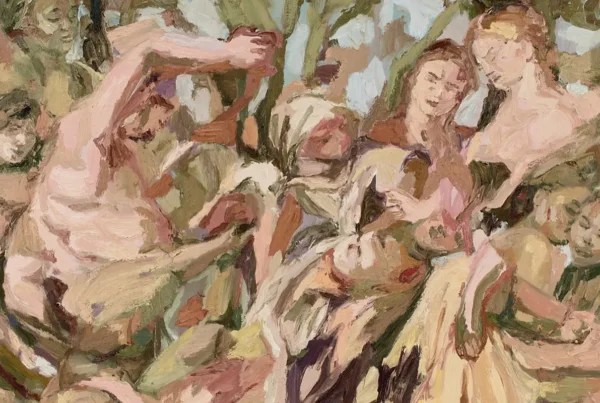
Drawing by Nadja Haas.
Water as Presence, Not Subject
The Blue, created with Abigail Sanders and Warya Ribanova and presented at Dock 11 in Berlin in 2025, brought several of Haas’s recurring concerns into close contact. Developed through movement, sound, image and spatial composition, the work began with water, fluidity and the relationship between the human body and ecological systems. Its significance lies in a shift that occurred during the process: water ceased to function simply as a theme and became an active presence within the work. That change generated questions Haas continues to carry forward. How might a landscape be listened to? What can water remember? How can a body respond to something defined by constant movement and transformation? Such questions connect ecological awareness to embodied experience without reducing either to illustration. They also show how her interest in memory extends beyond the individual body toward materials, environments and the traces that places may hold. Collaboration continues to widen this inquiry. With composer, sound artist and researcher Dr Felicity Wilcox, Haas is developing *Late Summertime Woman*, an interdisciplinary performance combining movement, music, sound and text. Their shared focus is the relationship between the female body, landscape, ecology and transformation, with the coastal landscapes and waters of Kerry, Ireland serving as an important point of departure. From a shared foundation of poetry and text, Wilcox creates the music and sound while Haas develops movement and choreography, allowing the two practices to shape one another in real time. The work is scheduled for DOCK 11 in Berlin on 4 December 2026.

Nadja Haas performing Migrant Body / Corpus Migrante at Performatica in Venice, 2026. Photo: Istvan Kovacs.
ResilientNatures collective In Projekte Florastr 90 and Photo: Lucas Haas
Nadja Haas: A Studio That Travels
Haas’s collaborative practice with Karim Teufel has developed into NKV, Nadja & Karim, an artistic duo working between movement, sound, visual art, material and landscape. Their next major undertaking, The Rivering: An Artistic Journey, is planned for 2027. Beginning on the Rhine in Oestrich-Winkel, the route will follow European waterways toward Sète on the Mediterranean before eventually returning to Berlin. At its center is Waterman, a historic Amsterdam tugboat built in 1912 and rebuilt with an additional cabin in 1952. For Haas, the uncertainty of what the journey will produce is fundamental. The river, boat, landscapes, encounters and passing time will enter the process rather than merely provide its setting. Waterman is understood not only as transportation but as a historical body carrying memory through its sounds, surfaces and traces. Water, meanwhile, becomes a connective element across locations and histories. Haas captures the project’s logic succinctly: the boat is the time body, and the water is the connecting line. The Rivering will operate simultaneously as a journey through Europe, a moving studio, an encounter with landscape and an experiment in allowing an artwork to travel. This outward movement also reflects Haas’s broader commitment to exchange. In 2026 she presented a performance in Venice during the second edition of PERFORMATICA, curated by Hector Canonge, an international context that connected her performance practice with movement, migration, place and artistic exchange. She also participated in Supersymmetry, the inaugural presentation of the Resilient Natures international art residency in Berlin, where her site-specific practice was framed through connections among body, place, memory and the living environment. Looking ahead, she hopes to build further international relationships, particularly in Japan, while NKV seeks funding partners, cultural institutions and collaborators to accompany The Rivering in 2027.