Heroes Drawn From the City
Hebru Brantley has built a contemporary practice around a familiar visual language: youthful figures rendered with the immediacy of cartoons, comics, and street imagery. Across paintings, sculptures, murals, installations, and narrative environments, those figures become vehicles for questions about Black identity, childhood, fear, aspiration, power, and representation. Flyboy, Lil Mama, and Phibby are not simply recurring characters. They belong to an expanding mythology in which popular culture and historical memory meet, allowing Brantley to reconsider who is permitted to occupy the role of hero. His work remains visually inviting while asking viewers to recognize the social and psychological weight carried by images that may initially appear playful.
Chicago provided the foundation for that vocabulary. Raised largely in Bronzeville, Brantley encountered the mural culture of neighborhoods stretching through the South Side, including works connected to AfriCOBRA. Their vivid colors, public presence, and engagement with Black identity offered an early lesson in how art could operate beyond museums and galleries. The route between home, school, and his grandmother’s house became an informal visual education. That influence later joined the graphic directness of graffiti, giving his work a connection to Chicago traditions in which public images could hold history, pride, politics, and collective memory at once.
Brantley began making graffiti while young, drawing constantly and participating in Chicago’s 1990s graffiti culture. Tagging offered a way to establish identity and circulate a personal mark, while comics, cartoons, science fiction, video games, graphic novels, cult films, and Japanese animation expanded his sense of narrative possibility. Charles Schulz and Peanuts showed him how simplified child characters could carry complex adult concerns. His references also include Robert Colescott, Andy Warhol, Kerry James Marshall, Jean-Michel Basquiat, and Romare Bearden. A BA in Film from Clark Atlanta University reinforced his interest in storytelling, while hand-painting clothing during college and working in design and media illustration developed skills outside a conventional fine-art education.

Hebru Brantley: Building a New Mythology
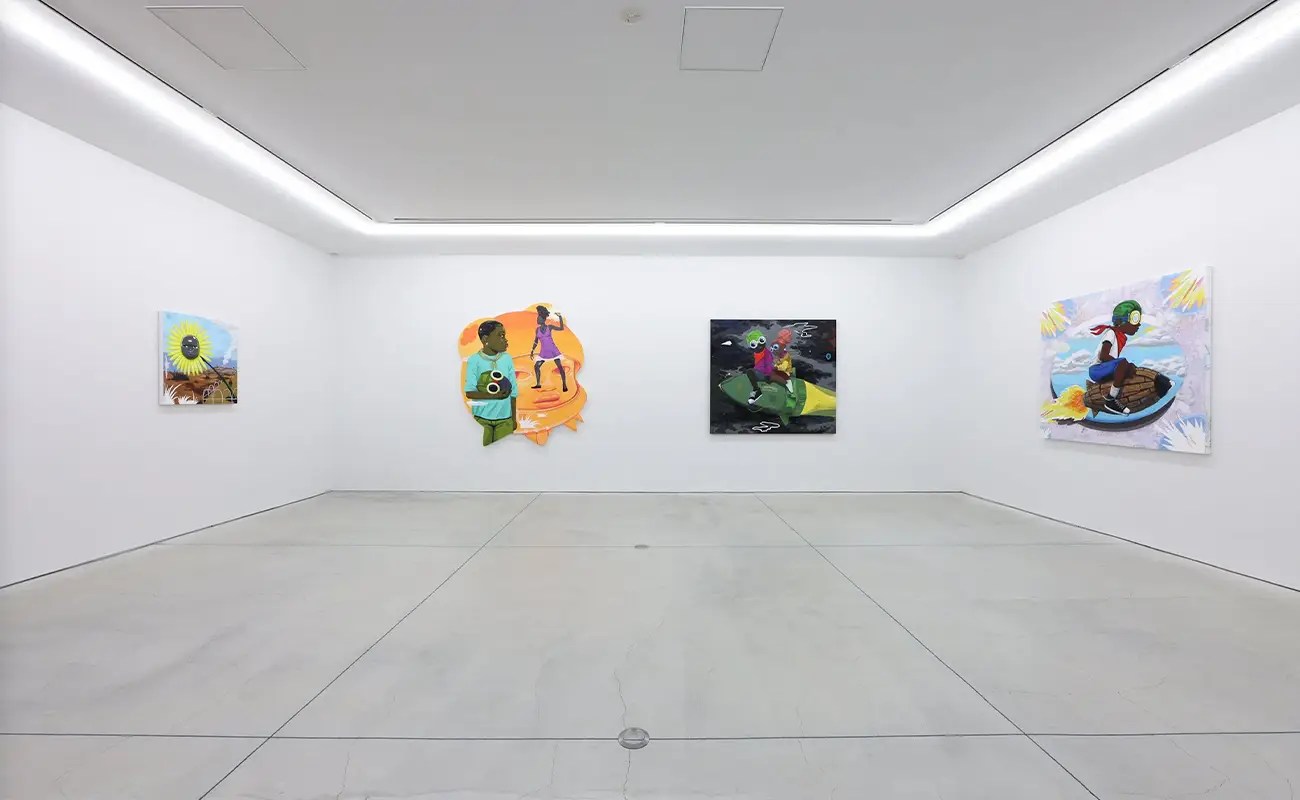
Flyboy emerged from Brantley’s dissatisfaction with the limited presence of people of color in the cartoons and comics he knew growing up. Rather than keep borrowing established figures such as Mickey Mouse or Batman, he wanted to create characters capable of occupying a similarly recognizable cultural space while carrying histories closer to his own experience. The Tuskegee Airmen became a key foundation for Flyboy, whose aviator helmet and goggles connect childhood fantasy with the legacy of Black military pilots who served during the Second World War. Within the Negro Mythos body of work, Brantley uses that connection to reposition Black children inside the language of American heroism.
The mythology extends through characters with distinct emotional and social roles. Lil Mama grew from the strong female presence surrounding Brantley during childhood, including the women in his extended family and the girls in his neighborhood. He has described wanting her to carry the confidence and strength he associated with young Black women around him. Phibby approaches identity from another angle. Encircled by a bright frog-like helmet, the character reflects Brantley’s awareness of entering spaces where he felt pressure to make others comfortable with his presence as a Black man. The helmet becomes comic, protective, and disarming at once, addressing accommodation, racial anxiety, perception, and self-presentation.
Brantley describes the territory inhabited by these figures as “dark fiction,” a phrase that reaches beyond atmosphere to include identity, geography, and lived experience. Childhood gives him a flexible lens for approaching adult tensions without giving up humor, imagination, or visual pleasure. Nostalgia remains present, but it is rarely innocent. Safety can sit beside danger, optimism beside disappointment, and vulnerability beside power. By placing Black children at the center of these narratives, Brantley challenges conventional superhero structures from within. The characters invite immediate connection while carrying histories of exclusion, private fears, communal memory, and imagined futures without becoming fixed symbols.

From Canvas to Immersive Worlds
The physical range of Brantley’s work supports that narrative flexibility. He has used oil, acrylic, watercolor, spray paint, pastel, collage, coffee, and tea, while sculpture has moved through vinyl, bronze, wood, brass, and marble. Recent paintings combine acrylic, oil pastel, spray paint, diamond dust, and canvas collage. Strong outlines and cartoon-derived forms often meet layered surfaces, saturated color, visible marks, and traces of street aesthetics. Brantley has said that he prefers to begin quickly when facing an empty canvas, disrupting blankness so that the surface can become active. He frequently develops several works at once, allowing separate moods or ideas to evolve before relationships between them become clear.
That working method has supported projects in which the same characters are redirected toward different emotional questions. Parade Day Rain at the Chicago Cultural Center combined painting, drawing, sculpture, murals, and a full-sized parade float to consider celebration, disappointment, optimism, and adversity. Saints & Shepherds at the Fort Wayne Museum of Art examined contemporary mythology and leadership, distinguishing established cultural guides from outsiders who become new leaders. Dark Fiction: Flowers & Frogs turned toward perceptions of the Black body through beauty, vulnerability, and survival. Rather than treating his recognizable figures as a fixed signature, Brantley changes their context to open new psychological, social, and cultural questions.
Nevermore Park made the scale of that ambition especially visible. Developed in Chicago around Flyboy and Lil Mama, the immersive installation transformed years of accumulated character histories, relationships, and imagined environments into a place visitors could enter. Fictional newspapers, advertisements, broadcasts, constructed spaces, interactive features, and gallery elements extended the characters beyond the wall and into a functioning narrative environment. The project drew together interests long present within Brantley’s paintings, including comics, animation, cinema, episodic storytelling, and world-building. Instead of asking viewers only to look at the protagonists, Nevermore Park positioned them inside the larger social atmosphere of the fictional universe.

Hebru Brantley: Expanding the Journey
Traveling Without Moving continued that expansion by linking cultural identity with emotional and spiritual development. Rockets and images of space travel introduced a new vocabulary of movement, but the project contrasted outward acceleration with the slower work of internal growth. Questions of origin, maturity, community, and direction became central. Flyboy, originally grounded in aviation and the history of the Tuskegee Airmen, could therefore travel beyond that initial symbolism. The character became a vehicle for thinking about journeys through physical space, historical memory, and personal transformation, showing how Brantley’s mythology can evolve without abandoning the visual signs that make it immediately recognizable.
The same adaptability explains why Brantley has moved comfortably between media. Public murals, monumental sculpture, intimate drawings, editions, objects, immersive installations, and moving-image projects through his company Angry Hero all serve a practice organized more by narrative than by material. His work has appeared at institutions including the Chicago Cultural Center, Elmhurst Art Museum, the August Wilson African American Cultural Center, and the Fort Wayne Museum of Art, with exhibitions extending through the United States, Europe, and Asia. He lives and works in Los Angeles and is represented by NANZUKA UNDERGROUND in Tokyo, yet Chicago remains a persistent source that continues to energize his work.
At the center of Brantley’s practice is the idea that changing the figure at the heart of a familiar story can alter the story itself. His characters use the visual codes of childhood to reorganize difficult subjects rather than avoid them. A child in aviator goggles can hold the memory of Chicago, the history of the Tuskegee Airmen, the absence of Black superheroes from formative media, and the possibility of a future not yet written. That collision of autobiography, public history, popular imagery, and invention gives Brantley’s work its reach. Representation becomes more than visibility. It becomes an act of authorship, with new heroes creating new narrative possibilities simply by taking their place at the center of the picture.