“Every brushstroke has been both a return and a tribute, honoring her memory and expressing my love for life, beauty, and meaning.”
Where Memory Becomes Movement
Maxine Xu‘s paintings begin with a discipline learned in childhood and continue through a life shaped by cultural movement, loss, and renewal. She began studying Chinese calligraphy at eight and brush painting at ten under the guidance of her grandmother, the artistic mentor she considers most important in her life. Those early lessons established control, rhythm, and flow as physical instincts, while introducing her to qi, the idea of life force. Today, Xu carries that foundation into contemporary paintings where ancient Chinese imagery, expressive brushwork, botanical forms, and abstraction meet.
Her path did not unfold continuously. Xu came to the United States in 1997, continued her education at Oklahoma City University, and received her master’s degree in 1999. Study and work pushed painting aside for years. The death of her grandmother nineteen years ago changed that course. Grief brought a renewed awareness of life’s fragility and awakened the need to create again. Painting became both a return to an early language and a way to honor the person who first placed that language in her hands.
That personal history gives tradition an active role in Xu’s work. She is interested in inherited forms not as fixed artifacts, but as material that can be rediscovered through contemporary experience. Living as a Chinese American artist has placed her in a position of looking at Chinese heritage from within it and across cultural distance. Her paintings consequently hold several tensions at once: inheritance and transformation, cultural memory and personal identity, delicacy and force, movement and stillness.

Maxine Xu: Ancient Jade, Contemporary Pulse
Han Dynasty jade is one of the central sources in Xu’s visual vocabulary. She studies carved imagery found on precious objects held by museums, private collections, and auctions, then transforms those references rather than reconstructing them literally. Archaic scripts, decorative patterns, clouds, flowers, fruits, and organic forms join the ancient motifs. Traditional Chinese pigments and brush techniques coexist with Western acrylics, allowing different material histories to occupy the same surface.
Eternal Love shows how a single historical object can become emotionally charged in Xu’s hands. The painting was inspired by a Han Dynasty jade pendant that sold for HK$1,386,000 in 2022. Xu interpreted the pendant through the idea of an enduring bond between soulmates. Its luminous, vortex-like composition brings energy, emotion, and sacred geometry together, turning an archaeological reference into a meditation on devotion beyond ordinary measures of time.
Geometry also carries meaning in Xu’s practice. Some paintings take a hexagonal form drawn from the geometry she associates with the heart chakra, where opposing forces meet in balance. She sees this structure as a field in which physical and spiritual experience can coexist in equilibrium. Circular and half-circular openings recur elsewhere as spaces of clarity and contemplation. Rather than functioning as blank areas, they create pauses within active compositions and express Xu’s belief that emptiness can hold potential, balance, and positive energy.

Stillness at the Center of Change
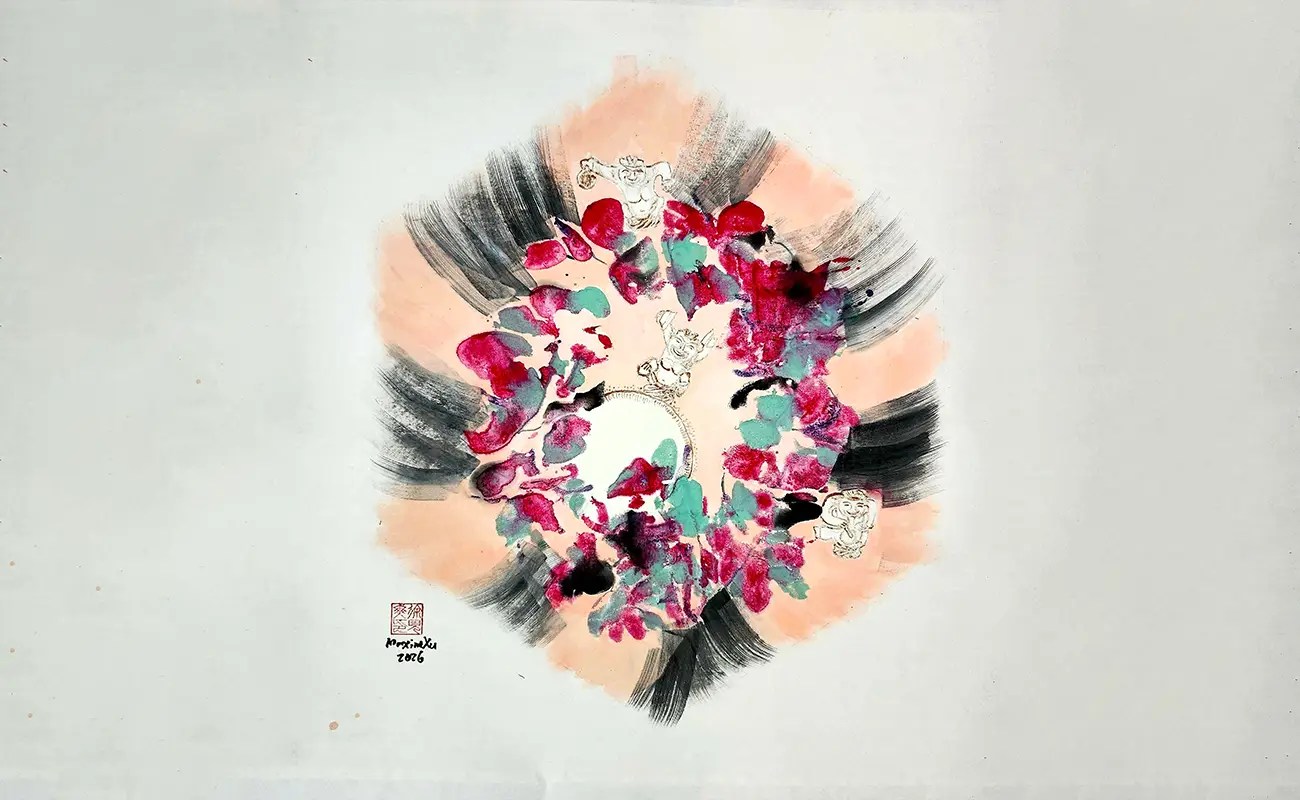
Stillness Within Motion, made after a June 2026 trip to Beijing, Xu’s hometown, brings many of these concerns into a single work. Painted with Chinese brush techniques and acrylics on Xuan paper, it combines layered floral forms in magenta, violet, crimson, and pale jade green with translucent leaves that seem to drift between emergence and disappearance. Strong black acrylic strokes radiate from the botanical center, adding directional force and tension. Softness and impact remain visibly distinct, yet neither overwhelms the other.
Within that movement, Xu introduces three figures derived from a roughly 2,200-year-old Han Dynasty jade cosmetic box with gold and silver inlay from a private collection. An inscription on the object states that Lord Zheng commissioned the auspicious box for his sister, Lady Wu. Xu incorporates a tortoise, a human-like dragon, and an archer as fine linear presences among the expressive forms. They appear as historical traces carried into a contemporary image, connecting mythology, inherited wisdom, and cultural memory to the painting’s organic energy.
Three empty half-circles interrupt the composition and provide its quieter counterweight. For Xu, they signify spaciousness, clarity, and inner balance rather than absence. The painting’s central idea emerges through that opposition: life can remain dynamic without surrendering an inner center. Its impact also moved beyond the visual field. Antonio Petro, founder and Chief Analyst of AETERNUM Art Sound in Spain, reinterpreted the artwork as music. Xu was the first artist to receive the certificate by AETERNUM Art-Sound.

Maxine Xu: A Brush Guided by Rhythm
Xu’s studio process remains closely tied to the habits established through calligraphy. She pays attention to line, rhythm, composition, movement, and the individual character of a brushstroke, while leaving space for experimentation to redirect a painting. Music is part of that working environment. She listens while painting and describes it as a way of entering a higher dimension, allowing sound to accompany the balance between deliberate control and spontaneity that has shaped her practice since childhood.
Her admiration for Wu Guanzhong offers another important reference point. Xu is drawn to the modern Chinese painter’s ability to combine Eastern and Western influences, including Chinese calligraphy and Western approaches associated with Fauvism and Impressionism. His paintings of architecture, plants, animals, people, landscapes, and waterscapes demonstrated a way for distinct traditions to meet without losing their identities. That example helped Xu develop a language in which Chinese visual heritage and materials associated with Western painting can interact directly.
Xu now wants to build a more ambitious body of work rather than focus on one isolated next project. Her aim is to give each painting enough time and freedom to reach greater technical quality, depth, and emotional resonance. She wants viewers to encounter images that reward close looking and create a sense of discovery. Ancient cultural memory will remain a source, but the goal is transformation: to carry something forward from the past while making a visual language increasingly personal to her experience in contemporary America.