Attention Before Appearance
Dominique Medici is a Seattle-based figurative painter whose practice is grounded in direct observation. Born in the United States in 1977 and trained in London, she works primarily in oil while maintaining a long engagement with drawing and egg tempera. The human figure and portrait remain central, but the defining concern is not simply likeness. Medici has described painting from life as a way of attending closely enough for habitual assumptions to fall away. Technique, in this view, is not an end in itself but a structure for sustained looking, concentration, and contact with what is physically present.
That approach has roots in an intensive early education. Drawn to art from childhood, Medici left a small town in upstate New York for London in the mid-1990s after learning about a traditional atelier devoted to drawing and painting. Portrait commissions and landscape sales helped finance later years of study. Her formal path also included St. Oswalds Studios, an apprenticeship at the Jeffery Courtney Atelier, the Waterperry House Fresco Project in Oxfordshire, and a period at the Julian Ashton Art School in Sydney. The resulting foundation centered on observation, craft, and historical painting methods rather than stylistic novelty.
Early exposure to Leonardo da Vinci and Michelangelo helped set that path in motion, while Medici has also named Fra Angelico and John Singer Sargent among the artists she returns to for devotion, subtlety, and technical command. She has spoken about the stillness found in Vermeer and the mysterious presence of Leonardo’s drawings, experiences that reinforce her belief that an image can exceed description. Within her own paintings, carefully judged proportions, controlled value structures, and restrained color relationships serve that search for presence, allowing observation to remain the central event.

Dominique Medici: A Classical Education Reconsidered
Medici’s career did not move in a straight line from atelier training to continuous studio production. After returning to New York, she spent several years working in construction, fine carpentry, interior design, and project management, while accepting occasional portrait commissions. She later described design as closely related to painting because it also depends on proportion, value, color, texture, and composition. In her early thirties she began attending the Art Students League of New York in the evenings. She subsequently studied with Max Ginsburg for roughly five years and eventually committed to working full time as an artist and teacher.
That second period of formation sharpened the practical side of her realism. Medici’s teaching method breaks painting into four broad stages: proportion, value, color, and edge. In a short portrait study, she may assign comparable time to each stage, building the image through large decisions before smaller ones. She also reduces a composition to three general value families and considers whether the light is warm or cool, which hues dominate, and how saturated the relationships are. The sequence keeps surface detail from overtaking structure and explains the economy visible in many painted studies, where a few shifts can establish a convincing head, posture, or field of light.
Her palette is similarly disciplined. Medici has worked with either a Zorn palette or a limited chromatic primary palette supplemented by black and white, preferring a small set of colors that makes relationships easier to judge. The same principle carries into her instruction, where reducing choices helps students understand color relationally rather than as a set of formulas. Skin is never treated as a fixed recipe because its appearance changes with illumination and surrounding color. The method returns the painter to comparison: warmer against cooler, lighter against darker, more saturated against less saturated. Realism becomes an active process of calibration rather than copying.

The Logic of Speed and Slowness
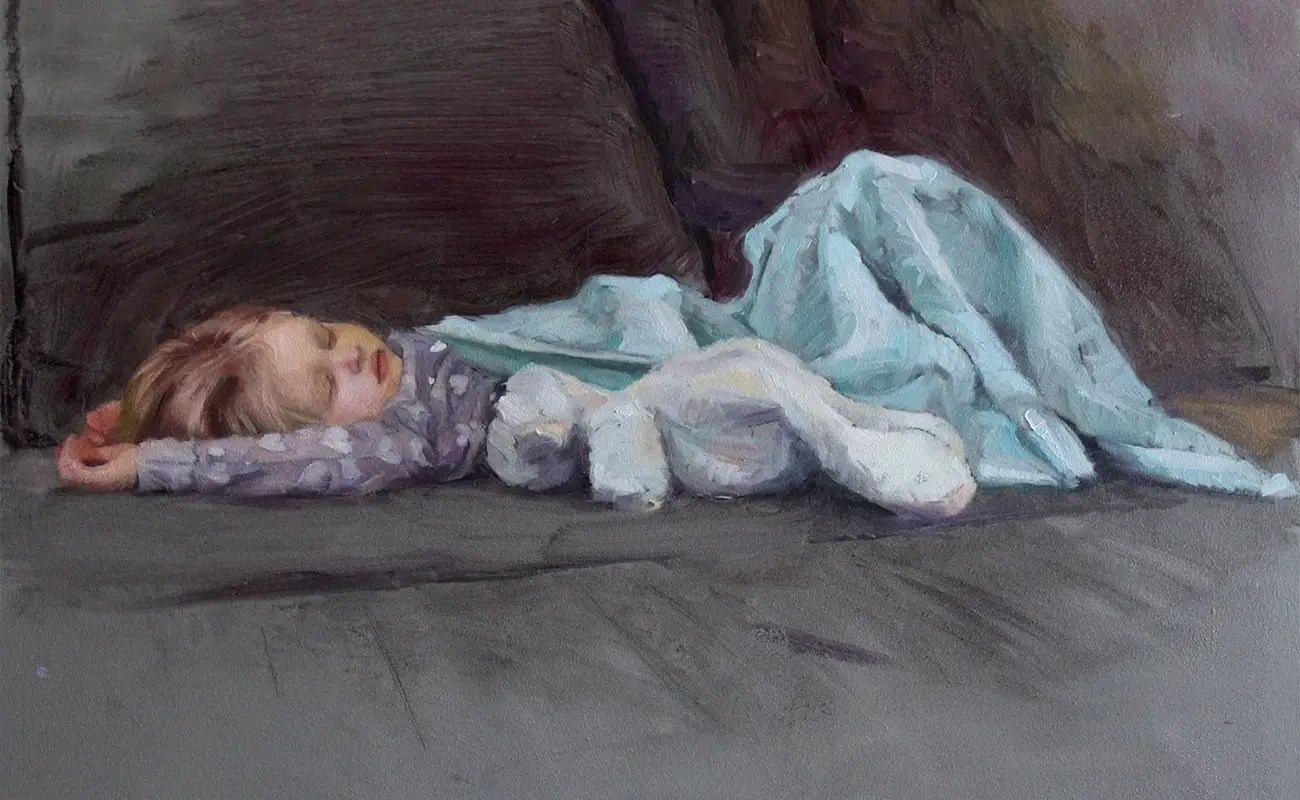
Oil and egg tempera give Medici two distinct working rhythms. She values alla prima oil painting for the tension between preparation and spontaneity. A limited session forces decisions about what matters most, and timed studies can run from very short exercises to several hours. The clock introduces pressure but also encourages clarity. Marks must carry information efficiently, and overworking becomes easier to recognize. Many portraits depend on that balance, combining descriptive accuracy with visible brushwork and passages that remain open rather than polished into uniform finish. The image retains a sense of being found through successive judgments.
Egg tempera offers the opposite tempo. Medici has described it as slow, linear, systematic, and built through numerous thin layers. She has also emphasized the artisanal procedures surrounding the medium, including preparing traditional gesso panels and grinding pigments by hand. Where oil can reward a quick, responsive stroke, tempera asks for accumulation and patience. Her gallery works include portraits and landscapes made in egg tempera on gesso, showing that the medium is part of a broader commitment to process. Moving between these materials allows her to work through two different kinds of attention, one compressed by time and another extended through repetition.
The subject matter expands beyond conventional commissioned portraiture. Medici’s selected works include portraits of poet and philosopher David Whyte and physician and author Gabor Maté, alongside works such as Vessel and Hearth and a continuing body of portrait studies. In Seattle, the 2023 exhibition Embodied paired Medici with Juliette Aristides and included paintings connected to Holi, the Hindu festival associated with color, love, and spring. Medici framed celebration and ritual as ways of recalling life cycles, value, beauty, and transience. That body of work placed the figure within a wider concern: how an image can register lived presence rather than merely reproduce outward appearance.

Dominique Medici: Painting as a Shared Practice
Meditation has accompanied Medici’s painting since adolescence. She learned the practice at sixteen and has described both painting and teaching as outward forms of meditation, activities that ask for full attention to the task and to the person in front of her. This connection is explicit in her artist statement, where painting from life is presented as a form of listening. The aim is to set aside expectation long enough for the observed subject to be encountered freshly. That idea helps explain why her technical system is so ordered. Structure creates conditions for attention rather than competing with it.
Teaching occupies an equally important place in that framework. Medici has taught extensively in person and online and is a current instructor at the Art Students League of New York. Her classes emphasize classical technique, observation, and the expressive uses of light, color, and form. She has described painting and teaching as complementary inward and outward movements: one offers solitude and concentration, the other turns accumulated knowledge into exchange. The connection is practical as well as philosophical. Demonstration keeps drawing and painting active, while explaining proportion, value, color, and edge requires intuitive decisions to become legible to other people.
Recognition from the Portrait Society of America, Oil Painters of America, the Art Renewal Center, and the Catharine Lorillard Wolfe Art Club situates Medici within contemporary figurative and realist practice. Her work has been exhibited in the United States and abroad, from early appearances with the Royal Society of Portrait Painters and Christie’s Young Artist Exhibition to later exhibitions in New York and Seattle. The durable thread, however, is the return to observation, whether through a quick oil study, a layered tempera panel, a portrait commission, or a classroom demonstration. For Medici, the discipline of seeing and the practice of attention remain inseparable.