What an Image Can Keep
Guim Tió has built a painting practice around a deceptively simple question: what can an image retain when memory itself refuses to stay fixed? Born in Barcelona in 1987, the Spanish artist first gained attention for psychologically charged interventions into fashion imagery before turning toward landscapes, distant figures, sleep, travel, and recollection. Across these shifts, painting remains his central medium, a place where identity can be erased, enlarged, displaced, or reduced to a trace. His scenes occupy a threshold between recognition and uncertainty, allowing remembered experience to surface without becoming literal description.
That sensitivity to images began close to home. Tió describes himself as the grandson of painters, while his father was deeply involved with photography and photographic chemistry. His mother, Esther Zarraluki, is a poet, and his uncle is the writer Pedro Zarraluki. The family library brought photography, literature, and art into everyday life, while the smell of turpentine became an early sensory marker. He later studied Fine Arts at the University of Barcelona, completing his degree in 2012, and continues to live and work in the city.
Literature still shapes the way Tió organizes thought. He reads around subjects that recur in his work, including memory, forgetting, myth, and perception, and treats books as visual resources as well as intellectual ones. When searching for references, he favors the intentional sequencing of a printed volume over the randomness of online imagery. That preference mirrors his paintings, where selection and omission matter equally. Images are not neutral containers of information for Tió. They are unstable structures through which experience is edited, carried forward, and sometimes lost.

Guim Tió: From Manufactured Faces to Unstable Memory
Tió’s early portraits emerged from the visual machinery of fashion magazines. In Magazine and related works, he intervened directly on printed photographs of models with pastel and paint, distorting eyes, noses, mouths, proportions, and expressions. The polished ideal promoted by advertising became comic, awkward, vulnerable, or disturbing. Rather than simply attacking conventional beauty, he used appropriation to interrupt an image designed for consumption and create a new character from its surface. The familiar face remained visible enough to register, yet its original authority had been broken.
By 2016, the logic of alteration had moved beyond appearance toward the mechanics of remembrance. Now Remember combined family photographs, found images, old material, and film to examine collective memory, forgetting, rewritten history, and the stories attached to stored pictures. Tió erased faces from found footage and worked with his father’s photographic archive. Appropriation remained important, but the purpose had changed. The missing or displaced information was no longer only a challenge to representation; absence itself became a way of asking how images survive after their context or identities have weakened.
This development established memory as both subject and method. Tió does not approach recollection as a dependable record. A photograph may preserve evidence while failing to preserve the experience surrounding it, just as a remembered event can change each time it returns. Erasure therefore carries emotional weight without requiring a complete narrative. His practice accepts that an incomplete image can remain powerful, perhaps because the missing information creates room for projection. The certainty once associated with a face gives way to a more ambiguous space where personal and collective histories can overlap.

Landscapes Built from Distance
Unreal Spaces, presented in 2017, marked a decisive expansion from the face into the surrounding world. Portraiture did not vanish, but figures grew smaller as mountains, fields, lakes, beaches, snow, cliffs, and horizons began to dominate. These environments are intentionally decontextualized rather than topographical. A scene might suggest the Empordà or an Icelandic spring without resolving into either. Tió constructs landscape as a composite of sensation and recollection, giving viewers enough visual information to recognize a place while withholding the coordinates that would fix it.
Some recurring forms carry specific autobiographical associations. Mountains connect to childhood hikes in the Catalan Prelitoral range and Montserrat, as well as summers around mountain refuges. Travel later expanded this store of visual memory, including the desert around Ciudad Juárez. Yet those references are not transferred intact onto canvas. Broad fields of muted or modulated color meet simplified ridges, slopes, shorelines, and skies, while a person may appear only as a contour, a small patch of color, or a figure seen from behind. Scale makes human presence both fragile and unusually charged.
Several bodies of work use that visual economy to preserve moments that might otherwise pass unnoticed. Vuit Sis Quatre Zero Zero organized ten small paintings around ten apparently monotonous instants within a day. Roots returned to journeys, leisure, memory, and the sensation of being physically small within expansive surroundings. Ja no hi és el xiprer drew from childhood journeys observed through a window, where passing scenery became a surface for projection. Solitude runs through these works without automatically becoming isolation. Pairs, families, swimmers, readers, sleepers, walkers, and small groups inhabit spaces where emptiness gives ordinary gestures greater weight.

Guim Tió: Painting Between Sleep, Myth, and Recollection
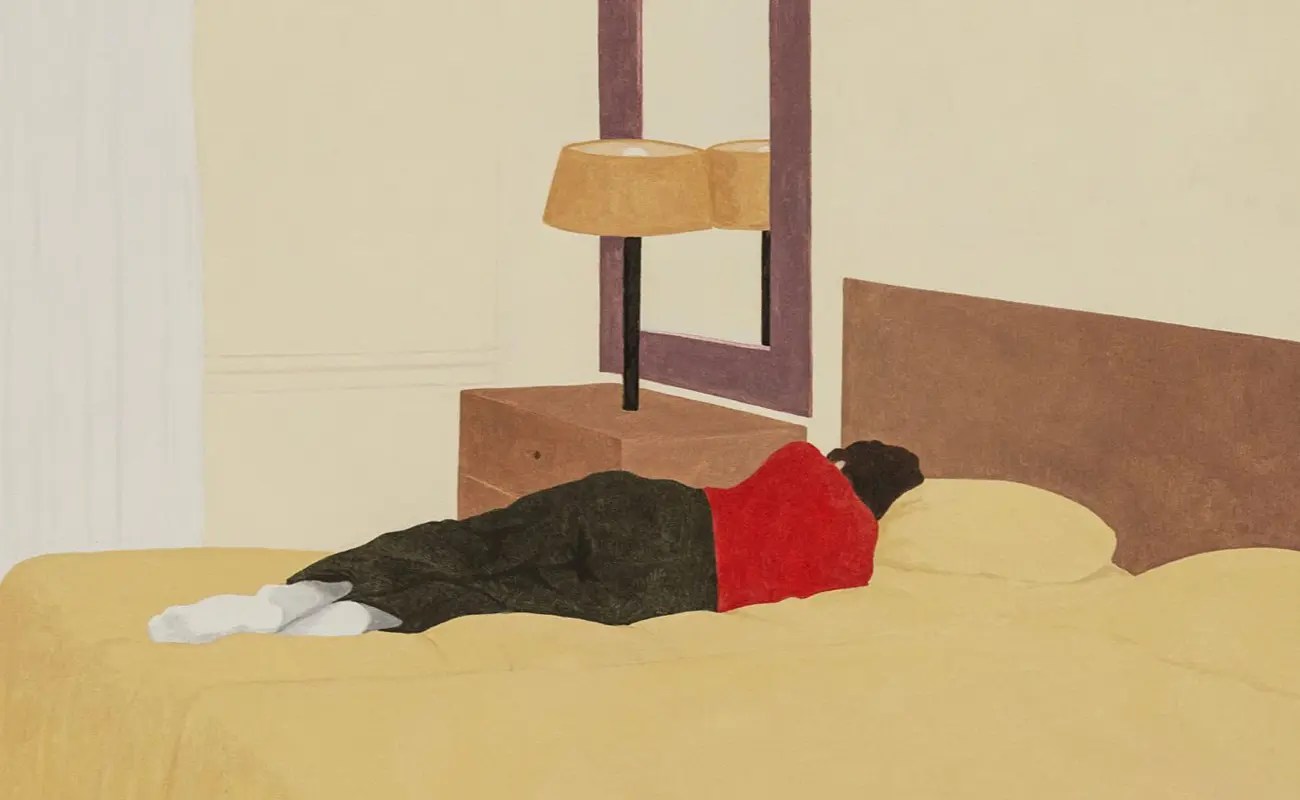
The instability of perception becomes especially clear in Despertares, where sleeping figures occupy the uncertain passage between dream and wakefulness. Familiar experience loosens from ordinary logic, making imagination difficult to separate from memory. Other projects approach recollection through literature. Este sol de la infancia takes its title from words associated with Antonio Machado, bringing childhood, warmth, distance, and longing into proximity. Pillow Paintings developed in dialogue with Sei Shōnagon’s The Pillow Book, whose lists and observations of daily life offered a structure for considering fragments that acquire private significance.
Myth provides another conceptual frame. Tió’s reading includes Greek narratives of passage, danger, and transformation, including Butes, the sailor who answers the Sirens by leaping into the sea. Such references do not make the paintings illustrations. They help him think through actions that already recur visually: sleeping, diving, wandering, remembering, and looking. The physical act of painting remains equally important. He works primarily in oil on linen or canvas, while other projects have incorporated colored pencil, watercolor over old photographs and postcards, altered photography, found images, and video. Turpentine, linseed oil, studio solitude, and repeated contact with paint form a ritual he still finds difficult to replace.
Tió’s practice has reached exhibitions and presentations across Europe, Asia, North America, and Australia, including the Marrakech Biennale and the More Museum in the Netherlands, alongside solo presentations in Barcelona, Madrid, Paris, New York, Seoul, Taipei, and Los Angeles. He was a finalist for the Fundació Vila Casas Painting Prize in 2022, and his work entered the art collection of the Faculty of Fine Arts at the University of Barcelona. He also co-founded Noom Books with Raimon Guirado and later became involved with Barcelona publisher Banana Books. Through every stage, the central tension persists: an image can hold a trace without securing its meaning, leaving experience suspended between what was seen and what can still be remembered.