“I like putting those things together and seeing what kind of visual language emerges.”
Where Logic Learns to Play
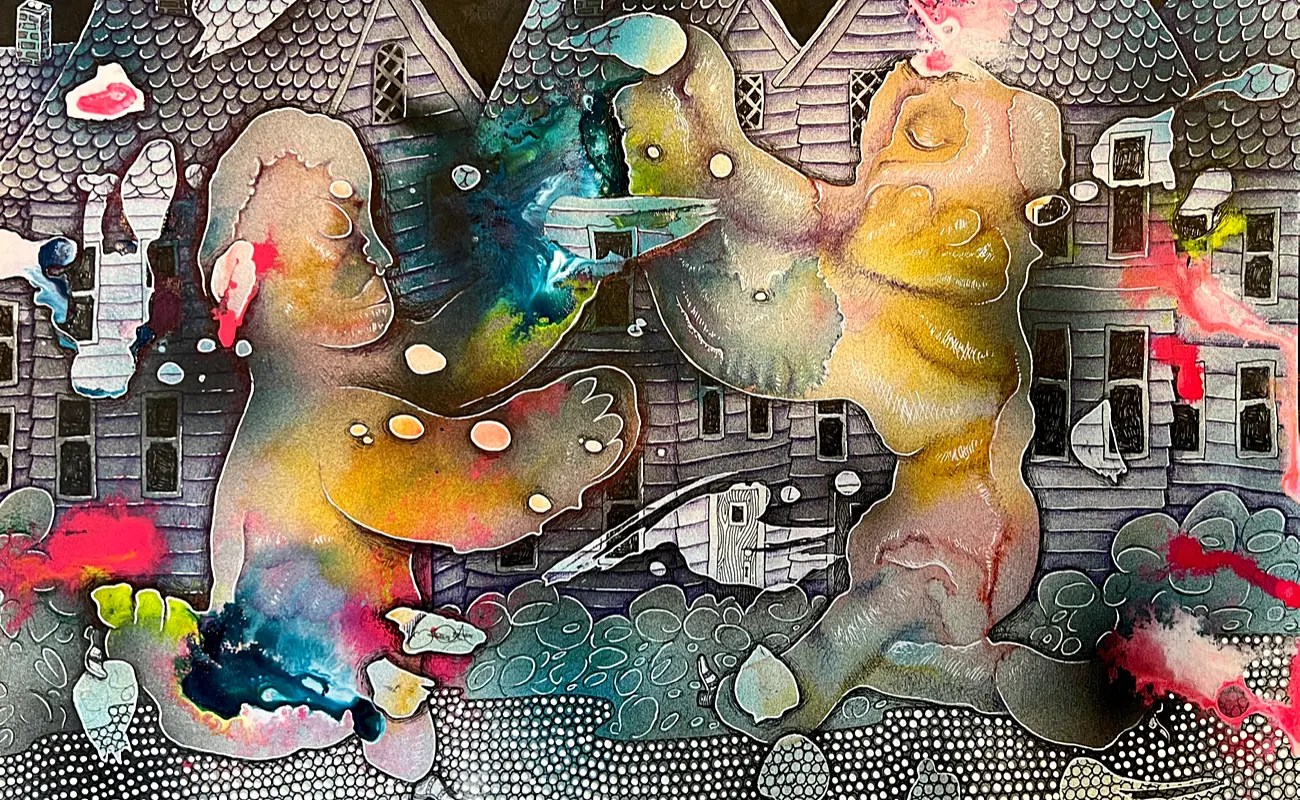
Bijijoo makes art at a point where scientific structure, personal symbolism, and unruly imagination meet. Working across painting, drawing, animation, music, sculpture, and performance, he has developed a practice shaped by seemingly opposing modes of thought. His visual language can appear playful or whimsical on first encounter, yet beneath that surface sit questions of mortality, memory, transformation, identity, and the instability of experience. Strange figures, geometric structures, biological suggestions, and symbolic objects inhabit compositions that seem familiar without fully belonging to any known world.
That balance has deep roots in his background. Bijijoo began making art as a child and started studying oil painting at around nine, later exploring abstract, figurative, conceptual, and performance practices. At the same time, science became another major part of his life. He earned a Ph.D. in biophysics and worked both as a research scientist and a patent agent, experiences that immersed him in mathematics, technology, problem solving, and the construction of ideas. During roughly the past decade, however, art and music have taken an increasingly central position in his life.
Rather than treating his technical education and creative work as competing histories, Bijijoo now sees them as intertwined. Mathematics and science trained his attention on patterns, systems, structures, and relationships. Art allows him to approach related questions through intuition, emotion, and experimentation. His practice repeatedly moves between these impulses: analytical and instinctive, organized and improvisational, rational and imaginative. The friction between them does not need to be resolved. It provides the conditions from which the work develops.

Bijijoo: Rediscovering the Freedom to Invent
A decisive shift occurred around ten years ago, when the birth of Bijijoo’s daughter prompted what he describes as a reset in his practice. Watching her draw, make things, and encounter the world returned his attention to something that formal knowledge can easily complicate: the direct pleasure of creation. Children do not necessarily begin by asking whether an image is technically correct or legible to an audience. Curiosity itself is enough reason to see what happens.
That observation gave Bijijoo permission to loosen his own process. Instead of requiring an idea to have a predetermined destination, he became more willing to experiment, play, and follow unexpected developments. His daughter remains his strongest influence, not simply because of the imagery surrounding her, which includes Pokémon, anime, manga, and her own drawings, but because of how freely children combine sources. A fragment from a cartoon can coexist with nature, a video game, and a completely invented form without requiring justification.
Bijijoo brings that freedom into conversation with a much broader set of references. Mathematics and science sit alongside anatomy, biological forms, architecture, ancient objects, sculpture, patterns, and systems of symbolism. He is particularly interested in humanity’s persistent attempts to give visible form to elusive subjects such as life, death, spirituality, energy, memory, and transformation. An equation might collide with one of his daughter’s drawings; an ancient sculpture might trigger thoughts about biological structure. These unlikely encounters help him construct images that resist a single visual genealogy while retaining an uncanny sense of recognition.

Turning Equations into Symbols
Recent paintings Fourier Transform and Platonic Solids mark an important development in that search. Bijijoo considers them especially meaningful because they point toward a new direction rather than repeating an established vocabulary. Before beginning such paintings, he has been spending more time brainstorming and sketching, consciously testing how new visual languages might be built. Mathematical and scientific concepts enter these works alongside symbolic imagery and forms that resemble sculptures or totems, allowing intellectual references to acquire an almost mythological presence.
Both works employ mixed media on canvas, including oil, acrylic, and ink. Bijijoo approaches their individual components almost as though he were assembling physical objects. Figures, spheres, patterns, geometric forms, architectural structures, and symbols retain distinct associations, but their placement changes how they operate. Once stacked, juxtaposed, or gathered into a composition, they begin to imply narratives that are never completely explained. This ambiguity is central to his interest in images that initially invite viewers through humor or strangeness before revealing something more visceral and unsettling.
The titles carry personal weight because mathematics belongs to Bijijoo’s own history. A Fourier transform offers a way to understand something through its underlying frequencies or components, while Platonic solids embody fundamental geometric structures. Yet neither painting is intended as a diagram or an illustration of mathematical knowledge. Bijijoo is more interested in what occurs when such concepts migrate into symbolic territory. Through that transformation, mathematics becomes part of an investigation into impermanence, life essence, vanitas, and energy. The paintings ask how people give physical presence to what continually escapes possession: time, identity, memory, and life itself.

Bijijoo: From Painted Worlds to Living Encounters
Structure still matters in the studio, although Bijijoo uses it to protect experimentation rather than restrict it. He maintains an ongoing list of projects and ideas, then organizes his days around different forms of making. Painting may give way to drawing, writing, animation, or music, depending on what a project requires. He has little interest in committing himself permanently to one medium. Increasingly, the movement between disciplines has become part of the work itself, with an idea beginning in one format and resurfacing elsewhere in an altered form.
That cross-pollination is currently becoming more deliberate. Alongside smaller paintings for an upcoming show, Bijijoo is devoting more time to music and searching for ways to connect his sonic and visual practices. The aim is not simply to maintain several creative outlets in parallel. He wants one discipline to affect another, allowing characters, objects, sounds, and images to move across formats. Such an approach extends the same logic already visible within his paintings, where independent elements gather into larger systems of association.
His band, ASSMYSTICS, offers one concrete path forward. Bijijoo has been sculpting large masks for its members to wear during performances, transferring the strange characters and objects of his paintings into physical space. What existed on canvas can therefore acquire scale, movement, sound, and a relationship to live bodies. He wants to push these connections further by combining painting, sculpture, animation, music, and performance into worlds that operate across media. The direction expands a long-running concern within his practice: not merely representing an imagined place, but finding ways for its symbols, structures, and energies to become something an audience can experience.