“I love peace; I love the green of this planet.”
Between the Quiet Landscape and the Moving City
Nguyen Thanh’s paintings emerge from a life shaped by two contrasting environments: the natural surroundings of Quang Binh and the restless urban energy of Ho Chi Minh City. Born on April 20, 1976, in Quang Binh, Vietnam, the contemporary artist developed his earliest understanding of beauty through the landscape around him. Nature introduced him to subtle rhythms, changing colors, stillness, and atmosphere, qualities that would remain important long after his subjects expanded beyond the natural world. He began painting in 1999 and committed himself to working professionally as a full-time artist in 2000, establishing a practice that has continued for more than twenty-five years. His formal education in Fine Arts at Khanh Hoa College of Education provided another foundation for this sustained career. Yet his artistic identity has never depended on a single subject or visual formula. Instead, observation and lived experience have continually redirected his attention, allowing painting to become a record of how his relationship with the visible world and his own inner life has changed over time.
Moving to Ho Chi Minh City introduced Nguyen Thanh to an entirely different visual environment. The quiet atmosphere associated with his hometown was joined by architecture, crowds, movement, reflections, and the shifting illumination of an active metropolis. Rather than treating nature and urban life as opposing subjects, he absorbed both into an expanding visual vocabulary. Everyday experiences became sources from which paintings could develop, whether the initial impulse came from a recognizable scene, an encounter with people, a memory, or something less tangible. This responsiveness explains why his body of work includes numerous series rather than one unchanging style. Different subjects have called for different forms of expression, brushwork, and visual organization. Some paintings remain closely connected to nature or city life, while others move toward abstraction and concentrate more strongly on atmosphere, memory, emotion, and illumination. What links these approaches is not a fixed appearance but a continuing sensitivity to experience and to the emotional resonance that can remain after a particular place or moment has passed.
With maturity, Nguyen Thanh’s attention has increasingly shifted from what can be directly observed toward what an experience leaves behind. A landscape, city scene, or gathering of people may offer the initial visual stimulus, but the deeper question concerns the feelings carried within it. Hope, loneliness, serenity, memory, and connection can exist beneath the surface of an ordinary moment, and these less visible qualities have become increasingly central to his paintings. Light is especially significant because it allows him to connect physical perception with emotional and spiritual ideas without separating the two. His practice therefore moves between external observation and internal response, using familiar experiences as openings into questions about how people remember, feel, and connect. This evolution also reflects his conviction that an artist does not need to remain confined to a single recognizable manner. Change, in his view, belongs to the process of learning and responding to life. Painting becomes not a fixed destination but an ongoing means of registering changes in society, surroundings, perception, and personal experience.

Nguyen Thanh: Building Emotion Through Oil, Texture, and Time
Oil on canvas is the exclusive medium of Nguyen Thanh’s practice, but within that deliberate limitation he has developed considerable freedom. Brushes and palette knives play distinct yet complementary roles in constructing his surfaces. Rather than completing an image through a single sequence of gestures, he gradually builds layers of paint, allowing color, texture, movement, and earlier marks to participate in the finished work. This method gives the surface a physical history. Previous decisions are not necessarily erased when the painting changes direction; traces can remain embedded beneath or among subsequent applications of oil. The palette knife creates a particularly immediate relationship between his hand, the paint, and the canvas, while brushes provide another range of movement and control. These tools allow him to negotiate between structure and spontaneity, physical substance and atmospheric suggestion. His technique has developed through decades of sustained observation and experimentation, yet he continues to approach painting as an open process rather than a system that guarantees a predetermined result. Technical experience supports discovery instead of replacing it.
A painting may begin with something Nguyen Thanh has seen, something he remembers, or simply an emotional impression that persists after an experience. At other times, the starting point can be an idea about light rather than a clearly defined image. He does not require himself to know precisely how the completed canvas will appear before beginning. Instead, the composition takes shape through repeated engagement with the surface. Layers accumulate, brushes give way to palette knives and return again, and the work may be revisited numerous times while he considers the relationship among texture, structure, color, and feeling. Completion arrives when those elements reach a balance that corresponds to what he is seeking emotionally. Such a process helps explain the variety across his different bodies of work. Each series can establish its own visual language because the method allows the subject and emotional impulse to influence the painting’s development. Consistency is found less in repeated imagery than in his sustained attention to atmosphere and the expressive possibilities of layered oil paint.
Color carries symbolic and emotional associations within this evolving approach. Green holds particular importance for Nguyen Thanh because he connects it with the Earth, living systems, renewal, and harmony. Its significance reaches back toward his formative relationship with nature while also supporting his broader wish for painting to communicate serenity. Light functions with similar continuity across otherwise different series. It can describe a visible condition, but it can also suggest hope, human spirit, and movement toward a more positive future. His statement, “I love peace; I love the green of this planet,” brings these concerns together in direct language. Peace, environmental awareness, renewal, and illumination are not presented as separate concepts but as interconnected aspects of the outlook that sustains his work. Nguyen Thanh hopes viewers can temporarily move away from the noise of everyday existence when encountering his paintings. The canvas becomes an invitation to reconnect with personal memories and emotions, creating space for stillness without dictating exactly what a viewer should feel or remember.

Gathering Light and the Presence of What Cannot Be Seen
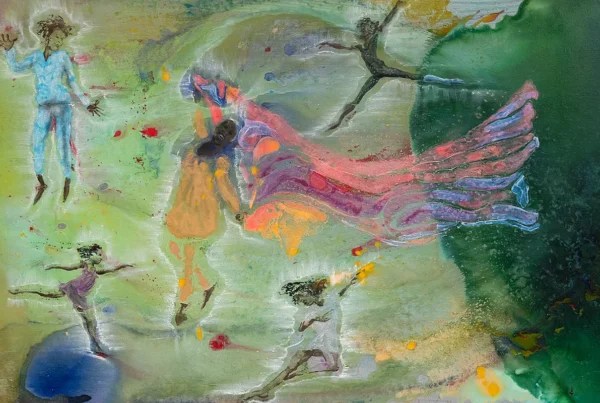
Among Nguyen Thanh’s works, Gathering Light carries particular significance because it concentrates several concerns that have become increasingly important in his recent practice. Painted in oil on canvas, the work focuses on illumination, atmosphere, and human presence without attempting to document one identifiable location. His interest lies instead in the sensation of people coming together. Movement within the painted marks suggests collective energy, while a brighter central area creates warmth and draws attention toward a shared point of visual intensity. This approach allows the painting to occupy a space between observation and emotional interpretation. Human presence can be sensed without the work becoming a literal account of a specific event or place. The title reinforces that ambiguity: light can be understood as something visually gathered within the composition, but it also carries associations that extend beyond physical brightness. Through this combination of movement and concentrated illumination, Gathering Light demonstrates how Nguyen Thanh transforms an ordinary human idea, people assembling together, into an exploration of warmth, connection, and hope.
The painting’s construction is equally important to its meaning. Nguyen Thanh developed Gathering Light gradually through multiple layers of oil, alternating between brush and palette knife. The slow accumulation of material mirrors his broader creative method, in which a canvas evolves through repeated decisions rather than following an entirely fixed plan. Texture gives movement a physical presence, while successive applications of paint allow the illuminated center and surrounding marks to interact with greater complexity. The technique is not merely decorative. Layering enables earlier gestures to remain part of the work’s history, just as memories and emotions can persist beneath later experiences. In Gathering Light, this physical buildup supports the impression that energy is forming rather than simply being represented. The luminous area at the center consequently operates on more than one level. It organizes the composition visually while also embodying the emotional ideas that prompted the work. Physical light becomes a vehicle through which Nguyen Thanh can address closeness, optimism, and the warmth generated by human connection.
This expanded understanding of illumination reaches across Nguyen Thanh’s wider practice. His earlier experiences taught him to notice the atmosphere of nature and, later, the changing reflections and visual rhythms of the city. With time, however, light became more than an observed phenomenon. It offered a way to consider inner experience and the emotional residue carried by ordinary encounters. A simple scene might contain peace for one person, loneliness for another, or evoke a memory that cannot be fully explained through recognizable imagery alone. Nguyen Thanh’s increasingly abstract concerns allow such possibilities to remain open. Rather than abandoning the world he sees, he uses painting to consider dimensions of experience that visibility alone cannot contain. Gathering Light is especially meaningful within this development because its subject brings together human presence and illumination without narrowing either into a single interpretation. Warmth exists alongside movement, and hope is communicated through visual relationships rather than through a literal narrative. The work therefore reflects his continuing effort to make painting responsive to both external life and internal feeling.

Nguyen Thanh: An Evolving Practice Beyond a Single Style
Nguyen Thanh’s professional history reflects the same commitment to continued development that characterizes his studio practice. Alongside more than twenty-five years of painting, he has presented work through exhibitions and international art events while maintaining his base in Ho Chi Minh City. His professional activities include solo exhibitions in the city in 2005, 2006, and 2008, followed by participation in a group exhibition in 2017. His work later appeared at the Affordable Art Fair London in both 2022 and 2023. International presentations continued with Red Dot Miami 2025, where Nguyen Thanh Gallery participated within the Spotlight program, and the Hamptons Fine Art Fair 2026. At the latter event, he was featured in the themed booth titled “A World of Peace and Serenity from Vietnam,” language closely aligned with the values that recur throughout his paintings. His career has also received coverage from VnExpress in Vietnam and Art Business News in Miami, while professional relationships have extended to galleries in France and the United Kingdom.
His role within the art world also includes founding Nguyen Thanh Gallery in Ho Chi Minh City. Through the gallery, he has developed long-standing relationships with collectors both in Vietnam and internationally, with particularly strong connections to collectors in the United States. This professional dimension exists alongside a studio practice that remains intentionally open to change. Nguyen Thanh has created numerous series, some of which have been developed privately and have not yet been shown publicly. The existence of these unseen bodies of work reinforces his view that artistic development need not be measured only by public presentation. Experimentation can continue away from exhibitions while new subjects, methods, and visual approaches take shape. He regards stylistic change as a natural consequence of observing life and responding to shifts in society rather than as a departure from artistic identity. Each body of work can therefore possess its own character while remaining connected to the experiences, values, and recurring concerns that have shaped his career.
Today, Nguyen Thanh continues to live and work in Ho Chi Minh City, carrying forward a practice that began in 1999 without treating longevity as a reason to stop experimenting. More than twenty-six years of painting have strengthened his technical knowledge, yet his current interests remain focused on questions that resist simple resolution. He continues to investigate how light might communicate inner life, how a painted surface can hold memory and emotion, and how visual experience can suggest hope or connection between people. Nature, urban movement, architecture, human presence, and personal recollection remain available sources, but their importance increasingly lies in what they can reveal beyond their immediate appearance. His ongoing work is guided by observation, learning, and responsiveness to change, with new paintings understood as part of a continuing journey rather than evidence of a completed destination. Across varied series and shifting visual approaches, his commitment remains centered on painting’s capacity to communicate feeling and offer viewers a space for reflection, peace, and serenity.