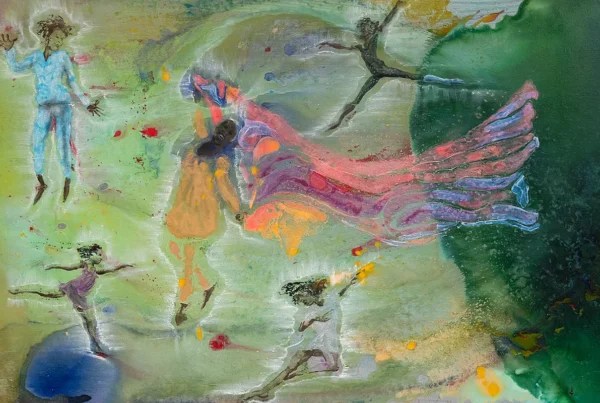
“Photography functions less as a fixed record than as raw visual material, allowing Lecoq to construct images whose identity depends precisely on remaining between mediums.”
Photography Beyond the Recorded Image
Remi Lecoq approaches photography not as a final record but as the beginning of a transformation. Working under the name Souffle Numérique, the Normandy-based photographer and digital creator combines photographic source material with digital painting to construct images that move between observation and abstraction. Texture, light, shadow, movement, and transparency become active components rather than descriptive details. His photographs retain a connection to the visible world while gradually shedding its literal appearance, opening a quieter visual space where emotion takes precedence over representation.
That hybrid language has roots in Lecoq’s early encounters with art. His elder brother, Jean-Jacques Lecoq, an engraver and draughtsman who studied at the École des Beaux-Arts de Caen, introduced him to painting and sculpture at a young age. Lecoq credits those experiences with developing his intuitive understanding of perspective and volume. Photography later added another discipline. Working with analogue processes encouraged rigor and deliberation, while digital tools eventually provided the precision and flexibility required to push photographs beyond their original form. These influences coexist in his current practice rather than belonging to separate stages of his development.
The camera consequently serves as a point of contact with a subject, not an endpoint. Lecoq photographs a place, object, structure, or atmosphere before entering a second process in which surfaces, contrasts, colors, and material qualities can be reorganized. Natural palettes may become softer or more forceful, while areas of graphic black introduce weight and tension. The underlying scene can remain perceptible without determining how the finished work should be understood. Through this method, Lecoq seeks the essence of what he encounters rather than a faithful reproduction of its outward appearance.

Remi Lecoq: Three Ways of Seeing
Lecoq has structured his work around three collections, Souffle, Lumen, and Aura, each addressing a different visual concern. Souffle focuses on matter and movement, allowing motion to appear as a trace, line, or imprint. Forms seem caught in transition, their instability becoming part of the image. Lumen turns toward light and transparency, using illumination and contrast to produce restrained atmospheres. Aura enters darker territory, giving shadow, mystery, and introspection a more prominent role. Together, the collections establish three related approaches to transforming photographic material.
Their differences continue into the physical presentation of the images. Works from Souffle are printed on canvas and placed in light wood floating frames, strengthening their dialogue with painting. Lumen uses matte paper with black framing, a presentation aligned with its interest in luminosity and transparency. Aura returns to canvas but employs black floating frames, reinforcing the collection’s darker visual register. These choices make the support and frame part of the distinction between the bodies of work rather than treating presentation as an interchangeable final step.
Despite their individual identities, all three collections share Lecoq’s preference for suggestion over description. His images are intended to create a quiet, nearly meditative encounter, allowing viewers to remain with a texture, contrast, silhouette, or fragment of light rather than immediately identify a subject. Minimalism becomes a way of concentrating attention rather than simply reducing visual information. The result is an aesthetic that shifts between the recognizable and the ambiguous, preserving enough of photography’s relationship with reality to anchor the image while allowing digital intervention to redirect its emotional character.

From the Road to the Digital Surface
Travel supplies much of the raw material for this process. A motorcycle enthusiast, Lecoq photographs during journeys through France, collecting scenes that can later be reconsidered through digital work. The geographical range is broad. Etrave began with a mooring at Cap Ferret, Solitude is connected to Saint-Gilles-Croix-de-Vie, and Ex-voto originates in Saint-Vaast-la-Hougue. Other photographs were made at Pont Perrière in Annecy, the Pointe du Siège at Ouistreham, Strasbourg’s Petite France district, Noirmoutier, and Rothéneuf. His sources therefore emerge from direct encounters with varied environments rather than from a single recurring location.
Nor does Lecoq restrict himself to conventional landscape photography. Harbors, boats, beaches, architectural structures, interiors, infrastructure, objects, and evidence of human presence can all become starting points. Souvenir, for instance, derives from an automobile displayed at the Musée National de l’Automobile in Mulhouse, while Plaisir began with a restaurant in Strasbourg. The diversity of these subjects matters because the photographed object is not required to carry the complete meaning of the final work. Its visual possibilities can become more important than its original function or setting.
Titles reinforce that shift. Passage, sourced from Pont Perrière in Annecy, and Horizon, originating at the Pointe du Siège in Ouistreham, move attention from geographical identification toward an idea or sensation. Tumulte is linked to the Plage des Sableaux on Noirmoutier, while Abandon comes from the Havre de Rothéneuf. These names establish a conceptual distance between the place photographed and the work ultimately presented. A location remains embedded in the image’s history, but Lecoq allows digital transformation and naming to create another layer of interpretation, turning a particular encounter into something less geographically fixed.

Remi Lecoq: Between Matter and Emotion
Recurring maritime imagery demonstrates how this method can transform related subjects in different ways. Boats, harbors, horizons, beaches, and coastal structures provide Lecoq with forms through which he can investigate movement, transparency, silhouette, texture, and shadow. Urban and architectural scenes undergo a comparable transition. Instead of functioning primarily as records of recognizable sites, they become arrangements of light, volume, surface, and contrast. The consistency of the practice lies less in what Lecoq photographs than in what happens to the photograph afterward.
This position between media has received recognition in contexts devoted to digital art. At The 12 Masters Art Prize, Tumulte and Résistance ranked fifth and sixth respectively in the New Talent category, while Abandon placed twelfth in the digital art category. Liberté, Estacade, Tumulte, Abandon, and Résistance were also identified among jury selections. Such recognition corresponds closely with the territory Lecoq has chosen to occupy, where photography provides an observed foundation and digital intervention changes the image into an object with painterly and abstract qualities.
Souffle Numérique, meaning “digital breath,” captures the central impulse of the practice. Lecoq brings together early exposure to painting and sculpture, the discipline of analogue photography, direct observation with a camera, and the control available through contemporary digital techniques. Across Souffle, Lumen, and Aura, none of those elements entirely overtakes another. Matter can appear to move, illumination can become structural, and shadows can loosen familiar forms from straightforward representation. The resulting images remain connected to real places and objects, yet their purpose lies elsewhere: in creating a visual breath through which an observed environment becomes an inward, emotional experience.