

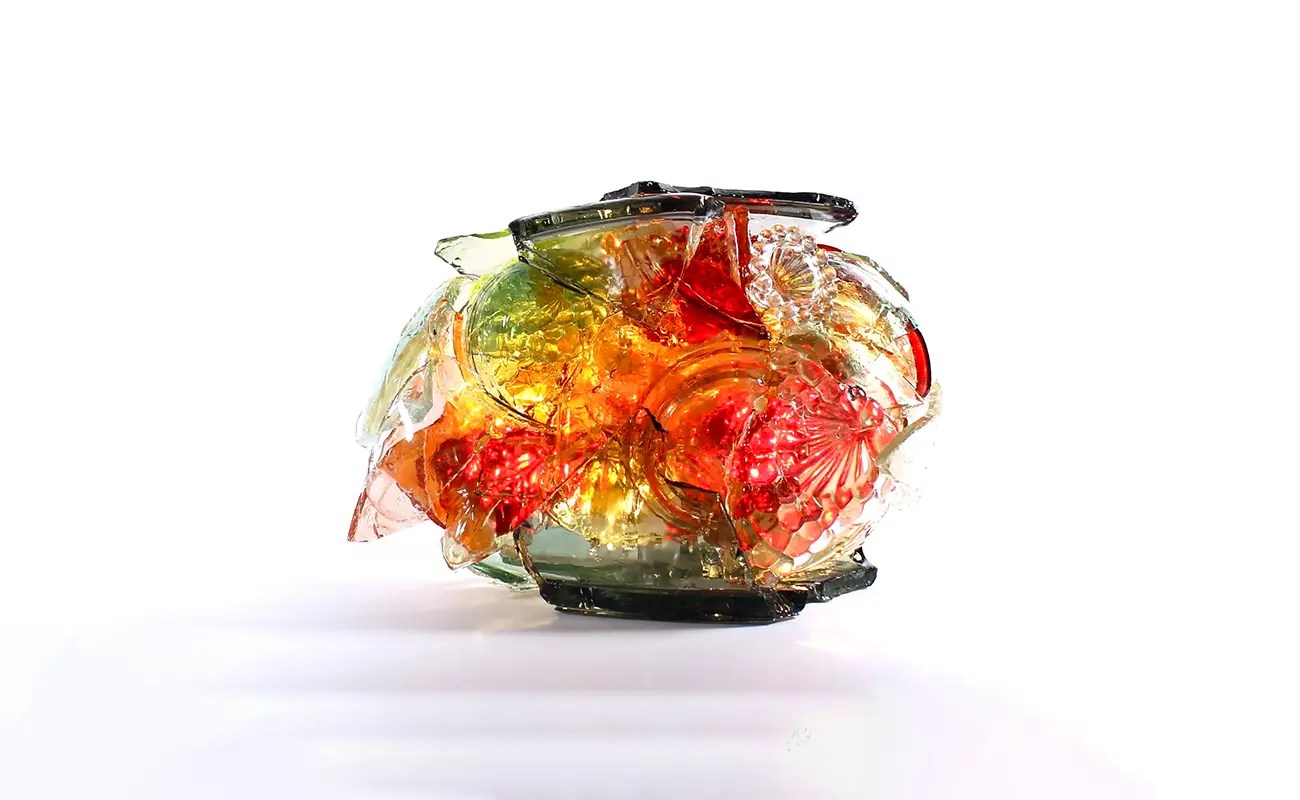
“How the ugliest shards can hold the most light once you clean them, turn them around, and see them differently.”

Photo credit: Resurrect Studio LLC
What the Water Leaves Behind
Along Dead Horse Bay in Brooklyn, pieces of glass discarded generations ago continue to emerge from a shoreline shaped by tides and erosion around the remnants of an old landfill. For Nancy Wu and Jean Davis, founders of Resurrect Studio, these weathered fragments became the foundation of a sculptural practice concerned with memory, transformation, chance, and renewal. Their work does not conceal the material’s former life. Chips, curves, worn surfaces, and irregular edges remain visible, carrying evidence of time into luminous constructions where color and light continually shift.
The collaboration took shape during the pandemic, when their Flatbush neighborhood was severely affected and familiar public spaces became inaccessible. Both artists had established relationships with painting, yet isolation made solitary studio work increasingly difficult. Walking to the decommissioned landfill offered another rhythm. They began collecting glass without intending to establish a new practice, drawn instead by the simple pleasure of searching the shoreline and bringing intriguing fragments home. Material that had spent roughly a century moving through the bay gradually redirected their creative attention toward sculpture.
Behind that discovery was a much more personal history. Wu and Davis knew each other through their daughters, Chloe and Naomi, who were best friends. Chloe died from altitude sickness in 2016, and the two families continued navigating grief together. Making art side by side eventually created room for friendship and play even as mourning remained present. Resurrect Studio grew from that shared experience without attempting to repair what could not be restored. Its sculptures instead accept fracture as a condition, asking what new possibilities might emerge from what remains.

Photo credit: Resurrect Studio LLC
Resurrect Studio: Letting Chance Enter the Composition
Wu and Davis approach collecting as an exercise in attention rather than acquisition. The tide determines what is accessible, and the shoreline rarely supplies precisely what they might want. Some visits reveal unusual colors or unexpected forms, while others produce familiar bottle bottoms and little else. Their studio collection is partly organized by color, including blues, greens, reds, and rarer discoveries, with newly gathered pieces waiting until their potential becomes clearer. Certain finds have distinctive histories of their own, including fragments associated with uranium glass that can glow beneath ultraviolet light.
The artists learned conventional stained glass techniques but became less interested in forcing fragments into predetermined shapes. Instead of cutting every piece into compliance, they work with curves, thicknesses, breaks, and surfaces produced long before the glass reaches their hands. That decision gives the found object unusual authority within the composition. A fragment can disrupt an idea or initiate another, while some remain unused until a later work reveals their purpose. The limitation is productive because the artists must negotiate with forms they did not design.
Their experiments eventually produced a method they call “3D Watercolors.” Where traditional stained glass commonly arranges pieces beside one another across a relatively flat plane, Resurrect Studio stacks bottle sections and dimensional fragments so transparent colors overlap. One piece changes the appearance of another behind it, creating optical mixtures that neither possesses independently. Daylight and refraction further destabilize the composition. Wu is especially interested in lenses and transformation, while Davis is drawn toward mood and stability. Davis also carries into sculpture an openness developed through painting, where flowing forms and broad areas of color encourage the eye to wander rather than settle immediately on one focal point.

Photo credit: Resurrect Studio LLC
Memory Finds a Shape
Some sculptures remain strongly abstract, but recognizable images can emerge from the peculiarities of individual fragments. For Universe in Utero and Lotus, Wu and Davis searched specifically for curling green glass and colorful pieces capable of suggesting new growth. Their existing collection could not simply supply substitutes. Fragments that were too dark or too weathered, as well as those that felt overly heavy, failed to communicate the freshness they wanted, sending them back to the shoreline to see what the tide might offer. Intention was present, but completing the work still depended upon circumstances outside their control.
Other pieces begin through spontaneous association. A long pink fragment once reminded Davis of a Barbie sofa, prompting Wu to think of an I Dream of Jeannie bottle. Those connections eventually helped shape Pimm’s Parlor, envisioned as a round room. A substantial piece of smooth blue glass led somewhere entirely different. Wu saw in its silhouette the kneeling Virgin Mary, and the fragment became the central figure of Incarnation, the studio’s contemporary crèche. Rather than treating found glass as neutral raw material, the artists pay attention to what its existing form might already suggest.
Even the Sparrow demonstrates how far that responsiveness can alter a work. Wu initially understood the sculpture as a tree of life, but its identity changed during construction. The emerging form could suggest a Buddha or a canopy, perhaps even a place of shelter where a small creature might find protection. Empty areas within such constructions are equally purposeful. Wu and Davis describe these spaces as “the presence of absence,” allowing what is missing to participate visually alongside what remains. The idea carries particular resonance in a practice formed through grief, where absence cannot be eliminated but can become part of how something new is structured.

Photo credit: Resurrect Studio LLC
Resurrect Studio: Light and the Freedom to Begin Again
Historical glass also activates memories that extend beyond the specific objects from which the fragments came. Wu associates soft olive, peach, amber, gold, mauve, Irish Coffee, and Kahlúa tones with the intimate atmosphere of her Nana’s living room. Other recollections gather around ice pops, Fudgsicles, Neapolitan ice cream, Charles Chips, Entenmann’s pound cake, and coffee prepared in a percolator. Viewers bring their own associations, sometimes recognizing colors or domestic moods connected with parents and grandparents. The material’s endurance makes those encounters possible, carrying traces of household objects produced in an era when many were designed to last rather than be quickly discarded.
Uncertainty remains present even after a sculpture has been assembled. One of Wu and Davis’s favorite moments occurs the morning after pouring resin, which must cure overnight before the final effect can be fully seen. Wu compares the anticipation to waiting for Jell O to set. Once a pour is finished, rejected fragments are cleared away and windows are opened, leaving the working surfaces available again. Humor interrupts the seriousness surrounding the practice too, including Wu joking about vacuuming partly to disturb Davis’s concentration. Their willingness to dismantle unsuccessful constructions serves a similar purpose. Nothing has to remain fixed simply because time has already been invested in it.
That openness now extends into architectural space through an installation for a wellness center under construction in Queens, New York. Wu sees art and healing gardens as integral elements of wellness environments rather than extras to remove when budgets tighten, a perspective that intersects with Davis’s work as an art therapist. Still, neither artist insists that viewers experience the sculptures in one prescribed way. Their collaboration began with a desire to make without imposing a goal, and that freedom remains central. The tide chooses what appears, while old breakage establishes each fragment’s geometry. Collaboration unsettles individual decisions, and changing light transforms overlapping colors. Resurrect Studio works within those conditions, showing how something discarded can acquire another identity without surrendering the history written across its surface.

Photo credit: Zachary Finkelstein


