Thresholds of the Familiar Made Strange
Robert Ram’s paintings immediately command attention through their ability to make recognizable worlds behave according to an unfamiliar logic. Caves, canals, windmills, ruins, deserts, forests, ladders, birds, flowers, masks, and theatrical figures appear with clarity, yet their relationships resist ordinary explanation. The result is not confusion for its own sake, but a sustained atmosphere of imaginative displacement. Born in The Hague in 1952, and shaped by studies in model drawing, lithography, and watercolor, Ram brings to oil painting a draughtsman’s discipline and a storyteller’s appetite for suggestion. His self-taught command of oil on panel allows him to construct scenes with a firm sense of surface, volume, and spatial recession, while still preserving the ambiguity that he values. These works matter because they demonstrate how figurative painting can remain open, symbolic, and intellectually active without surrendering visual pleasure or technical conviction.
The first striking quality across the submitted works is Ram’s control of threshold imagery. Doorways, arches, cave mouths, windows, hinged panels, ladders, canals, and framed openings recur throughout the paintings. They do not merely organize the composition; they create psychological invitations. In the image of the child on a rope ladder reaching toward a balloon, the viewer is suspended between ascent and danger, wonder and instability. In the painting of the man gathering marbles in a rocky watercourse, the ravine frames a distant urban scene where dancers appear inside a transparent sphere, setting manual labor against unreachable festivity. In the triptychs and cabinet-like works, painted frames and real hinged structures deepen this sense of passage. The artwork becomes an object one can imaginatively open, enter, and question. Ram’s strongest compositions use these thresholds to guide the eye while leaving the mind uncertain about what lies beyond them.
Ram’s visual language is grounded in precise representation, yet it consistently turns away from realism as a final destination. Rocks may resemble flesh, trees assume bone-like or muscular form, birds gain ceremonial presence, flowers become watchful beings, and architecture is placed in states of ruin, performance, or impossible persistence. The careful rendering is important because it gives these inventions credibility. A viewer believes the textures of bark, stone, cloth, feathers, water, and skin before confronting the impossibility of their arrangement. That tension between credibility and disruption is central to the work’s effect. It aligns with the artist’s stated interest in alienation, but the alienation is rarely cold. More often, it is curious, theatrical, and quietly emotional. The paintings invite the audience to linger, not because they solve a puzzle, but because they suggest that recognition itself may be unstable.

Robert Ram: Oil, Panel, and the Architecture of Imagination
Ram’s use of oil on panel suits his artistic intentions especially well. Panel provides a stable surface for the kind of controlled detail and layered atmosphere visible throughout the submitted works. The paint handling favors smooth transitions, crisp contours, and carefully modulated light rather than expressive looseness. This approach gives the paintings a staged quality, as though each scene has been arranged for a moment of revelation. In several works, the surface appears to support dense micro-narratives: tiny travelers, distant monuments, concealed animals, pendant objects, masks, ropes, symbolic tools, and figures placed at different scales. The technical challenge is considerable because this density could easily flatten into illustration. Ram largely avoids that by building convincing spatial corridors, often through diagonals, receding pathways, water channels, cliff faces, or architectural apertures that pull the viewer inward.
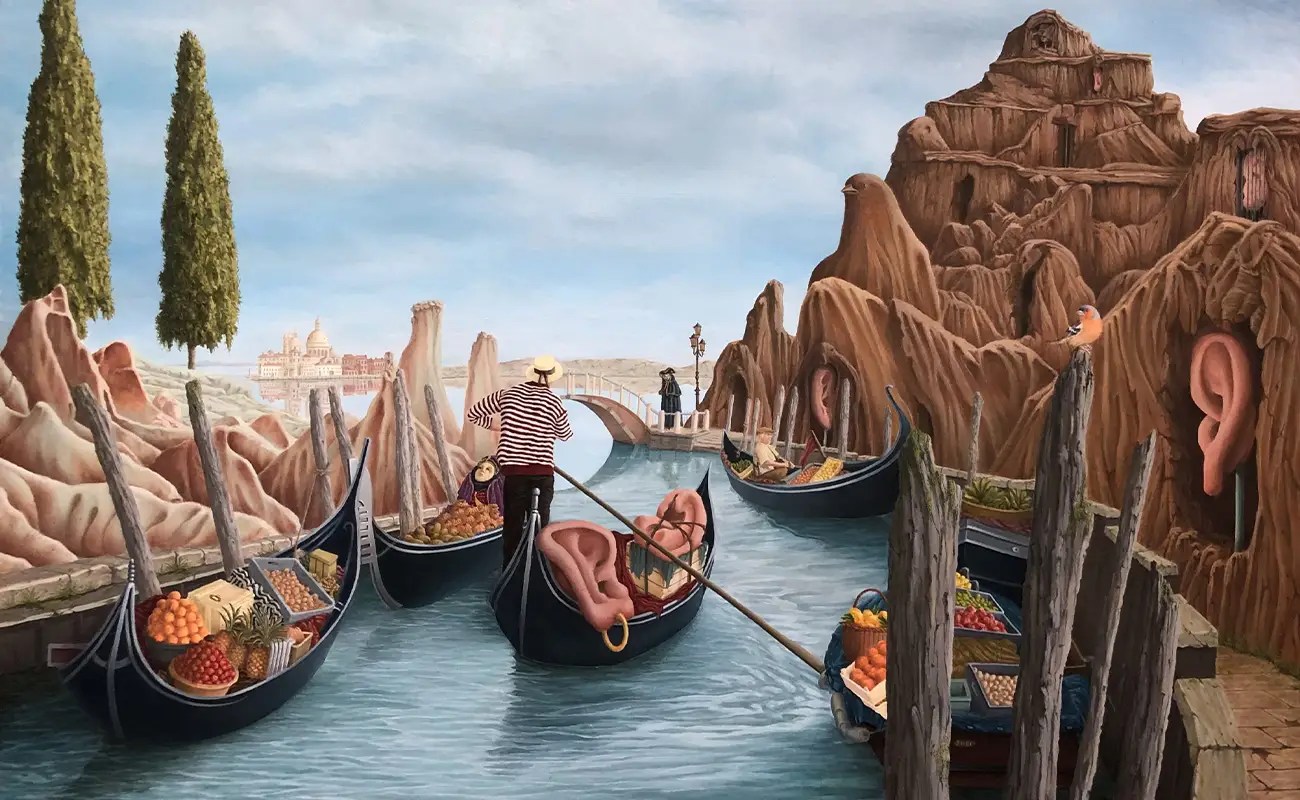
Composition is one of the most persuasive aspects of the practice. Ram frequently structures images through oppositions: enclosed and open, natural and artificial, miniature and monumental, intimate and cosmic, playful and ominous. The painting with the gondolas presents a canal scene filled with fruit, boats, wooden posts, distant architecture, and a mountain-like formation marked by ears and hidden cavities. Its apparent scenic charm is interrupted by bodily fragments embedded within the landscape, turning travel into a meditation on listening, perception, and absurd transformation. The diptych with anthropomorphic flowers and a rider moving toward the horizon similarly balances theatrical invention with landscape recession. The left side offers animated, watchful blooms with feet and faces, while the right side opens into a muted journey across a path toward sea and sky. The split panel becomes more than a format; it becomes a visual argument about divided states of awareness.
The object-based works are particularly significant because they extend Ram’s pictorial imagination into physical form. The gold-framed cabinet pieces, arched double doors, and triptych structures carry associations with reliquaries, devotional panels, and theatrical stages without requiring any fixed religious reading. Their hinges and frames make viewing feel participatory. One cabinet opens to reveal a central landscape with a bird-masked figure, serpentine forms, and ruined architecture, while the side panels present a female profile and a distant ruin. Another arched work places mountains, a winged horse-like creature, a skull on a post, and ornate metal fittings across the surface, merging painting with objecthood. These works strengthen the sense that Ram is not only painting imaginary scenes, but constructing containers for imagination. Their challenge lies in maintaining balance between decorative structure and conceptual necessity, yet at their best the frame becomes inseparable from the fiction inside it.

Alienation, Story, and Open Meaning
Ram’s stated desire to let the paintings speak for themselves is strongly supported by the submitted images. Many works appear to contain narratives, yet the plots remain deliberately incomplete. A group of men struggles at the mouth of a mountain cave while a spectral figure seems to emerge from rose-colored clouds above them. Golfers stand beneath an enormous suspended rock formation supported by thin poles. A Buddha-like figure holds a fishbowl inside a dark cavern while a child ascends a ladder toward a balloon containing a goldfish. These scenes feel charged with action, but they refuse a single explanatory key. This refusal is productive. It allows viewers to generate associations around rescue, ritual, burden, illusion, childhood, labor, memory, confinement, and escape. Ram’s images succeed when their symbolism feels active rather than prescribed.
The paintings often use scale shifts to unsettle the viewer’s expectations. Human figures become small within landscapes that feel alive, while flowers, birds, masks, and fragments of anatomy gain monumental status. This strategy is visible in the work with the pale blue legs dominating a pastoral waterway, where a domestic landscape of houses, reflections, reeds, and ribbon barriers is partly occluded by an oversized body. The image generates an odd intimacy, neither comic nor purely erotic, but concerned with proximity, obstruction, and the instability of viewpoint. Similarly, the interior painting with seated women, Egyptian-style wall imagery, a suspended mythic figure, and a large mask at the doorway brings multiple cultural and theatrical registers into one room. The space feels archaeological, domestic, dreamlike, and performative at once. The viewer is positioned not as a passive observer, but as someone arriving after a sequence of events has already begun.
Birds, masks, and hybrid forms are among Ram’s most potent recurring motifs. The plague-doctor-like masks, crows, owls, vultures, doves, and winged creatures create a vocabulary of watching, warning, and transformation. The masks are especially effective because they sit between concealment and identity, suggesting both protection and estrangement. In the portrait-like painting of a figure with striped garments, a long scarf, a bird-like beak form, and another masked figure behind, Ram fuses fashion, disguise, and dream logic into a compressed psychological image. The figure is not presented as a conventional sitter, but as a composite presence assembled from costume, animal suggestion, and interior distance. This is where the work’s magical realism becomes most convincing: the impossible does not erupt violently into the ordinary, but appears to have always belonged there, waiting for the viewer’s perception to adjust.

Robert Ram: Position, Strengths, and Critical Possibilities
Ram’s work sits confidently within a lineage shaped by surrealism and magical realism, yet its most distinctive quality lies in the patient construction of believable impossibility. Rather than relying on shock, distortion alone, or purely irrational juxtaposition, he builds scenes through recognizable craft: perspective, tonal modeling, atmospheric recession, and finely rendered detail. This gives the paintings accessibility for a broad audience while preserving enough ambiguity for curatorial and critical engagement. In an institutional context, the work would be strongest when presented as a sustained visual universe rather than as isolated fantasy images. The repeated thresholds, hybrid bodies, cabinet formats, masks, theatrical landscapes, and altered natural forms reveal an internally coherent practice. For galleries, that coherence offers a clear position: figurative oil painting that combines narrative allure with psychological openness and object-based experimentation.
The principal strength of the submitted body of work is its ability to sustain curiosity. Ram clearly understands that mystery depends on partial recognition. Viewers can identify canals, ruins, flowers, birds, trees, deserts, interiors, houses, and travelers, yet the paintings rearrange these components into scenes that feel suspended between memory and invention. The technical precision usually supports this effect, especially in the rock formations, wooded passages, architectural fragments, and reflective waterways. At times, however, the sheer abundance of motifs can create competition within the image. Some paintings contain so many symbolic cues that the eye must work hard to determine hierarchy. This is not necessarily a flaw, since density is part of Ram’s visual identity, but the most powerful works tend to establish one dominant dramatic relation, then allow smaller details to orbit around it.
The next stage for Ram’s practice may lie in refining the balance between intricate description and atmospheric silence. His paintings are most affecting when detail serves tension, mood, or passage, rather than filling every available space with equal importance. The strongest examples show restraint inside complexity: the ladder and balloon, the marble gatherer in the ravine, the cabinet works with hinged revelation, the night scene of figures carrying brooms toward a ruined structure, and the diptych of watchful flowers all create clear emotional entry points while leaving interpretation open. Ram’s art succeeds because it trusts the viewer’s imagination, just as the artist asks the image to exceed its source material. The work is strange, engaging, technically assured, and personally coherent, offering a vision in which reality is not abandoned but made porous, symbolic, and unexpectedly alive.
For more information, please visit the artist’s website: https://robertram-art.nl/