“Art allows me to keep asking questions without needing definitive answers.”
A Life Written Between Cultures
Canal Cheong Jagerroos creates art from movement, memory, and the quiet instability of belonging. Born in Hainan in 1968 and raised in an artistic family in Macau, her work has been shaped by decades of life across Asia, Europe, Africa, and Scandinavia, developing a practice that resists fixed borders. Her work moves through abstract painting, drawing, calligraphy, installation, mixed media, and site-specific intervention, forming a visual language where personal history becomes both image and atmosphere. Rather than presenting identity as something complete, she treats it as a living process, altered by place, language, memory, and encounter. This openness gives her work a distinctive presence in contemporary art, where cross-cultural experience is not used as ornament but as structure.
Her artistic foundations began in childhood, within a family where creativity was part of daily life. Her father introduced her to traditional Chinese ink and brush painting, while her mother, an opera singer, surrounded her with another form of expressive discipline. These early influences gave Cheong Jagerroos a lasting sensitivity to gesture, rhythm, and emotional tone. Later studies in Fine Arts at the Guangzhou Academy of Fine Arts, followed by art and graphic design studies in Hong Kong, expanded her relationship with contemporary visual expression. From there, her work began to absorb both inherited traditions and new artistic possibilities, creating a language rooted in Chinese art yet continuously reshaped by global experience.
Curiosity has remained central to her development. Cheong Jagerroos has said that she wanted to become an artist from childhood, and that art gave her a way to ask questions without requiring final answers. This attitude still defines her practice today. Diaries, memory, language, landscape, and the poetry of ordinary life all appear throughout her work, not as separate subjects but as interwoven forces. Her studio process includes painting, research, sketching, walking, collecting, editing, meditation, and observation. Even moments of stillness become productive, allowing ideas to mature slowly before finding their form.

Canal Cheong Jagerroos: The Architecture of Fragment and Return
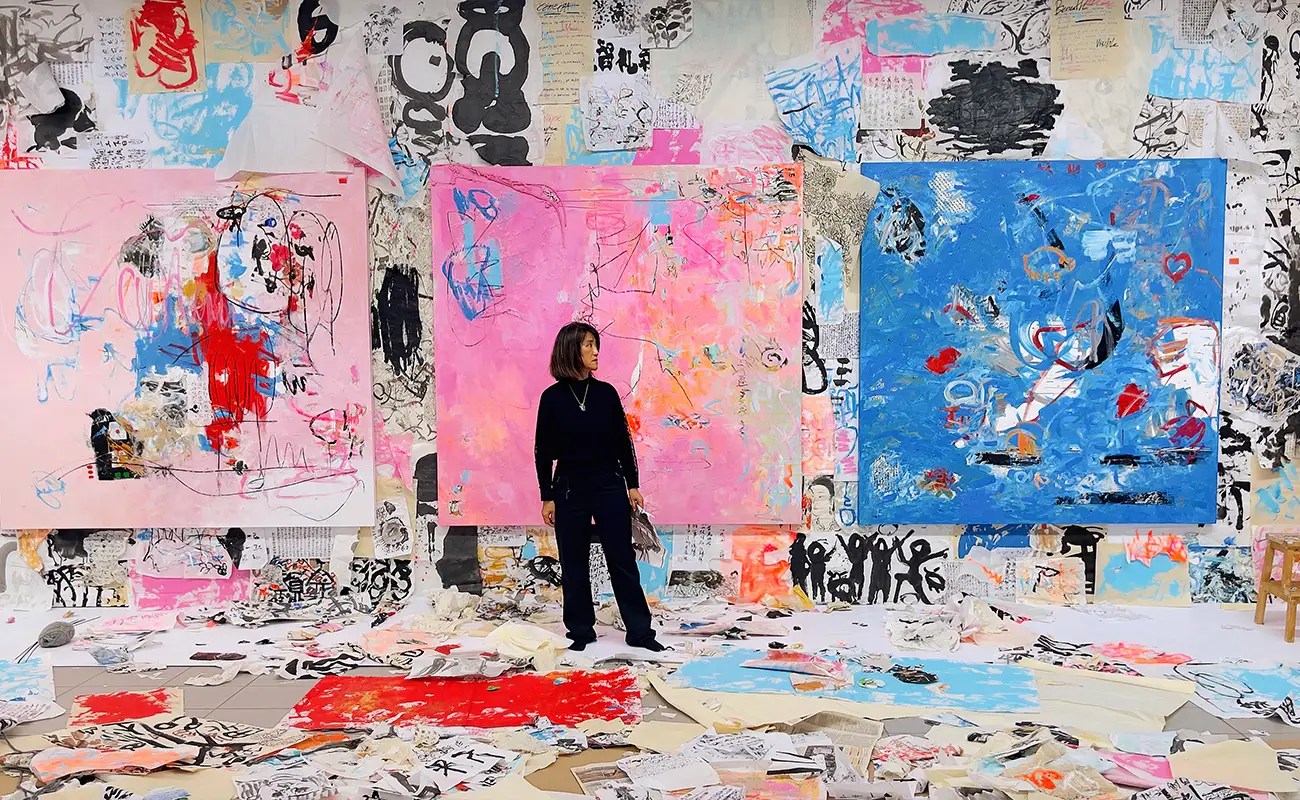
A defining feature of Cheong Jagerroos’s practice is her use of construction, fragmentation, and reassembly. She often begins with large ink drawings on rice paper, introducing symbols, words, calligraphic marks, and spontaneous gestures. These works may then be torn apart and rebuilt into layered compositions using acrylic paint, traditional Chinese pigments, collage, and mixed media. The process gives physical shape to ideas of transformation, suggesting that memory and identity are never static. Instead, they are gathered, broken, revised, and remade through experience.
This working method reflects a life lived across many cultural settings, including Hong Kong, Shanghai, France, Switzerland, Italy, Senegal, and Finland. Over more than thirty years, Cheong Jagerroos has encountered different landscapes, languages, philosophies, and artistic traditions, all of which continue to influence her visual decisions. Her paintings do not simply combine East and West in a decorative sense. They create spaces where different systems of thought can meet, overlap, and change one another. Through layered surfaces and calligraphic movement, she allows cultural memory to become active rather than fixed.
Colour also carries philosophical weight in her work. Cheong Jagerroos approaches colour not only as a visual element but as a meditative force connected to balance, peace, and positive energy. Nature, ancient philosophy, memory, displacement, and belonging often inform her compositions, giving the work both visual intensity and contemplative depth. Her abstract language is therefore neither detached nor purely formal. It is grounded in lived experience, shaped by migration, reflection, and the search for continuity amid change.

Floating Islands, Shifting Ground
Among Cheong Jagerroos’s most meaningful projects is Floating Island, an ongoing body of work she founded in 2017. The project has become a central metaphor for her artistic and personal journey, expressing movement, cultural fluidity, imagined territories, and the unstable search for place. Floating Island moves across different forms, including drawing, installation, text, public intervention, and large-scale painting. It has included hundreds of small flowing drawings, LED light, strings, yarn, bamboo, branches, flowers, and calligraphy on rice paper.
The importance of Floating Island lies in how it transforms personal displacement into poetic space. Rather than treating belonging as a fixed location, Cheong Jagerroos imagines it as something mobile and evolving. The floating island becomes a symbol of passage, where permanence and impermanence coexist. This idea reflects her own movement between countries and cultures, but it also invites viewers to consider their own relationship to place. In a globalized world, the project speaks to the emotional complexity of being between homes, histories, and languages.
Floating Island has appeared in several forms across major exhibitions, including presentations in Finland and the United States. Related exhibitions include Floating Island: Utopia at Jyväskylä Art Museum, Floating Island: Tower/Cinderella in Pink at Salo Art Museum, Floating Island: Beyond Arctic at Korundi Rovaniemi Art Museum, and Floating Island: Drifting at Saimaan Taideluola Art Cave. Through each version, the project continues to evolve rather than repeat itself. Its strength comes from that openness, allowing new materials, sites, and emotional conditions to reshape its meaning.

Canal Cheong Jagerroos: Beyond the Surface of Knowing
Cheong Jagerroos currently works with several projects at once, allowing some to develop quickly while others remain in a slower state of formation. This rhythm suits an artist whose practice depends on patience, intuition, and long observation. Her current focus is Joy and Symmetry: Beyond the Surface, shown at Helsinki Meilahti Kunsthalle / Art Museum in Finland from 1 April to 30 August 2026. The exhibition presents eleven large-scale paintings alongside an installation that recreates her studio environment, including hundreds of drawings.
This exhibition offers insight into the relationship between finished works and the thinking process behind them. By bringing the studio environment into the museum, Cheong Jagerroos reveals drawing not as preparation alone but as a living archive of attention. The installation allows viewers to encounter the density of her practice, from daily marks and collected ideas to expansive paintings shaped by years of reflection. It also continues her interest in surfaces, hidden structures, and the quiet tension between order and uncertainty.
Across her career, Cheong Jagerroos has exhibited internationally at museums, art fairs, and cultural institutions, including Korundi Rovaniemi Art Museum, Joensuu Art Museum, Jyväskylä Art Museum, Salo Art Museum, Xi’an Art Museum, Art Miami, LA Art Show, and Venice Biennale related programming. She also co-founded the Blue and Red art project, presented in museums and institutions in China and Finland from 2015 to 2020. Yet her practice remains guided by a simple, restless force: the desire to keep questioning. Her best projects, she suggests, begin with certainty and end by proving otherwise.