


Any attempt to categorize Sari Fishman‘s artistic practice through the conventional conceptual framework of the contemporary art world is destined to fail. In an art market that frequently crowns a recognizable “house style,” consistent visual branding, or predictable career strategies, Fishman establishes a radical stance of refusal. She operates on the understanding that rigid definitions and formal titles are reductive mechanisms seeking to tame the image and confine it within a fixed social or commercial function. The single consistency across her body of work is absolute dynamism: the insistence on beginning every series of works from a completely blank page, without relying on past formulas, without reproducing a previous visual language, and without seeking to please the viewer’s eye.
Her practice moves freely, and entirely independent of any artificial intelligence technologies, within an elusive twilight zone where visual art, photography, video, poetry, and movement meet and merge. For Fishman, different mediums are not separate categories but fluid axes of expression activated by a total internal impulse. Her creation is not the result of calculated planning or responsiveness to fashionable trends; it is an act born of a powerful internal experience—emotional, existential, or intellectual—that becomes, at a given moment, an inescapable necessity. In the absence of this distinct inner urge, she chooses complete inaction. However, when the artistic action does manifest, it functions as a therapeutic process and a personal catharsis—an act in which the birth of the image brings a material release of existential weight that found no rest elsewhere.
Each of Fishman’s series completely transforms her visual vocabulary according to the psychological or conceptual state from which it grows. The work is entirely intuitive, with no interest in preserving a pre-established formula or constructing a recognizable visual brand. Accordingly, her body of work does not lean on a single core material, but is characterized by multiplicity and sharp transitions between diverse and varied materials that can best express what she seeks to convey in the present moment. Fishman never uses conventional paints that blend into one another; instead, she operates through a unique technique that brings together materials that inherently do not mix. The identity of these substances and their processing methods are details she usually chooses to keep hidden from the viewer’s eye. These mediumistic choices are positioned precisely at the point where the surface ceases to suffice, and the need to dismantle the external image becomes an absolute imperative.

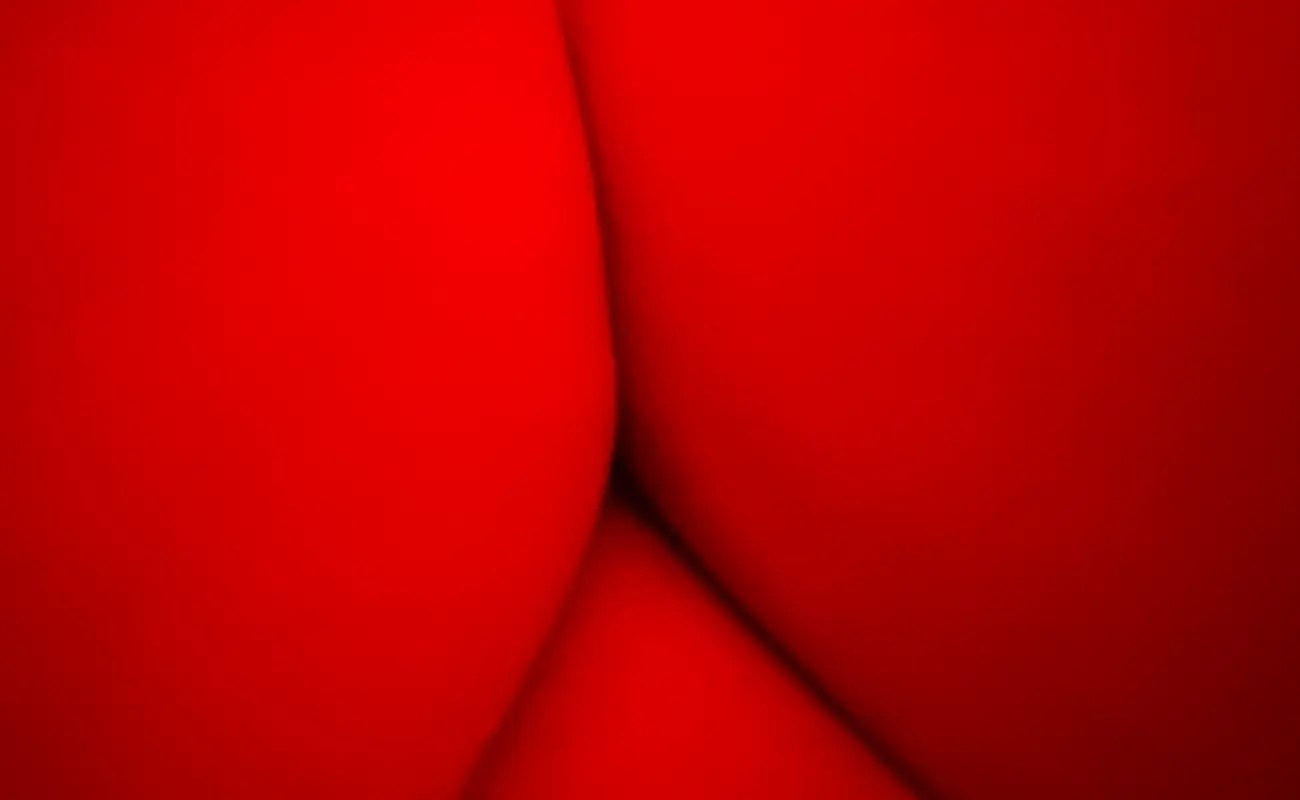
From this perspective, which seeks to deconstruct the self-evident, emerges her new series of works, RED. In this series, Fishman aggressively constricts the visual space, choosing to operate almost exclusively with a single color—red. This is the absolute color of passion, danger, seduction, warning, and fire. Like the cloth waved in a bullring, Fishman’s red demands absolute presence and magnets the gaze, forcing the viewer to stop and look long before any conceptual, narrative, or thematic meaning begins to formulate in their mind. Out of this visual monolith of the color red, a complex and multi-layered investigation unfolds.
In recent years, Fishman’s work has focused sharply on the gap between visibility and understanding—between the external image that people consume and what remains hidden beneath it. In a cultural world relying on speed, instant attraction, and flat consumption of visual content, it becomes painfully clear how much the human gaze has been trained in the contemporary era to halt at the level of form alone. The social and technological mechanisms surrounding us encourage a thoughtless skimming; the viewer is drawn to the immediate, to the glittering first impression, and only rarely finds the time or the courage to stop and ask what lies beneath the surface. The very choice to dive beyond the visible layer requires psychological effort, as it confronts us with complexities, internal contradictions, and truths we are not always comfortable acknowledging. Fishman’s art insists on documenting precisely this moment of destabilization, the point where the external envelope cracks and the need for deeper knowledge becomes inevitable.

The closer one tries to get to the images in the RED series, the more they prove to be elusive, restless, and resistant to the accepted logic of decoding. Fishman deliberately maintains absolute ambiguity regarding the material medium; she refuses to clarify whether it is a still photograph, a frozen frame from a video work, or a specific painting technique.
This mediumistic and material instability is not a technical manipulation or a visual gimmick; it constitutes the very heart of the work itself. These pieces examine the limits of human capacity to contain truth, touching upon an ancient idea that echoes through many cultural and philosophical traditions: the inherent distinction between the layer of “Peshat” (the literal)—the external, accessible, and easily digestible truth—and the layer of “Sod” (the secret)—that hidden, intricate mystery of existence, the inner layers of meaning that not everyone seeks or is capable of encountering in their daily lives. Fishman uses her art to explore how these two layers coexist alongside and within one another, in the same space and within the exact same image.
The RED series demonstrates that the truth can be laid completely open before our eyes, yet remain entirely invisible to the observer. Concealment here is not carried out by traditional means of darkening, blurring, or erasing. Fishman hides nothing behind a curtain; she chooses to conceal the image through a sharp conceptual and visual paradox of excessive proximity. The image becomes so exposed, direct, dense, and burning that the human eye loses the optimal optical distance required to read it, and loses the code for its decryption. This excessive proximity acts upon the viewer almost physically: it blinds them with sheer presence. In this state, when the image is too close and too exposed, an essential psychological defense mechanism is triggered in the viewer. This is the conscious choice—often occurring in the subconscious—to avert one’s gaze from the flame, to refrain from asking explicit questions, and to avoid deep diving, all in order to escape the painful burn of truth and not be “consumed” by the fire of knowledge. Paradoxically, excessive proximity becomes the most perfect tool of concealment.

The focused and total choice of the color red intensifies this conceptual move, transforming it into an amplified sensory experience. Red does not function here as a decorative element or a mere aesthetic choice; it is selected as a living, pulsating material charged with immense cultural and historical meanings. It is a color that embodies the sharpest contradictions of human existence: it simultaneously symbolizes the most intense passion and absolute danger, the vitality of blood flowing through veins and the warning of consuming fire. Much like the cloth brandished in the bullring, Fishman’s red instinctively magnets the human gaze, forcing the viewer to pause and look before any rational, narrative, or conceptual mechanism can formulate in their consciousness. The power of the color lies in its ability to bypass conscious thought and appeal directly to emotion and the body, thereby generating a direct and immediate experience that requires no mediation or prior explanation.
This critical and total engagement with the gap between external appearance and deep understanding now reaches full maturation and receives official validation on the international stage. The new series of works, RED, is set to stand at the center of a large-scale, extraordinary exhibition project in Italy, presented as part of the World Wide Art Show 2026. The showcase will unfold across three major Italian cities as a continuous and fascinating wandering journey: it will open in Milan (September 26 – October 1), continue to Florence (October 24 – 29), and conclude in Rome (December 4 – 10). This traveling project will grant the European viewer a rare opportunity to encounter Fishman’s artistic trajectory in its full material and conceptual power.
Ultimately, the RED series challenges the accepted conventions of the contemporary art field and holds a piercing mirror up to it. In an era characterized by ironic distance, alienation, and the mass production of fast-paced images, Fishman chooses to return to the exhibition space the terror and the grace entailed in deep and honest knowledge. She is not interested in providing the viewer with a polished cultural product. Instead, she places within the space a pulsating, raw, and direct material testimony of a creation arising entirely from an inner drive and an uncompromising truth—reminding us that truth is not found in far-off distances or behind locked secrets; it is always present right before our eyes, open, exposed, and burning—awaiting those who dare to stay long enough, take the risk, and truly look.


