Streets That Refuse to Stay Silent
Marria Pratts stands out as an artist who treats creativity as something active, open, and inseparable from daily experience. Born in Barcelona and based in L’Hospitalet de Llobregat, she has built a practice that resists narrow definitions. Painting may sit at the center of her work, yet it never remains confined to a canvas. Drawing, sculpture, carpets, furniture, ceramics, fanzines, neon, photography, and installation all become part of a wider visual conversation. This breadth is not a matter of collecting mediums for variety alone. Instead, each format offers another route for expressing movement, memory, emotion, and the pulse of urban life. Her art often feels made in direct contact with the world around her, carrying the speed of thought and the unpredictability of the street. That quality gives her work an immediate presence, one that feels spontaneous while still holding deep awareness of place, community, and personal history.
Her home and studio in L’Hospitalet have often been described as extensions of her paintings, spaces where art and life overlap rather than remain separate. This connection reveals much about her method. She gathers inspiration from streets, passing encounters, improvised architecture, found materials, and the people who animate the neighborhoods around her. Friends and regular collaborators, including photographers, designers, and musicians, also shape the atmosphere in which ideas emerge. Such surroundings feed a language built from observation rather than distance. Instead of presenting polished scenes detached from reality, she transforms everyday details into vivid forms charged with humor, tension, and affection. The result is work that feels inhabited, as though each mark carries the presence of conversations, footsteps, changing weather, and the countless unnoticed moments that make up city life.
That sensitivity to overlooked environments also gives her practice a social dimension. Pratts responds to contradictions embedded in urban spaces, especially the pressures created by gentrification and systems that marginalize those trying to live and create within changing cities. She has shown an attraction to what many ignore: discarded objects, rough surfaces, neglected corners, traces of graffiti, flowers pushing through concrete, and signs of resilience where others might see decay. In her hands, these fragments become evidence of endurance and possibility. Rather than offering direct slogans, she allows materials, symbols, and atmosphere to speak. Her art suggests that beauty can arise where value is denied, and that imagination remains a form of resistance. This perspective gives her work unusual force, balancing celebration with critique while keeping human experience at its core.

Marria Pratts: Painting as an Unfixed Freedom
Painting remains essential to Marria Pratts, though she approaches it less as a traditional discipline and more as a changing field of freedom. She has described painting as something magical and radical, a place where rules can be invented, broken, and remade. That philosophy can be felt in works that seem to arrive through motion rather than strict planning. Instead of beginning with rigid designs, she often allows compositions to develop through instinct, repeated gestures, and the physical rhythm of making. Surfaces may shift over long periods, accumulating additions, erasures, and revisions before reaching a final state. This process gives her paintings a sense of life unfolding in real time. Viewers encounter not only finished images, but evidence of decisions, hesitations, recoveries, and sudden bursts of certainty embedded within the surface itself.
Her methods embrace what many would classify as imperfections. Drips, scratches, spray lines, scribbles, tears, and abrasions are not hidden or corrected. They become active participants in the composition, carrying energy that cleaner surfaces might lose. At times she has even used flame directly on the support, turning scorched areas into expressive marks. Such gestures reveal a willingness to accept vulnerability and risk within the act of creation. Damage becomes language, and disruption becomes structure. This approach aligns with her wider refusal of polished expectations. Rather than presenting art as controlled distance, she offers it as lived encounter, where accidents can redirect meaning and roughness can carry truth more clearly than refinement ever could.
Even when bold and unruly, her paintings are carefully alive to emotional complexity. Joy and anxiety often share the same space. A playful line may sit beside a scarred patch of color, while exuberant movement can coexist with quieter signs of fatigue or uncertainty. This balance prevents her work from becoming decorative noise. Instead, it holds the unstable feelings of contemporary life, where pleasure and pressure frequently arrive together. By trusting instinct while remaining open to contradiction, Pratts creates paintings that feel honest rather than resolved. They invite viewers into an experience of making where uncertainty is not a flaw but a source of possibility.

Signs, Spirits, and the Language of Return
Across Marria Pratts’ varied output, recurring images appear again and again, forming a visual vocabulary that links separate works across time. Clocks, faces, hands, ladders, chairs, flowers, fragmented figures, and smiling forms move through paintings and installations like familiar visitors. At first glance these motifs may seem playful or even childlike, yet their repetition gives them weight. They function less as literal objects than as carriers of memory, time, companionship, labor, and absence. Because they return in changing contexts, they remain open to multiple readings. A ladder may suggest ascent, escape, or unstable ambition. A hand can imply touch, support, warning, or creative action. Through this flexible symbolism, Pratts builds a language that feels personal while staying accessible to others.
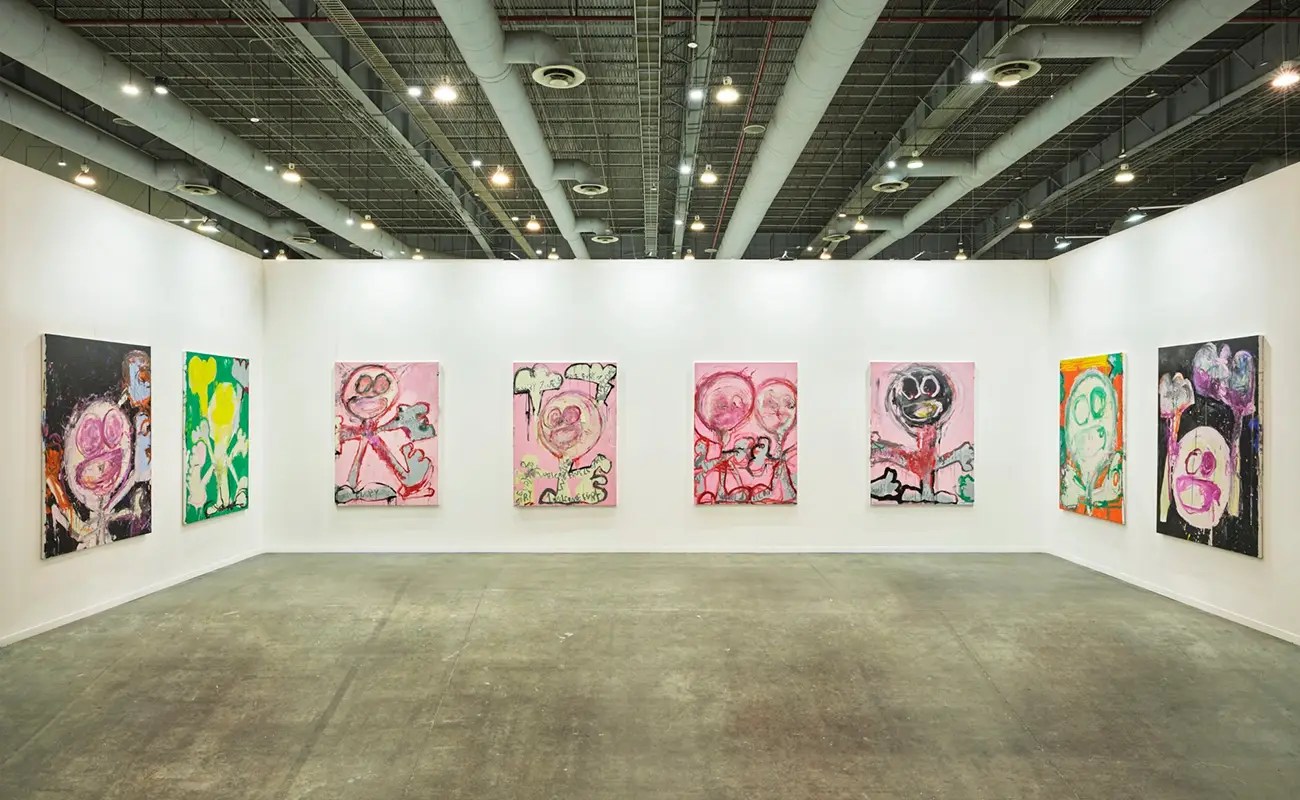
Among these recurring forms, the ghost has become one of her most recognizable presences. Often humorous, loosely drawn, or unexpectedly tender, these figures bring wit to her compositions while also suggesting something more haunting. They can be read as traces of lives overlooked by the city, memories that refuse disappearance, or spirits generated by places carrying layered histories. Their simplicity allows them to move between comedy and melancholy with ease. In one painting they may appear mischievous and light; in another they feel like witnesses to social change. This capacity to shift meaning helps explain why the ghost remains central to her imagery. It captures the unstable condition of urban life, where what is erased often continues to linger.
The recurring symbols also help unify a practice that spans many mediums. Whether appearing on a painting, woven into a carpet, incorporated into furniture, or placed within an installation, these forms create continuity across changing materials. They turn separate objects into chapters of an ongoing conversation. Viewers begin to recognize patterns, yet each return brings fresh context. This strategy mirrors city experience itself, where familiar signs are encountered daily but never under identical circumstances. By allowing motifs to travel and transform, Pratts keeps her work open, intimate, and richly associative. Her images do not deliver fixed answers. They remain alive through repetition, mutation, and the emotional echoes they carry from one work to the next.

Marria Pratts: Color, Care, and Expanding Space
Color plays a defining role in the emotional charge of Marria Pratts’ work. Bright pinks, intense reds, saturated blues, vivid yellows, and deep blacks frequently collide across her surfaces. These combinations can feel sudden and impulsive, yet they reveal strong visual instinct. She uses color not simply to decorate but to generate atmosphere, rhythm, and psychological tension. A joyful burst of pink may sit beside a dark field that complicates its optimism. Blue can cool a composition only to be interrupted by aggressive red marks. Through these relationships, she creates paintings that pulse with changing moods rather than settle into a single tone. Her palette helps explain why even static works seem to move. Color becomes a force that pushes forms forward, pulls others back, and keeps the eye in constant motion.
That energy often extends beyond the wall. Pratts has worked with sculptural supports, handmade neon, furniture, carpets, and installations that challenge the passive rectangle associated with conventional display. In these projects, painting expands into physical space and asks viewers to navigate it differently. A line may continue into an object, or a symbol may appear where furniture meets sculpture. Neon can intensify color into light itself, while textiles bring imagery into tactile form. Such decisions reflect her refusal to separate art from lived surroundings. Works become environments rather than isolated objects, inviting bodily awareness and a more direct encounter. The viewer is not merely observing an image but entering a shifting field of relationships between color, form, and space.
Later developments in her practice have also introduced themes of motherhood, care, bodily change, exhaustion, and love. These subjects do not replace earlier urban concerns but widen them, connecting public pressures with intimate experience. Domestic life enters the work without losing its rawness or vitality. Questions of identity and expectation become visible through the same honesty that has long defined her approach. Throughout exhibitions in Spain and internationally, including presentations in Barcelona, Brussels, Los Angeles, Stockholm, and New York, this commitment has remained consistent. No matter the setting, her art retains the sensation of discovery in the act of making. It feels generous, vulnerable, restless, and unmistakably alive.