“Art should provoke, disturb, and question, rather than remain a simple decoration.”
A Life Shaped by Early Passion and Artistic Formation
Michel Marant stands as a compelling figure in contemporary figurative painting, grounded in a lifelong commitment to visual expression that began in early childhood. Born in 1945 and based in Saint Junien, France, he developed an instinctive connection to drawing and color long before formal education refined his direction. This early inclination matured into a disciplined pursuit when, following the advice of painter Jacques Bleny, he attended courses at the École Nationale des Arts Décoratifs de Limoges, an institution that played a defining role in sharpening his technical abilities and compositional awareness. His trajectory from instinctive creativity to structured artistry reflects a balance between intuition and learned precision, a duality that continues to shape his work today.
During his formative years, a decisive encounter with painter Jacques Bleny proved pivotal. Recognizing Marant’s potential, Bleny encouraged him to pursue formal studies, effectively guiding him toward a professional path in the arts. This mentorship left a lasting imprint, not only in Marant’s technical development but also in his understanding of artistic identity and persistence. Over time, his practice gained institutional recognition, with listings in AKOUN, certification by Artprice, and inclusion in I CAC, affirming his place within established international art networks. These acknowledgments underscore a career built on both dedication and evolving exploration.
Marant’s artistic foundation is deeply rooted in figurative painting, yet it resists conventional representation. His works are organized around themes drawn from lived experience, nature, and contemporary events, allowing each series to function as an evolving investigation rather than isolated creations. This thematic continuity reveals an artist who views painting not as a static outcome but as an ongoing dialogue. Each completed canvas becomes a stepping stone toward the next, reinforcing his belief that artistic expression is never truly finished but always in motion.
Michel Marant: Constructing Meaning Through Form and Color
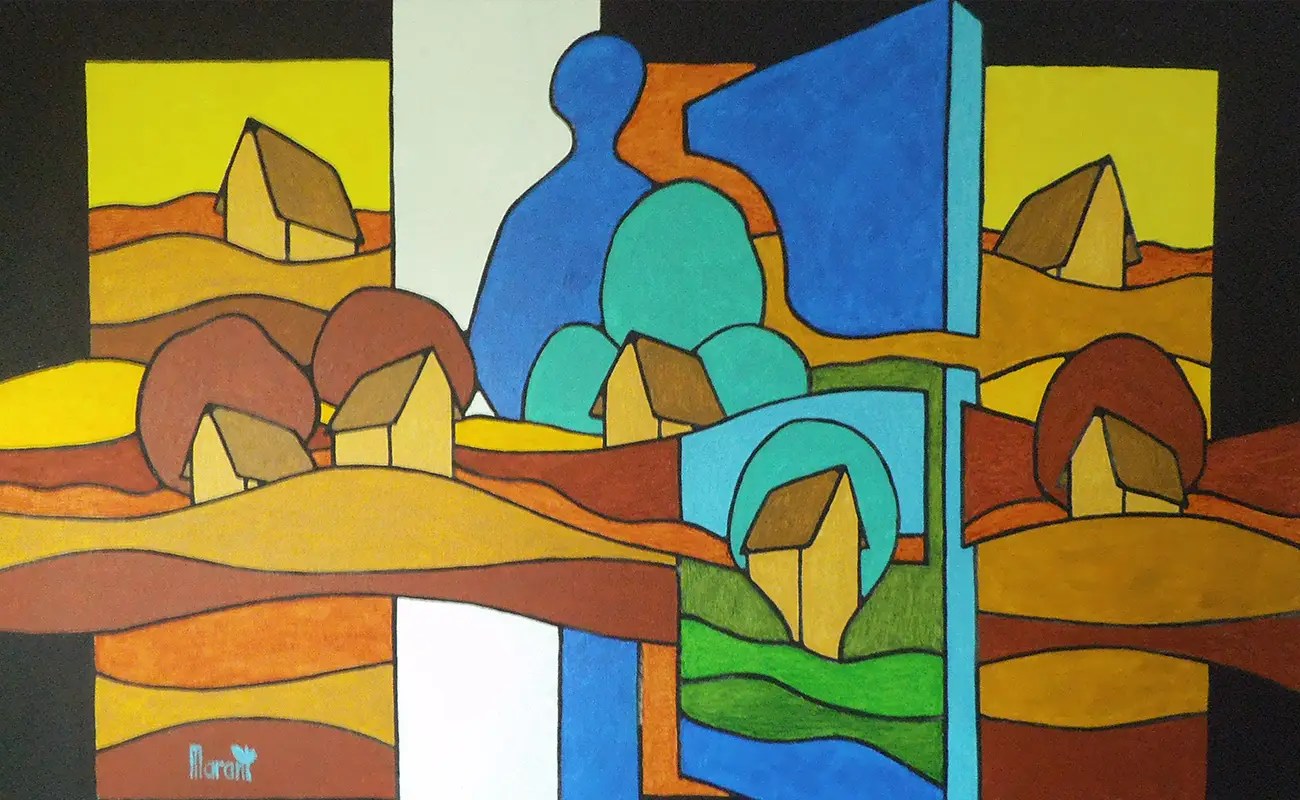
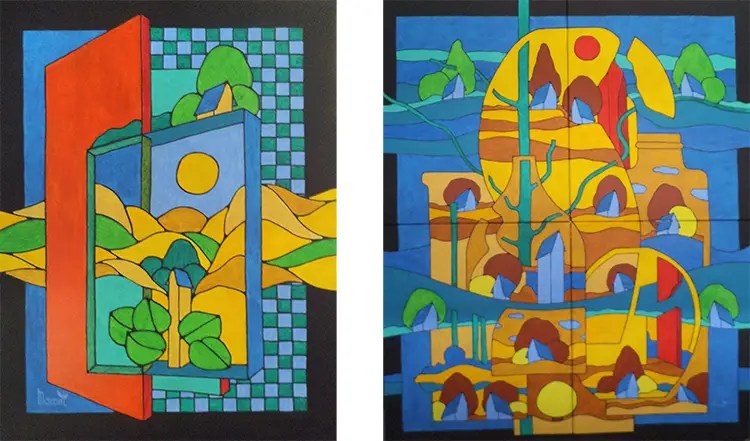
The defining characteristics of Michel Marant’s work emerge most clearly in his distinctive visual language, where structure and spontaneity coexist. His creative process begins without overanalysis, often initiated by a simple charcoal line that gradually unfolds into a fully realized composition. This intuitive starting point allows ideas to develop organically, yet the resulting works are far from arbitrary. They reveal a careful orchestration of geometric forms, flattened spaces, and deliberate color arrangements that guide the viewer’s perception with clarity and rhythm.
Color operates as a central organizing principle rather than a decorative addition. Marant employs bold, saturated tones arranged in clearly defined zones, often bordered by strong outlines reminiscent of stained glass techniques. This approach lends his paintings a sense of stability while maintaining visual energy, as each segment contributes to the overall harmony of the composition. The interplay between color fields and structured forms creates a balance between abstraction and figuration, allowing recognizable subjects to coexist with stylized simplifications.
His compositions frequently draw from rural landscapes, natural elements, and scenes of everyday life, yet they are transformed into carefully constructed visual systems. Houses become simplified volumes, trees adopt rounded or segmented forms, and human presence is suggested rather than explicitly detailed. Through this method, Marant does not replicate reality but reorganizes it, presenting a version of the world that is both familiar and reinterpreted. This synthesis of observation and transformation defines his artistic identity and reinforces his commitment to a coherent visual language.

Narrative, Perception, and the Role of the Viewer
Beyond formal structure, Michel Marant’s work engages with narrative in a subtle yet powerful manner. Rather than presenting explicit stories, his paintings function as open invitations for interpretation, encouraging viewers to bring their own perceptions and emotions into the experience. This dynamic interaction is central to his philosophy, as he views painting as a means of expressing sensations and translating lived moments into visual form. Each canvas becomes an illustrated message, shaped by both the artist’s intent and the viewer’s response.
A particularly revealing moment from his career highlights this relationship between artwork and audience. During an exhibition centered on the theme of tableware, Marant presented a painting that included three bowls balanced within the composition. A visitor, after observing the piece for an extended period, remarked that they could almost hear the bowls falling. This reaction deeply resonated with Marant, as it demonstrated a profound level of engagement where the viewer moved beyond observation into sensory imagination. Such experiences affirm his belief that the true value of art lies in its ability to evoke emotion and provoke thought.
This perspective extends to his broader view on the role of art in society. Marant firmly believes that art should not be confined to decorative purposes but should instead serve as a reflection of lived experience and a catalyst for questioning. By drawing parallels between painting and storytelling, he emphasizes that artists, like writers, document moments, convey emotions, and preserve cultural memory. His reference to prehistoric cave paintings illustrates this conviction, suggesting that art remains an essential medium for understanding both past and present human existence.

Michel Marant: An Ongoing Pursuit of Expression
Michel Marant’s approach to creation is defined by continuity and forward movement. Completion does not signify closure in his practice but rather the beginning of a new exploration. Once a painting is finished, his attention immediately shifts toward expanding the underlying idea, seeking a deeper and more comprehensive expression of the theme. This relentless progression reflects a mindset rooted in curiosity and discipline, where each work contributes to a broader artistic investigation rather than standing alone.
His choice of materials further supports this dynamic process. Working primarily with acrylic paint, Marant benefits from its quick drying properties, allowing him to maintain momentum and respond rapidly to evolving ideas. This practical decision aligns with his conceptual approach, reinforcing a workflow that prioritizes continuity and experimentation. The immediacy of acrylics enables him to sustain the energy of his initial inspiration, preserving the spontaneity that defines the early stages of his compositions.
Looking toward the future, Marant expresses a perspective grounded in humility and openness. Despite decades of experience, he maintains that there is always more to learn and more to express on canvas. This outlook underscores a fundamental aspect of his identity as an artist: the recognition that creation is an endless process. His work embodies this philosophy, presenting a body of art that evolves over time while remaining anchored in a consistent exploration of color, structure, and human perception.