“Water is not a simple backdrop; it is a living substance, a constantly shifting archive.”

Returning to a Practice in Motion
Revisiting Joëlle Cabanne’s work reveals not a repetition, but a transformation that feels both inevitable and quietly radical. Previously explored through her affinity for indigo and her deeply embodied process, her artistic language now unfolds further, shifting from an investigation of gesture and material toward a more intricate dialogue with place, memory, and environmental presence. This continuation does not retrace familiar ground. Instead, it expands outward, inviting a renewed understanding of how her practice has evolved into something more porous, where the boundary between artwork and environment becomes increasingly fluid.
At the center of this evolution lies a decisive conceptual refinement. Cabanne’s work no longer gravitates toward interpreting landscapes in a visual sense, but rather toward registering them as physical and temporal phenomena. Her focus has turned to traces, residues, and the subtle imprints left behind by natural processes. Water, collected directly from specific sites, operates not simply as a medium but as a carrier of information, embedding within each piece a material record of location. Minerals, sediments, and microscopic elements become active participants, marking the surface with a form of authorship that extends beyond the artist’s hand.
This shift introduces a more complex relationship between control and surrender. While her process remains structured through repeated actions such as soaking, folding, and drying, the outcome is increasingly shaped by forces that resist prediction. The resulting works suggest neither fixed compositions nor stable meanings. Instead, they function as living surfaces where memory is not depicted but physically inscribed. Through this approach, Cabanne positions her practice within a broader reflection on time, transformation, and the fragile persistence of place.

Joëlle Cabanne: Water as Archive, Landscape as Imprint
Water emerges in Cabanne’s current body of work as both subject and substance, carrying with it a conceptual weight that extends far beyond its visual presence. Drawn from alpine springs, rivers, canals, and coastal environments, it embodies a layered history that is transferred directly into the artwork. Each droplet contains a complex mixture of organic and inorganic matter, effectively encoding the conditions of its origin. In this context, the act of collecting water becomes an act of gathering memory, one that transforms the artist into both observer and conduit.
The notion of landscape is consequently redefined. Rather than presenting a distant view or a composed scene, Cabanne’s work engages with what might be described as the internal structure of place. The emphasis shifts toward indexicality, where the artwork functions as a trace rather than a representation. This approach resonates with her ongoing exploration of the Genius Loci, understood not as a symbolic idea but as a tangible presence that can be captured through material interaction. The landscape is no longer external. It becomes embedded within the fibers of the work itself, dissolving distinctions between subject and surface.
This transformation carries significant ecological implications. Within the Swiss artistic tradition, landscapes have often been framed as enduring and monumental. Cabanne challenges this perception by foregrounding impermanence and vulnerability. Glaciers, once perceived as stable icons, are reimagined as transient archives undergoing continuous change. Through processes such as evaporation and crystallization, her works reveal the gradual disappearance of these environments. The material itself becomes evidence of a world in flux, offering a subtle yet powerful commentary on environmental fragility in the context of the Anthropocene.

Material Rituals and the Poetics of Transformation
The physical process behind Cabanne’s work has developed into a precise yet open-ended ritual, one that emphasizes interaction between human intention and natural behavior. Washi paper plays a central role in this methodology, chosen for its fibrous structure and its capacity to absorb and respond to liquid through capillary action. Immersed in water collected from specific locations, the paper becomes saturated, transforming into a sensitive membrane that records every variation in density and composition. This immersion is not passive. It initiates a sequence of transformations that continue long after the initial contact.
Subsequent actions such as crumpling and unfolding introduce a spatial dimension that disrupts uniformity and generates complexity. These gestures guide the movement of ink and water across the surface, creating areas of concentration and dispersion that reflect both physical constraints and organic unpredictability. The resulting formations often evoke branching systems, cellular structures, or shifting terrains, yet they resist definitive interpretation. Each fold and crease becomes a site where material forces converge, producing patterns that emerge through interaction rather than design.
A particularly significant manifestation of this approach can be observed in the Aqua Alta series, created using water sourced from Venice during periods of high tide. In works such as Aqua Alta 26.01 and Aqua Alta 26.05, the presence of sodium chloride and other marine elements leads to crystallization as the surface dries, leaving behind shimmering deposits that capture the fleeting intensity of the lagoon environment. These mineral traces are not added embellishments but direct consequences of the water’s composition. Through this process, the artwork becomes a record of transformation, preserving a moment where liquid transitions into solid, and where absence is marked by residue.

Joëlle Cabanne: Respiro and the Living Surface
The exhibition Respiro, presented in Venice, marks a pivotal moment in Cabanne’s ongoing development, introducing both a geographical and chromatic expansion of her practice. Situated within the Castello district, the project centers on water collected from the Rio dei Greci, a site defined by its dynamic exchange with the Adriatic tides. This location is not incidental. It embodies a continuous movement between influx and withdrawal, offering a context where water functions as an active, breathing entity. Within the exhibition space, this vitality is transferred onto paper, transforming each piece into a fragment of the city’s pulse.

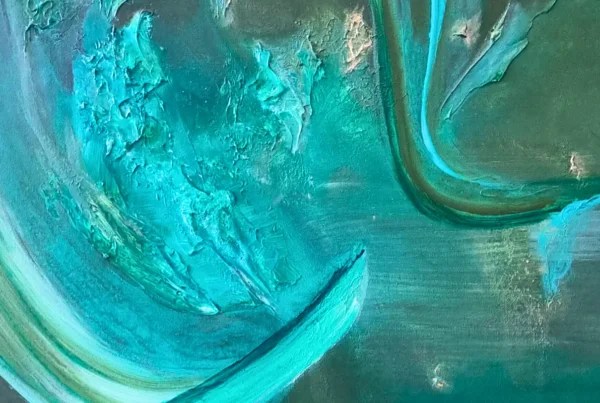
A notable evolution within this body of work is the introduction of green and turquoise pigments, which enter into dialogue with the residual presence of indigo. This shift reflects not a departure from her established visual language but an adaptation to the specific conditions of the Venetian lagoon. The resulting palette captures subtle variations in salinity, depth, and light, translating hydrological characteristics into visual form. These colors do not merely describe the environment. They embody it, allowing the work to resonate with the physical reality from which it originates.
Equally significant is the responsive nature of the works themselves. Sensitive to humidity, the paper surfaces continue to react to their surroundings, expanding and contracting as atmospheric conditions fluctuate. This hygrometric quality transforms the exhibition into a temporal experience, where each viewing moment reveals slight variations in texture and tone. The artworks are not fixed objects but evolving entities, maintaining an ongoing relationship with their environment. In this way, Cabanne extends her exploration beyond the act of creation, positioning the work within a continuous cycle of interaction, where material, space, and viewer converge in a shared experience of transformation.