“Iva Tratnik’s artistic practice could be described, with a bit of her favorite humor, as transgressive realism.”
A Language of Excess, Transformation, and Visual Intensity
Iva Tratnik stands as a compelling figure within contemporary art, recognized for a practice that resists confinement to any single medium or stylistic category. Born in 1980 and educated at the Academy of Fine Arts and Design in Ljubljana, she has cultivated a multidisciplinary approach that moves fluidly across painting, textile collage, sculpture, drawing, installation, and performance. Her work commands attention through its dense visual intensity, where forms proliferate and intertwine in compositions that appear almost alive. Rather than presenting a stable image, Tratnik constructs environments saturated with movement, growth, and mutation, inviting viewers into spaces where perception itself becomes unsettled. This expansive artistic vocabulary reflects a sustained inquiry into how images can embody complexity, contradiction, and transformation without settling into fixed meaning.
Her visual language is immediately recognizable due to its abundance and intricacy, often described as a vivid accumulation of organic and hybrid forms. Totemic masks morph into insect-like structures, while microscopic organisms seem to expand into entire ecosystems populated by imagined flora and ambiguous landscapes. These elements do not exist in isolation but merge into dynamic constellations that evoke both fascination and discomfort. Although some critics have associated her work with magical realism, such a label falls short of capturing its specificity. The dreamlike quality present in her compositions does not align neatly with surrealist traditions; instead, her imagery remains grounded in a material and bodily logic that insists on its own internal coherence. Her preferred notion of transgressive realism offers a more fitting description, emphasizing how her work stretches and disrupts the boundaries of the real rather than escaping it.
This commitment to expansion extends beyond imagery into the very structure of her practice. Painting serves as a foundational element, yet it is continually reconfigured through the integration of textiles, assemblage, and relief. Surfaces become tactile and layered, blurring distinctions between image and object, decoration and structure. Ornamentation plays a crucial role, functioning not as passive embellishment but as an active force that shapes the visual field. Repetitive patterns reminiscent of textiles or wallpaper generate rhythm while simultaneously enclosing and destabilizing the composition. Within these environments, ruptures emerge in the form of fragmented bodies and hybrid anatomies, creating a tension between seduction and disruption that defines her artistic voice.

Iva Tratnik: Formative Worlds and the Making of an Independent Vision
Tratnik’s early life unfolded in an unorthodox environment that profoundly shaped her artistic sensibility. Raised by student parents within an expressive circle of family and friends, she experienced a childhood immersed in both high and low cultural influences. During this period, Slovenia was transitioning from socialism to capitalism, creating a unique social atmosphere in which creative freedom persisted without strong economic constraints. Many people engaged in artistic expression regardless of their profession, while also remaining informed about Western and global cultures through television and other media. This context allowed her to engage with a broad spectrum of expressions while living within a strong communal framework. Listening to David Bowie as a bedtime ritual and absorbing diverse influences from an early age, she developed a sensibility attuned to hybridity, experimentation, and the coexistence of contrasting elements.
Her adolescence, marked by introspection, became a period of intense internal cultivation. Drawing functioned as both refuge and necessity, enabling her to construct an inner world that would later inform the complexity of her artistic output. These formative experiences established a pattern of self-reliance and imaginative independence that would continue to define her approach. Rather than adhering to established norms or expectations, she gravitated toward a personal visual language shaped by instinct, observation, and continuous experimentation. This inward orientation did not limit her scope; instead, it provided the foundation for a practice capable of engaging with broader cultural and existential questions.
Her time at the Academy of Fine Arts and Design in Ljubljana introduced her to formal artistic training, yet it also highlighted the limitations of institutional frameworks. Surrounded predominantly by older male professors who emphasized the canon of high modernism and Western art history, she found herself distanced from the narratives being presented. This disconnection led her to develop a largely self-directed approach, refining her practice outside the confines of prescribed methodologies. The result is an artistic voice that maintains a critical awareness of tradition while refusing to be constrained by it. Her work reflects both an engagement with and a departure from academic discourse, positioning her as an artist who constructs meaning through independence and sustained inquiry.

Embodied Fractures and Material Intelligence
Central to Tratnik’s work is an exploration of the body as a site of instability, transformation, and reconfiguration. Her figures rarely appear as complete entities; instead, they emerge as assemblages of fragments, suggestions, and hybrid forms. Limbs detach from recognizable structures, organs shift into unfamiliar contexts, and skeletal elements merge with botanical or synthetic components. This fragmentation does not signify absence but rather multiplicity, suggesting that identity is never singular or fixed. Through these compositions, the body becomes both subject and material, a space where boundaries dissolve and new configurations take shape. This approach situates her within a broader lineage of post-surrealist figuration while maintaining a distinctly contemporary sensibility grounded in material exploration.
Materiality plays a crucial role in articulating these ideas. Fabric, stitching, and collage function as more than decorative techniques; they operate as conceptual tools that evoke processes of repair, concealment, and transformation. The use of textiles introduces associations with skin and domesticity, while also referencing broader cultural and historical contexts. These elements contribute to a layered visual language in which meaning is embedded not only in imagery but also in the physical construction of the work. The interplay between softness and structure, between organic growth and constructed form, creates a dynamic tension that reinforces the complexity of her themes. Each piece becomes an object that embodies its own process of making, emphasizing the inseparability of concept and material.
Color further amplifies this duality, operating within a spectrum that ranges from vivid, almost synthetic hues to subdued, earthy tones derived from textile traditions. Bright greens, electric blues, and fleshy pinks heighten the immediacy of her compositions, while muted browns and neutral patterns ground them in a tactile, familiar register. This chromatic contrast underscores the friction between natural and artificial elements, reinforcing the sense of instability that permeates her work. Ornament and disruption coexist within the same visual field, creating compositions that are at once alluring and unsettling. Through this interplay, Tratnik constructs environments that challenge viewers to reconsider the relationship between beauty, discomfort, and transformation.

Iva Tratnik: Totem, Tatu, and the Rituals of Becoming
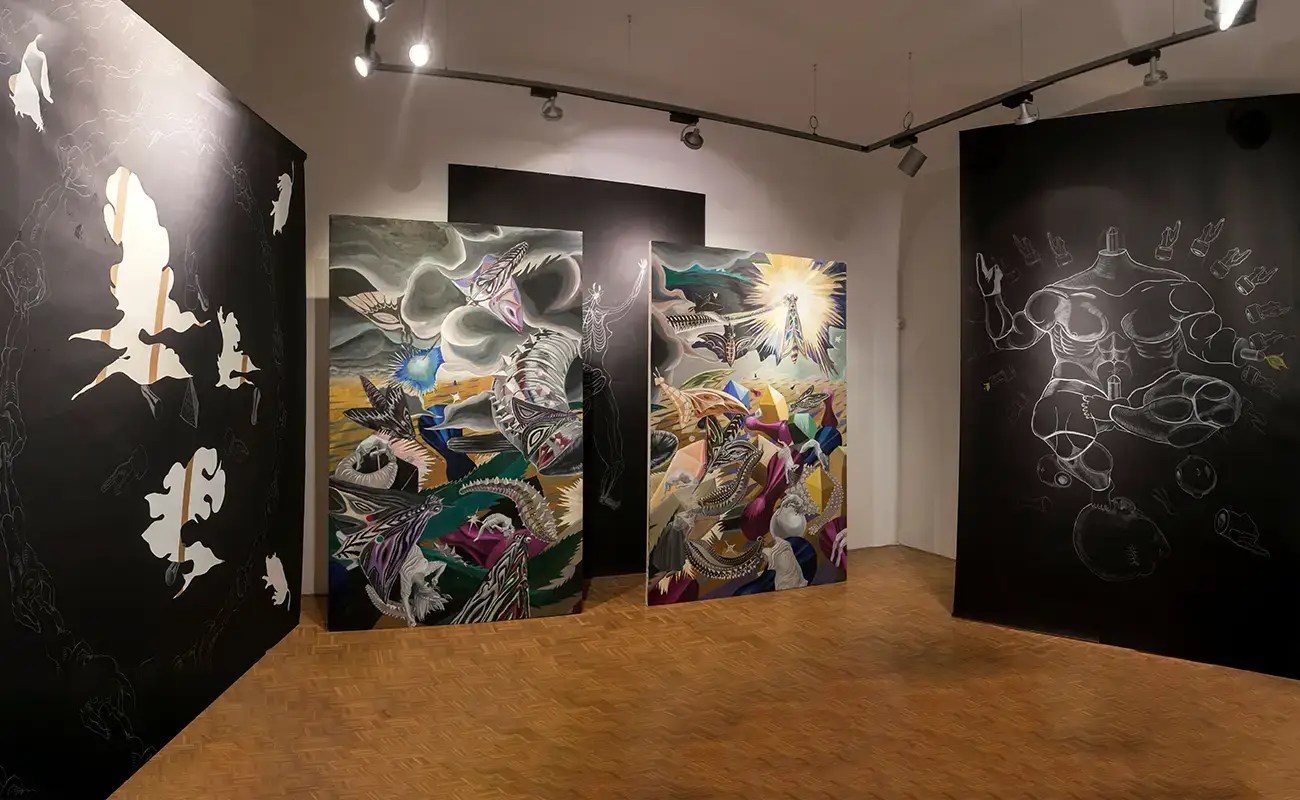
The exhibition Totem and Tatu represents a significant articulation of Tratnik’s artistic concerns, bringing together paintings, tapestries, and textile sculptures in a unified yet multifaceted installation. This body of work creates an environment that feels both fertile and decaying, abundant yet fragile. Organic forms proliferate alongside images of disintegration, producing a visual atmosphere charged with tension. Skulls, exposed bodies, and displaced organs appear within settings characterized by intense growth and vitality, suggesting a coexistence of life and death that resists resolution. This interplay generates a sense of continuous transformation, where creation and dissolution occur simultaneously, shaping a space that feels both immersive and unsettling.
The exhibition’s title references Freud’s Totem and Taboo, invoking questions about the origins of culture and the structures that govern human behavior. However, Tratnik’s interpretation moves beyond direct theoretical engagement, instead presenting a visual exploration of rituals and symbolic systems that address the discomfort of human existence. The works suggest a quasi-ritualistic environment populated by objects and forms that function as contemporary artifacts of belief. These elements, drawn from diverse temporal and cultural references, create a setting that feels both ancient and immediate. Through this synthesis, the exhibition engages with enduring questions about identity, mortality, and the mechanisms through which individuals navigate their own vulnerability.
Within this context, the body emerges as a central site of negotiation, particularly in relation to gender and lived experience. The exhibition can be understood as a reflection on the specific complexities of being a woman, articulated through imagery that resists idealization and embraces contradiction. Fragmentation, excess, and transformation become strategies for addressing the instability inherent in human existence. Rather than offering resolution, the works maintain a state of tension that invites ongoing interpretation. This approach reinforces Tratnik’s broader practice, in which meaning is not fixed but continuously generated through the interaction of material, image, and viewer.