
“Darkness is not an absence of light, but a necessary condition that sharpens perception and allows for a more attentive way of seeing.”
Painting Beyond Language: Origins of an Introspective Vision
Daun Suh’s artistic journey emerges from a deeply personal impulse to communicate beyond the limitations of speech. Born and raised in South Korea, she later relocated to Chicago after completing her MFA at the School of the Art Institute of Chicago, carrying with her a sensibility shaped by cultural memory, emotional introspection, and an enduring curiosity about human experience. During childhood, she often felt misunderstood, sensing a gap between her internal world and the ways others perceived her words and actions. Painting became a vital alternative language, one that allowed her to convey sensations and thoughts with a directness she could not achieve through conversation. This early reliance on visual expression continues to inform her practice, positioning painting not simply as a medium but as a mode of inquiry into perception, existence, and the fragile nature of understanding between individuals.
Her work focuses on the uncertain boundary between presence and absence, probing how bodies, interior states, and surrounding environments intersect and influence one another. Rather than depicting what is clearly visible, she gravitates toward phenomena that linger at the threshold of recognition. Subtle emotional tensions, fleeting sensations, and atmospheric shifts become key components of her imagery. Through this approach, she constructs visual spaces that feel simultaneously intimate and elusive, inviting viewers to question what can truly be known or grasped. This persistent attention to ambiguity reflects her broader philosophical interest in the unseen dimensions of experience, including memory, solitude, and the unspoken forces that shape daily life.
Living and working in Chicago has further expanded her perspective, placing her in dialogue with a dynamic artistic community while reinforcing her commitment to introspection. The city’s shifting light, varied architecture, and quiet pockets of stillness offer her opportunities for observation that feed directly into her creative process. Yet even within this new environment, she remains grounded in the formative influences of her upbringing. The interplay between past and present continues to guide her exploration of perception, allowing her paintings to function as spaces where emotional and physical realities converge. In this way, her background serves not merely as context but as an active force shaping the themes and methods that define her evolving practice.

Daun Suh: Solitude, Darkness, and the Shifting Image
From an early age, Suh encountered art through academies in South Korea, where she developed a fascination with the transformative potential of a blank surface. The act of constructing an image from nothing captivated her imagination, offering both technical challenge and philosophical intrigue. Over time, her focus moved beyond skill toward deeper questions about human relationships and the complexities of perception. Experiences of misunderstanding, both personal and interpersonal, encouraged her to reflect on solitude as an essential aspect of life. This awareness gradually expanded into a contemplation of mortality, leading her to view existence as a continuous process that moves toward an inevitable end. Rather than approaching these themes with despair, she treats them as fundamental conditions that heighten sensitivity and sharpen awareness.
In Suh’s work, darkness functions not as a void but as an active presence that clarifies vision. She considers it a necessary counterpart to illumination, one that enables more attentive seeing and feeling. This conceptual stance informs her visual language, which often unfolds through cycles of layering, erasure, and revision. Paint accumulates only to be partially removed, leaving traces that suggest both emergence and disappearance. Forms hover in a suspended state, never fully resolved, capturing a sense of constant transformation. Such processes mirror the instability she perceives in emotional and physical experience, where certainty remains elusive and perception continually shifts.
Her commitment to flux extends beyond technique into the conceptual structure of each painting. Images resist stabilization, encouraging viewers to remain alert and receptive rather than seeking definitive interpretation. This openness reflects her belief that understanding is always provisional, shaped by time, memory, and individual perspective. Through repeated gestures of making and unmaking, she constructs compositions that feel alive with tension. The resulting surfaces convey an atmosphere of quiet intensity, where subtle transitions replace sharp contrasts and where presence appears to flicker at the margins of visibility. This nuanced approach has become a defining characteristic of her style, distinguishing her within contemporary painting discourse.

Ritual, Loss, and the Quiet Influences That Shape Seeing
Personal history plays a central role in Suh’s artistic development, particularly her early exposure to rituals surrounding death in Korea. Each year, her family participated in ancestral rites that involved preparing traditional foods, lighting incense, and bowing in reverence to those who had passed away. These repeated acts instilled in her a profound awareness of continuity between the living and the deceased, shaping her understanding of presence as something that can exist beyond physical form. Such experiences encouraged her to question conventional distinctions between life and death from a young age. Over time, these reflections became embedded in her visual language, informing her exploration of what it means for something to be perceptible yet intangible.
Later encounters with personal loss and periods of depression deepened these inquiries, intensifying her sensitivity to states of simultaneous appearance and disappearance. Depression, in particular, introduced her to the unsettling sensation of feeling both present and absent within her own life. This paradox resonates strongly in her paintings, where forms seem to hover between material solidity and dissolution. Rather than depicting dramatic narratives, she turns her attention toward understated moments that often escape notice. Dim interiors, fleeting glimmers of light, and objects situated at the edge of attention become catalysts for image-making. Through these observations, she constructs compositions that echo the emotional textures of her experiences.
Her attraction to subtle atmospheres extends into her daily routines, where careful observation guides the development of new ideas. She frequently photographs overlooked details such as shadows pooling in corners or transient shifts in illumination that last only seconds. These visual fragments function as reflections of her inner world, offering starting points for further exploration in the studio. Solitary night walks also provide fertile ground for contemplation, allowing her thoughts to expand in the stillness of darkness. Notes gathered from books, films, and articles that resonate with her themes contribute additional layers of meaning. Together, these influences create a complex network of references that informs both the conceptual and material dimensions of her practice.

Daun Suh: Material Transitions and the Resonance of “This is not here”
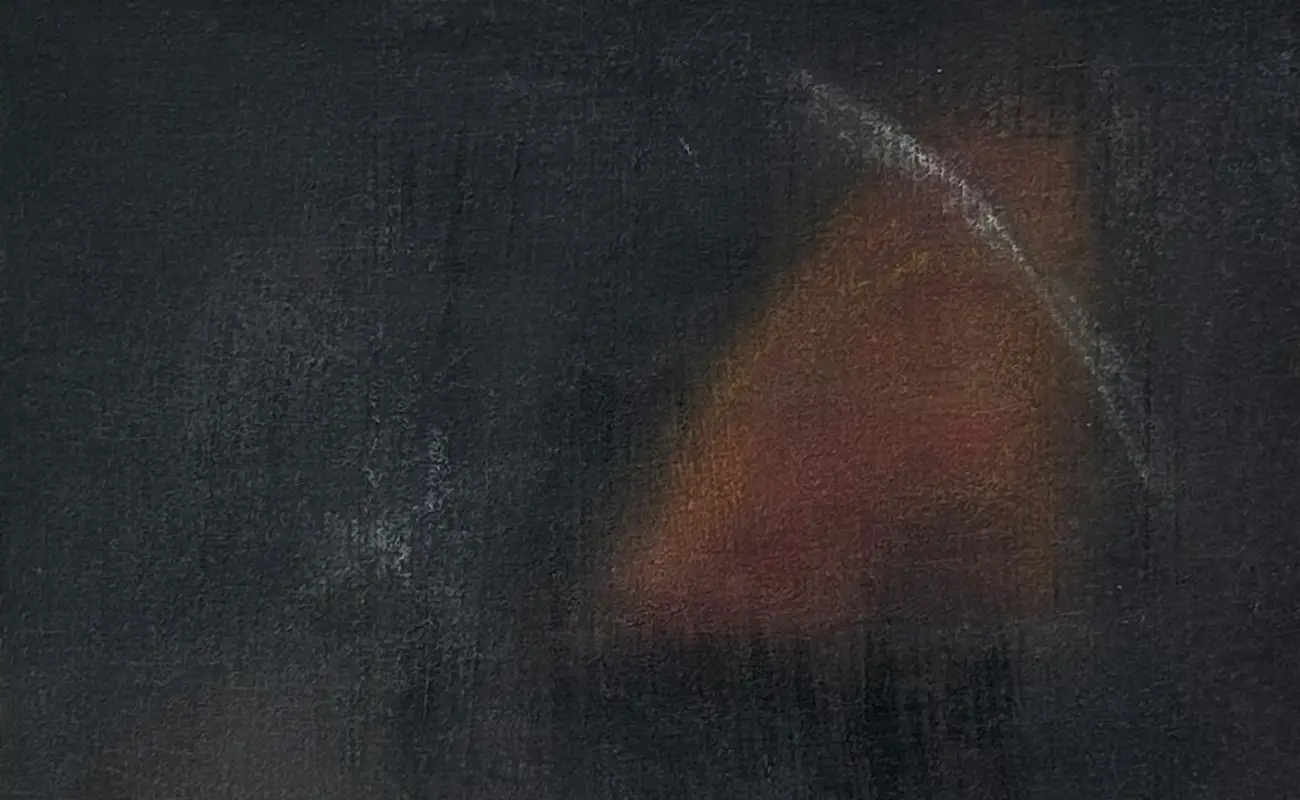
Among the works that hold particular significance in Suh’s oeuvre, the painting This is not here stands as a pivotal moment of transformation. Conceptually, the piece represents a breakthrough in her investigation of the fragile relationship between presence and absence. Through a sustained process of layering and erasing both darkness and light, she allowed the image to surface gradually while remaining in a state of instability. Rather than pursuing a clearly defined form, she focused on capturing the transitional instant in which something appears to exist yet remains just beyond reach. This emphasis on in-between states clarified the core concerns of her practice, revealing how perception itself can become a site of tension and uncertainty.
Materially, the painting also marked a shift in her technical approach. Earlier works often relied on acrylic ink to establish luminous areas, producing sharper contrasts that anchored compositions more firmly. With This is not here, she began to move away from these fixed boundaries, embracing softer transitions that permitted greater ambiguity. This evolution did not replace her existing methods but expanded them, encouraging experimentation with oil on canvas and the integration of unconventional substances. She started mixing charcoal powder into oil paint and hand-dyeing linen surfaces, exploring how texture and dispersion could influence the viewer’s experience of visibility and disappearance. These material investigations opened new pathways for expressing the conceptual themes that define her work.
Her studio practice continues to unfold through cycles that balance immediacy with contemplation. She creates landscape-oriented pieces on small wood panels, using their scale to investigate memory’s instability in a concentrated format. After completing a series of panels, she transitions to larger figurative compositions on canvas or linen, allowing ideas to evolve across different dimensions. This movement between formats sustains a sense of momentum and prevents the work from becoming static. Looking toward the future, she aims to extend her interest in charcoal’s ash-like qualities into installation, bringing the tension between presence and absence into three-dimensional space. By expanding her material vocabulary in this way, she seeks to create environments where viewers can physically encounter the delicate interplay of what is seen and what slips away.