“Only explosion can create new identity. So, explode your ideas!”
From Cosmic Origins to the Artist’s Studio
Trupti Dave Wehner stands at a rare intersection where laboratory precision meets artistic intuition, shaping a practice that unites chemistry, physics, and visual expression. Based in Berlin, she is trained as a chemist and self-taught as an artist, a combination that informs every dimension of her work. For her, art and science are not opposing disciplines but inseparable companions. She often reflects on the Greek terms “Techni,” referring to the act of making, and “episteme,” meaning knowledge, once used interchangeably by Plato. Within this philosophical lineage, she situates her own approach, viewing art as the aesthetic translation of scientific understanding into sensory experience. What begins as data, theory, or molecular interaction is transformed into color, surface, and movement. This conceptual framework elevates her paintings beyond visual compositions, positioning them as perceptible manifestations of invisible forces that shape existence itself.
Her scientific background continuously guides her curiosity toward the origins of color, the physics of light, and ultimately the beginnings of life. These investigations extend outward to a cosmological scale, where the birth of the universe becomes the earliest chapter in the story of painting. Around 13.7 billion years ago, the Big Bang initiated expansion and cooling, leading to nuclear reactions that produced hydrogen, helium, and lithium. Subsequent processes formed heavier elements up to iron, while elements beyond iron emerged only during supernova explosions through complex neutron capture events. In her thinking, the pigments and materials used in art are direct descendants of these stellar events. Paintings, therefore, originate in galaxies long before they enter galleries. This cosmic perspective reframes artistic creation as part of an immense chain of transformations, linking the studio to stellar furnaces and the viewer to ancient astronomical phenomena.
Such reflections influence the way she perceives visual energy. When photons strike a painted surface, they travel on light waves toward the human eye, animating color and form. Digital painting, in contrast, suggests an encounter with matter at a quantum scale, a subtle interaction with the structure of elements themselves. This dual understanding prompts a provocative question at the heart of her practice: is art a source of energy because it literally engages with light and matter? In her view, visual art is not passive decoration but a dynamic exchange between physical forces and perception. By framing painting as a continuation of cosmic and atomic processes, she invites audiences to consider each canvas as an energetic field. The artwork becomes a site where universal history, scientific inquiry, and human emotion converge into a vivid and immediate experience.

Trupti Dave Wehner: Imagining Life from Primordial Soup to Conscious Form
Since 2015, Trupti Dave Wehner has expanded her inquiry through experimentation with digital painting, uniting her fascination with color chemistry and contemporary technology. Over time, this exploration evolved into a synthesis of digital imagery and acrylic painting, frequently incorporating polymeric materials to produce sculptural and plastic elements. Exhibitions in Berlin have presented these hybrid works, where luminous surfaces and layered materials suggest both microscopic structures and vast cosmic expanses. Her style is driven by persistent questioning and a desire to experience what she describes as an unforgettable aesthetic journey into the unknown. Chemistry and physics serve as intellectual engines that propel her toward new ways of thinking about a technologically advancing yet still mysterious world. Each project becomes an investigation, not only of materials and processes, but also of humanity’s place within a universe governed by scientific laws and creative possibility.
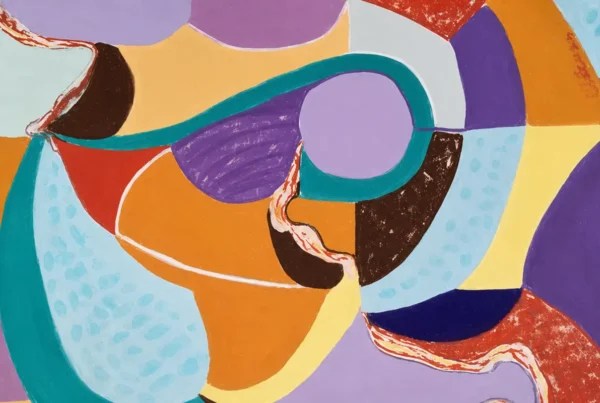
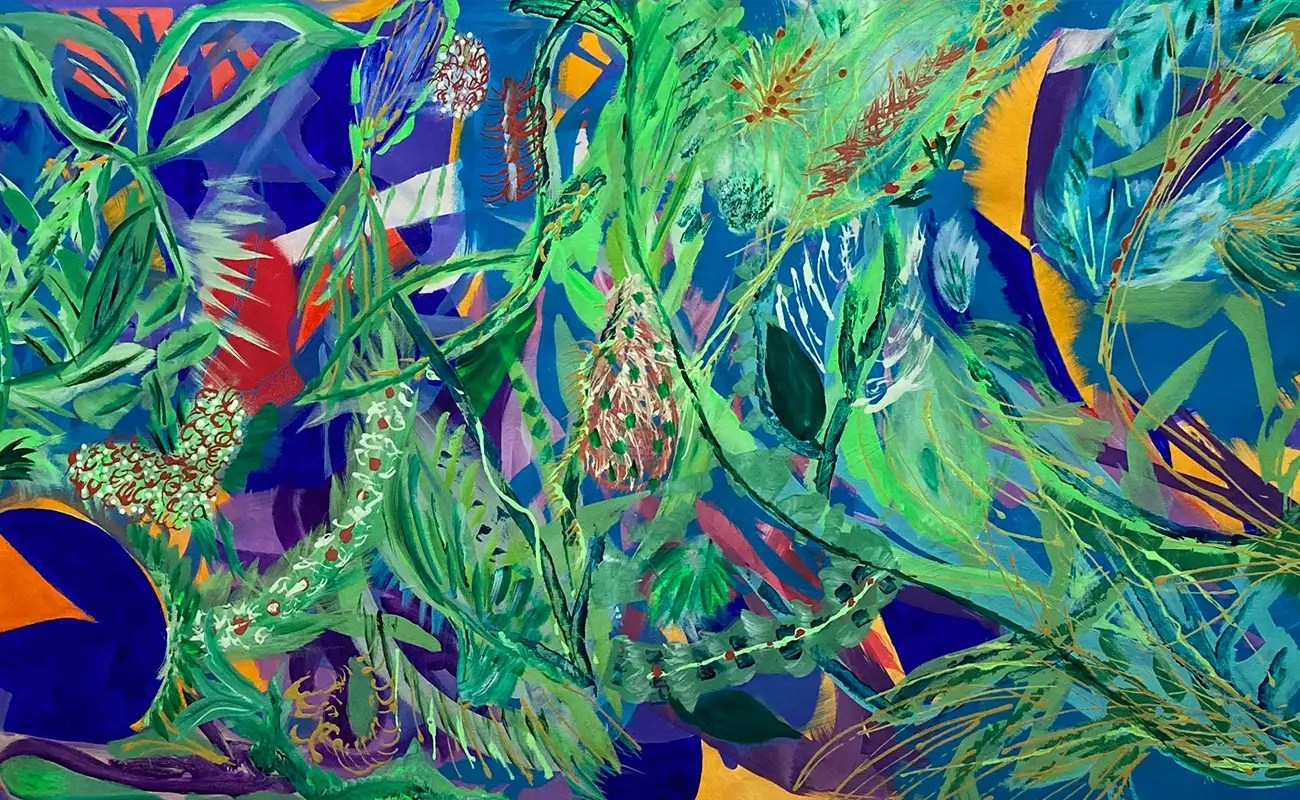
Many of her paintings reflect imagined stages in the formation of life on Earth, beginning with the primordial soup and moving toward the emergence of the eukaryotic cell. She envisions fleeting cosmic seconds during evolutionary turning points, translating invisible molecular forests into visible, aesthetic forms. Swirling colors and layered transparencies evoke chemical reactions, cellular membranes, and the fragile architecture of early biological systems. This approach does not illustrate scientific diagrams; instead, it interprets them through intuition and abstraction. The viewer encounters not a literal depiction of evolution but an atmospheric suggestion of processes that unfolded billions of years ago. Through these compositions, she transforms theoretical knowledge into immersive visual environments. The paintings propose that the story of life is not confined to textbooks or laboratories but can be sensed, imagined, and emotionally experienced through color and structure.
One particularly meaningful work, titled Blue Zone, addresses humanity’s enduring desire for longevity. Scientists have identified specific regions of the world where unusually high numbers of people live beyond one hundred years, calling these areas Blue Zones. In this piece, she questions what might be discovered if we could examine the cellular composition of individuals in such regions. Could genetic engineering replicate those characteristics to create humans with customized life spans? Who would have the authority to make such decisions, and how many would have access to this power? The painting extends beyond biological curiosity to ethical and ecological considerations, asking how nature would respond and how evolution might be altered. Blue Zone embodies her method of merging scientific speculation with philosophical inquiry, encouraging viewers to confront both the promise and the complexity of extending human life.

Stellar Matter, Artistic Heritage, and the Necessity of Transformation
Human beings have long sought to understand their presence on Earth, and Trupti Dave Wehner situates this quest within a cosmic narrative. Every atom of calcium in human bones and every atom of iron in blood originated in stars that exploded billions of years ago. This scientific fact carries profound implications for art. The heavy elements that compose essential pigments such as Cadmium Yellow, Cobalt Blue, and Cinnabar Red were forged in stellar deaths and later embedded within Earth’s crust. Without cadmium, cobalt, and mercury, the visual history stretching from the caves of Lascaux to the canvases of Rembrandt would not exist in its known form. By recognizing this lineage, she underscores that artistic heritage is inseparable from astrophysical events. Pigments become condensed starlight, and every brushstroke carries the legacy of supernovae that once reshaped the cosmos.
Her reflections on stellar evolution extend to the metaphorical significance of explosion and transformation. When a star does not explode, it becomes a white dwarf, dense and limited, radiating only residual heat without generating new elements. In the formation of future stellar bodies, such an object contributes little to renewal. By contrast, explosive events create the conditions for new identities and material possibilities. This astronomical principle informs her creative philosophy. Ideas, like stars, must undergo rupture to give birth to something unprecedented. Creative stagnation mirrors the quiet fading of a white dwarf, while conceptual risk parallels the dynamic force of a supernova. Through this analogy, she encourages a mindset that embraces change and reinvention. Artistic growth, in her understanding, depends on moments of intensity that shatter boundaries and allow new forms to emerge.
This cosmic framework strengthens the conceptual depth of her work, linking scientific knowledge with cultural continuity and personal expression. The materials she employs are not neutral substances but carriers of universal history. By drawing attention to the stellar origins of pigments, she invites viewers to reconsider the physical substance of art. Paintings are not merely images on a surface; they are accumulations of transformed matter shaped by astronomical and geological processes. Such awareness shifts the perception of artistic creation from a purely human endeavor to a collaborative act between humanity and the universe. The canvas becomes a meeting point where ancient cosmic events, scientific understanding, and contemporary creativity intersect. Through this perspective, her work fosters a renewed appreciation for the profound interconnectedness that binds stars, materials, artists, and audiences.

Trupti Dave Wehner: Light, Matter, and the Alchemy of Transparency
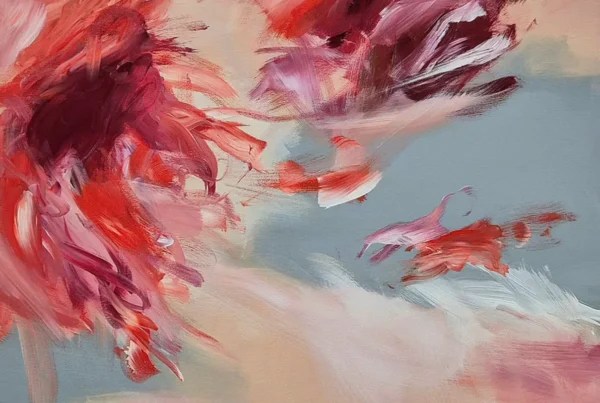
Within her Berlin studio, which overlooks woods and grazing deer, Trupti Dave Wehner develops large-scale acrylic paintings often measuring between 150 and 250 centimeters. She typically advances two or three projects simultaneously, allowing them to influence one another and form interconnected episodes. This method reflects the Buddhist concept of dependent origination, which holds that phenomena arise in relation to other phenomena and never in isolation. Her digital works begin on a tablet and are later printed onto acrylic sheets, a process she interprets as the transformation of optical energy into tangible matter. Transparent polymeric materials play a central role, creating a visual dialogue between light and substance. Surfaces absorb, reflect, and transmit energy, producing shifting spectra that evolve as the viewer moves. The result is a dynamic interplay in which color appears as the visible outcome of interaction.
In this ongoing investigation, she considers whether the relationship between light and matter represents a struggle or a union. Light alone remains invisible, and energy without interaction lacks perceptible form. When a beam is separated into a spectrum, color emerges and energy becomes observable. During the printing process, what originates as luminous data acquires mass and presence, concentrating energy within a physical surface. Acrylic glass mediates this exchange, absorbing and releasing photons while maintaining transparency. At times she frames this progression as a transition in which matter dissolves into light or light permeates matter, culminating in a state of transmutation. The artwork stands as localized energy with a subtle gravitational pull on perception. Alongside these explorations, she is initiating a new project that seeks to integrate art into healthcare and medicine through collaboration with medical experts at a local hospital, extending her inquiry into the restorative potential of visual experience.