The Architecture of Tension
Túlio Pinto has built a singular position within contemporary sculpture by transforming gravity into both subject and collaborator. Born in Brasília in 1974 and now based in Porto Alegre, he constructs works that appear to resist the very laws that govern them. Iron beams lean into glass volumes, concrete presses against air, and blocks of stone seem to hover in improbable stillness. At first glance, his compositions may evoke the disciplined vocabulary of Brazilian Constructivism or the clarity associated with international minimalism. Yet the experience of standing before his sculptures quickly exceeds formal reference. What emerges instead is a charged encounter with balance under pressure, a moment in which opposing materials negotiate coexistence. Through these orchestrated confrontations, Pinto proposes that physical forces can echo social and emotional ones, suggesting that harmony is not given but continuously achieved.
Raised in Brazil, Pinto developed an early fascination with tension understood not as metaphor alone but as a measurable interaction between forces. From the outset of his career, he was captivated by the fragile equilibrium produced when weight, density, and dimension counteract one another. That fascination materialized in sculptures where colored balloons were compressed by heavy concrete slabs, works that seemed to breathe slowly beneath the burden imposed upon them. Viewers sensed an anxious suspension, as though the pieces might exhale and collapse at any instant. This sensation of a breath held too long became a defining characteristic of his practice. Over time, the balloons gave way to blown glass, and concrete beams were replaced by iron rebars or wooden blocks. Steel cables and fabric straps began to bind disparate elements together, expanding his vocabulary while maintaining a rigorous investigation into the dynamics of pressure and resistance.
Rather than carving or molding materials into predetermined forms, Pinto approaches sculpture as an act of articulation. He does not rely on traditional sculptural tools, nor does he reshape matter to fit a preconceived image. Instead, he selects materials in their given state and positions them in unstable relationships governed by gravity itself. This method places him in dialogue with the legacy of Russian Constructivism, which legitimized industrial materials and structural logic within art. However, his work moves beyond historical citation. Each configuration transforms difference into a new sculptural outcome, one that feels at once inevitable and precarious. The persistent objective, as he has stated, is to render the invisible visible by giving tangible form to gravity, a force that dominates every body yet remains unseen. Through this focus, he shifts attention from surface appearance to the silent mechanics that shape both objects and lives.

Túlio Pinto: Between Order and Collapse
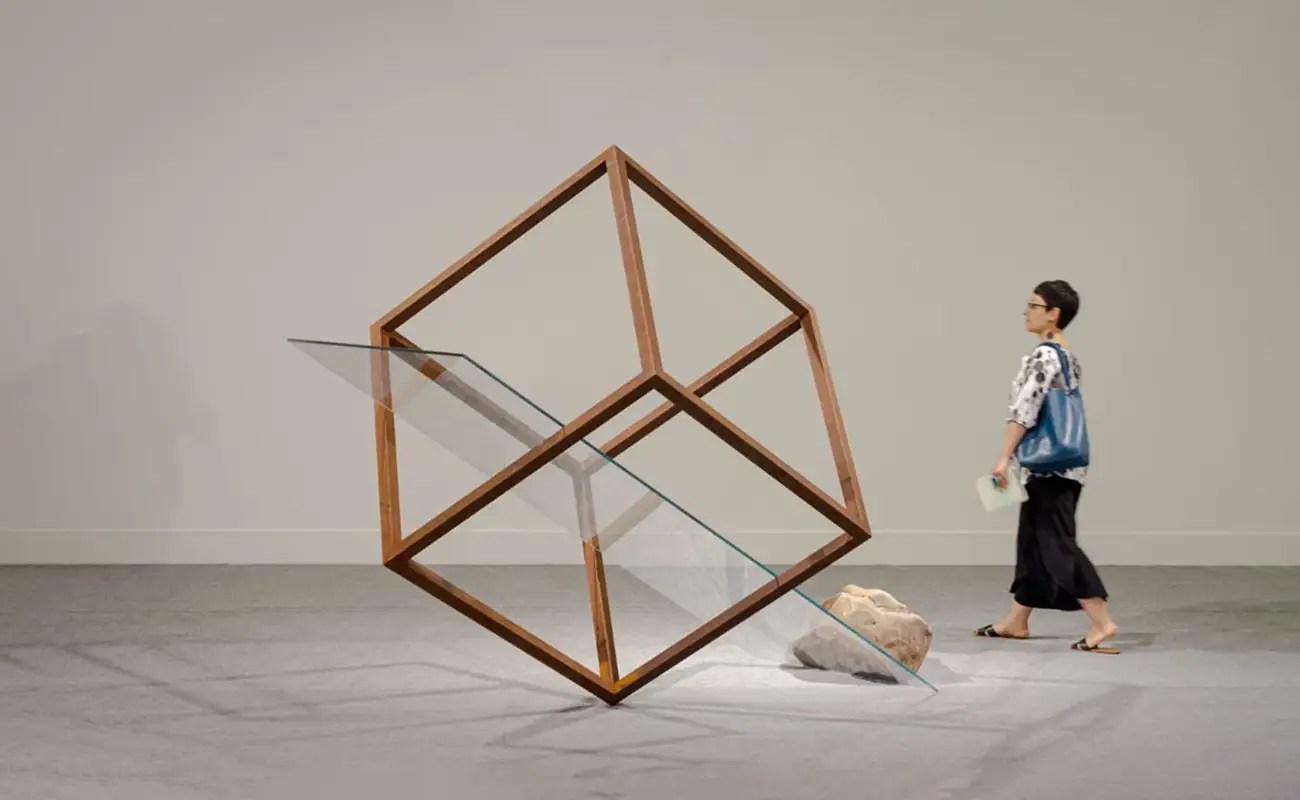
The word antithetical seems inseparable from Pinto’s production. His sculptures oscillate between geometric precision and organic unpredictability, between opacity and transparency, lightness and mass. Iron I beams evoke architectural rationality reminiscent of figures such as Le Corbusier, Oscar Niemeyer, Lucio Costa, Lina Bo Bardi, Frank Lloyd Wright, and even Zaha Hadid. Yet these structural references are unsettled by amorphous glass forms or accumulations of sand that appear vulnerable and transient. The resulting compositions feel suspended in time, as if caught in the instant before a fall. This cultivated instability is not theatrical but disciplined. Each element remains materially honest, and nothing is disguised. Steel compresses glass, glass braces iron, and stone counters metal without illusion. Through this interplay, Pinto transforms sculpture into a diagram of forces, inviting viewers to sense the push and pull that sustains the entire arrangement.
One of the most emblematic episodes in his career underscores the centrality of risk. During the installation of a solo exhibition at Baró Gallery in São Paulo in 2013, Pinto constructed a monumental cube of wet sand measuring 1.60 meters on each side, connected to a sheet of glass. The work embodied constructive danger, invoking the childhood metaphor of sandcastles while confronting the limits of structural resistance. During assembly, the sand cube collapsed into heavy fragments on the floor. Rather than rebuilding it, he chose to incorporate the accident into the final piece. The collapse intensified the sculpture’s meaning, revealing vulnerability as an intrinsic condition rather than a flaw. Pinto has spoken of his fascination with the abyss, particularly the threshold at which materials reach their limit. Fear, for him, is not paralyzing but generative, a guide that pushes him toward discoveries found only at the edge of failure.
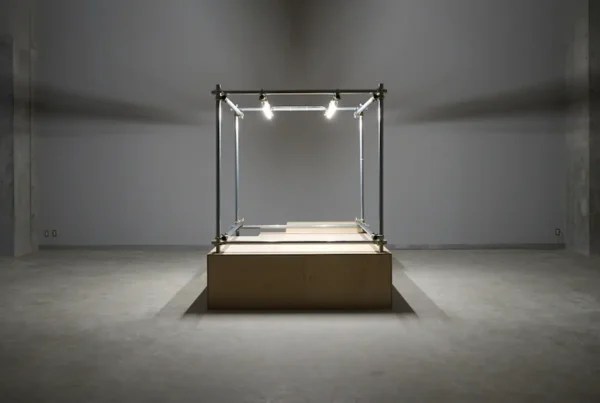
This negotiation between order and collapse extends to works that engage architectural space directly. In Trajetórias Ortogonais, wooden blocks were held in suspension through the tension created between walls, ceiling, and floor, relying solely on gravity and pressure for stability. The gallery itself became a structural component, transforming space into an active participant. Another installation, Práticas de reconhecimento e algumas aproximações from 2012, referenced Giovanni Anselmo’s Arte Povera gesture La Scultura Che Mangia. Pinto assembled boxes containing vegetable beds that pressed against latex balloons, creating a living system of compression. At the close of the exhibition, part of the installation was served as salad to visitors, collapsing distinctions between artwork and daily life. Through such gestures, he reaffirms that equilibrium is temporary and relational, shaped by time, consumption, and the continuous exchange between organic and inorganic matter.

Material Choreographies and Invisible Forces
Pinto’s sculptures often occupy a threshold between object and installation, activating not only mass but also void. Sheets of transparent glass slice through solid volumes, producing optical continuities that complicate perception. Negative space becomes as consequential as steel or stone, and the viewer becomes acutely aware of gravity pressing downward and tension stretching laterally. Many compositions resemble systems in which every element depends upon another for survival. Cubes tilt on marble ellipses, circular bands contain crystalline forms, and planes of glass function like ligaments binding heavier components. The impression is one of imminent movement, although the structure remains still. By allowing materials to retain their inherent properties, he foregrounds the physical and visual capacities of matter itself. The sculptures thus operate as ideograms, silent propositions about the forces shaping the world beyond the gallery walls.
His interest extends to substances that oscillate between states, reinforcing the idea that permanence is an illusion. Ice and tar have entered his investigations, as has glass understood not as fixed transparency but as sand transformed through heat and capable, over centuries, of slow deformation. Sand itself has become a recurring element, both as a structural risk and as a symbolic reference to dreams built on shifting ground. Such materials emphasize transience and variability, challenging conventional expectations of durability in sculpture. Although he admits he was not an exemplary physics student, his work demonstrates a sustained fascination with the discipline. For larger and more complex pieces, he occasionally collaborates with structural engineers to calculate loads and stresses. Most often, however, intuition and attentiveness to material behavior guide his decisions, revealing potential only when matter is placed in unfamiliar configurations.
Through these explorations, Pinto articulates a broader reflection on coexistence. The tension between rigidity and fragility, balance and fall, mirrors the negotiations inherent in human relationships. His works do not dramatize instability as spectacle; instead, they present it as a condition of life. Harmony appears not as a fixed state but as a shifting territory continually redefined by opposing forces. When materials of contrasting nature are integrated into a single system, their differences do not disappear. Rather, they become the very basis of equilibrium. This perspective lends his practice a poetic dimension that transcends formalism. The sculptures suggest that vulnerability and resistance are intertwined, and that stability emerges from the careful calibration of contrasts. In this way, gravity becomes more than a physical law. It becomes a lens through which interdependence and shared tension can be understood.

Túlio Pinto: Expanding Horizons
Pinto’s trajectory has been marked by increasing international visibility and a consistent presence in major exhibitions. He has presented solo shows at institutions and galleries such as Museu Oscar Niemeyer in Curitiba, Millan in São Paulo, Fondamenta Sant’Apollonia and Piero Atchugarry Gallery in Venice, Galeria Senda in Barcelona, Humo Gallery in Zurich, Phoenix Institute of Contemporary Art in the United States, and Santander Cultural in Porto Alegre, among others. His participation in significant group exhibitions includes the 13th Mercosul Biennial in Porto Alegre, Manifesta in Lyon, Marta Herford Museum in Germany, and Museu de Arte do Rio Grande do Sul. Awards such as the 65th Salão Paranaense and the Energisa Artes Visuais Award further attest to the recognition of his practice. These milestones confirm not only the solidity of his artistic vision but also the resonance of his investigations across diverse cultural contexts.
Residencies abroad have broadened his conceptual range, introducing what he describes as mental sculpting intermediations. During a period in Phoenix, Arizona, he developed experiences that extended beyond static objects into performance and video. The work Unicórnio from 2016 exemplifies this expansion. In the video, Pinto wanders among the rock formations of the Superstition Mountains, carrying helium filled balloons that punctuate the arid landscape with bursts of color. The balloons function as graphic signs in space, linking his sculptural language to the vastness of the desert. Mythological references such as the unicorn or even the minotaur surface as metaphors for displacement and desire, suggesting that imagination persists even in inhospitable terrain. Through these explorations, Pinto reinforces the continuity between object, body, and environment, reaffirming his enduring commitment to tension, risk, and the search for balance in a world defined by opposing forces.