“Painting is not about resolution. It is about holding complexity and allowing fracture to become form.”
Origins of a Fluid Identity
Bianca Pirlog stands within contemporary figurative painting as an artist who transforms portraiture into a meditation on identity, memory, and emotional tension. Born in Romania and currently based in London, with formative academic experience in Japan, her artistic language reflects a life shaped by cultural transition. Each geography contributed not only visual influence but also a distinct psychological framework. Romania instilled a heightened sensitivity to history and emotional intensity, London introduced the dynamics of reinvention and hybridity, and Japan offered a refined understanding of restraint and impermanence. These layered experiences inform her central inquiry: identity is not static but continually adapting, fragmenting, and reforming.
The movement between cultures sharpened her awareness of how the self adjusts in order to belong. Living across different social and symbolic systems revealed how identity translates itself according to context. This recognition forms the psychological foundation of her work. Her portraits frequently function as altered self representations, though never as literal autobiography. Facial features shift subtly, atmospheres change, and emotional tones are recalibrated. These modifications evoke camouflage, suggesting that identity can be both authentic and adaptive at once. Through this lens, portraiture becomes less about capturing likeness and more about articulating the quiet transformations that occur beneath the surface.
This ongoing negotiation between inner continuity and outer change generates the central tension in her practice. The figures she paints appear composed and still, yet they carry an undercurrent of fracture. Emotional presence takes precedence over spectacle, and silence holds greater power than overt drama. The viewer is invited into a suspended state, one that mirrors the artist’s own experience of existing between cultures. Rather than presenting identity as resolved, Pirlog portrays it as something perpetually in formation. The result is work that feels intimate yet universal, grounded in lived experience while resonating with broader questions about belonging and self perception.

Bianca Pirlog: Portraiture as Psychological Architecture
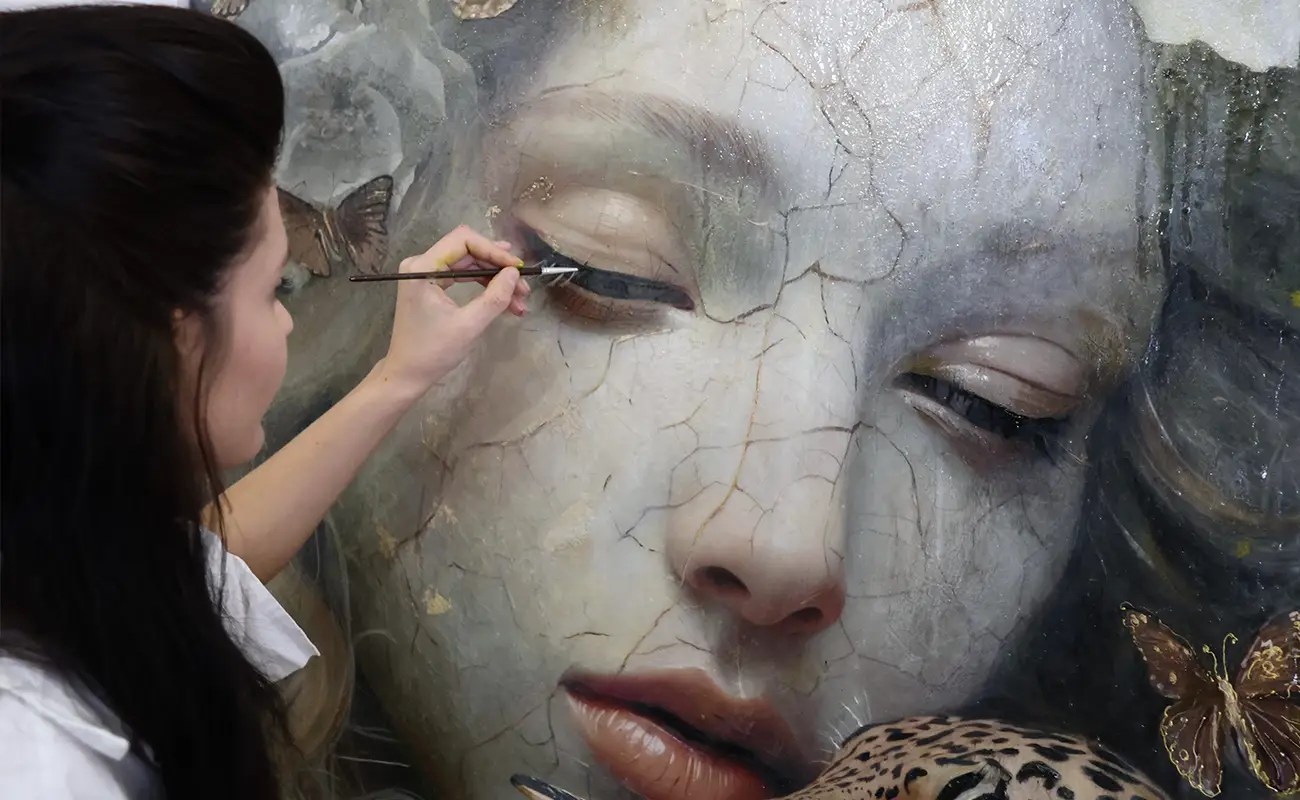
At the core of Bianca Pirlog’s practice lies a devotion to portraiture that transcends representation. Her figures emerge with striking clarity, luminous eyes and carefully modeled skin recalling classical traditions of light and shadow. Yet beneath this technical precision lies a conceptual structure concerned with fragility and resilience. The faces she creates often appear porcelain smooth at first glance, only to reveal networks of cracks that traverse the surface. These fissures transform the portrait from an image of stability into a site of psychological complexity.
The influence of the Japanese philosophy of Kintsugi plays a decisive role in this visual language. During her time in Japan, Pirlog encountered the practice of repairing broken ceramics with gold lacquer, a method that honors damage rather than concealing it. This idea reshaped her understanding of rupture. In her paintings, gold leaf traces fractures across the skin, illuminating rather than disguising them. The break becomes luminous, an assertion that transformation frequently occurs at the point of vulnerability. Through this gesture, weakness is reimagined as strength, and repair becomes a visible record of lived experience.
Her attraction to Japanese literature further deepened her sensitivity to emotional subtlety. Rather than staging dramatic expressions, she gravitates toward suspended psychological states where vulnerability and quiet authority coexist. The gaze of her figures is steady and contemplative, neither confrontational nor submissive. Viewers encounter a presence that feels inward yet undeniably aware. This balance between restraint and intensity gives her portraits a contemplative gravity. Emotional depth is suggested through nuance, allowing silence to carry meaning. In this way, portraiture becomes a form of psychological architecture, constructed through stillness and sustained attention.

Material Alchemy and Surface Tension
Material experimentation plays an essential role in shaping the atmosphere of Pirlog’s work. Her process often begins with digital composition, allowing her to refine structure and balance before committing to physical execution. However, the final pieces are firmly rooted in hand built surfaces. Oil paint, ink, diamond dust, gold leaf, and mixed media are layered onto velvet canvas, producing a tactile richness that digital tools alone cannot achieve. This interplay between technological planning and manual labor creates a dialogue between control and intuition.
The surfaces she constructs are dense and immersive. Velvet absorbs light, deepening tonal contrasts and lending the compositions a hushed intensity. Oil paint is applied gradually, building depth through repeated layers. Ink introduces subtle shadows, while diamond dust catches light with crystalline brilliance. Gold leaf punctuates the surface, marking fracture with radiance. Many works feature textures that resemble real skin, cracked yet luminous, imperfect yet enduring. These tactile qualities reinforce the thematic tension between fragility and resilience, transforming material into metaphor.
Patience defines her daily practice. Each layer requires time to settle before the next can emerge, and depth cannot be accelerated. This slow accumulation of surface creates a palpable sense of presence. Close viewing reveals delicate scoring, raised ridges, and glimmering particles embedded within paint. The physicality of the medium anchors the conceptual inquiry, reminding the viewer that identity, like pigment, is built through accumulation and revision. Through disciplined repetition and intuitive adjustment, Pirlog crafts works that feel both deliberate and alive, holding complexity within every textured plane.

Bianca Pirlog: Holding Complexity Without Resolution
Looking toward the future, Bianca Pirlog seeks to expand both the scale and emotional resonance of her paintings. Larger formats offer the possibility of immersing viewers more completely within her suspended atmospheres. She remains committed to exploring identity as fluid and multifaceted, resisting simplification in favor of layered nuance. The ambition is not to confront or console, but to create a space where the viewer feels quietly suspended. In front of her canvases, time appears to slow, allowing reflection to unfold without urgency.
Her practice ultimately investigates how rupture and resilience coexist without canceling one another. Identity, in her vision, maintains coherence even as it shifts. Fracture does not signal collapse but transformation. Gold lined cracks, luminous skin, and restrained expressions all contribute to this philosophy. Painting becomes a site where contradictions can remain unresolved, where strength and vulnerability occupy the same surface. Rather than offering solutions, the work sustains tension. It invites recognition rather than explanation, presence rather than analysis.
What Pirlog seeks from her audience is not interpretation but acknowledgement. She hopes viewers recognize fragments of their own internal complexity within the faces she presents. Art, for her, functions as encounter rather than answer. Meaning arises in the shared space between painting and observer, in moments of quiet awareness that resist closure. Through stillness, fracture, and radiant repair, her portraits affirm that identity can remain fluid without losing integrity, and that within every break lies the possibility of form.