“I think of painting as a way of constructing perception—an architecture that’s alive to change”

The Structure Behind the Seen
In a world increasingly saturated with fast images and fleeting impressions, Daniel Mullen’s work invites a slower, more attentive form of seeing. Born in Glasgow in 1985 and now working in Amsterdam, Mullen engages with painting, sculpture, and installation to examine how perception is formed not as a static event but as an ongoing, relational process. His art is not content to merely depict; instead, it builds perceptual structures that shift and breathe alongside the viewer’s presence. Light, color, form, and material do not operate as isolated entities in his work, but as agents in a carefully calibrated choreography that only completes itself through encounter.
Mullen’s practice is deeply grounded in a phenomenological understanding of how the body interacts with space and image. He treats perception not as a detached act but as something lived—subject to time, motion, and proximity. Each artwork becomes a point of activation, where the viewer is invited to participate in meaning-making through their movement and gaze. This insistence on co-authorship sets his work apart; perception is not passively received but actively shaped in real time. The boundary between object and observer becomes fluid, generating a shared experiential field where each moment of looking reshapes the artwork anew.
Rather than illustrating these ideas, Mullen constructs them directly into the materials and rhythms of his practice. His work does not exist outside of experience; it is experience made visual. The repetition of forms, the layering of pigment, the interplay of reflective and opaque surfaces—all serve to create a mutable visual architecture. The familiar rectangle recurs as both a constraint and an opportunity, housing complexities of rhythm and deviation within its frame. It becomes less a window and more a proposition: what if vision were not about clarity, but about contingency? What if art could serve not as a representation, but as a site for relational awareness?

Daniel Mullen: Painting as Constructed Perception
From his earliest works, Mullen approached painting not simply as image-making, but as a method for building perceptual environments. His luminous paintings on raw linen, composed of delicately layered acrylics, revealed spatial depth not through perspective, but through the accumulation of light. This early period marked a significant shift from depiction to construction, where each plane of color and each geometric rhythm was a deliberate act of shaping how space could be seen. These paintings did not illustrate volume; they generated it, evoking a sense of weightless structure that hovered between flatness and form.
Influenced by the veil-painting technique associated with Rudolf Steiner, Mullen developed a sensitivity to how transparency, rhythm, and time intersect in the painting process. Thin washes of pigment were applied repeatedly, creating surfaces that seemed to glow from within. This approach, while technical in its origin, became a conceptual strategy as well. Limiting his palette to a triad—phthalo turquoise, quinacridone magenta, and primary yellow—Mullen discovered an expressive flexibility within restraint. Within this reduced chromatic range, he orchestrated tonal variations that shifted based on the viewer’s position, emphasizing perception as dynamic rather than fixed.
The logic of his compositions gradually began to shift, moving away from static grids toward more open, responsive forms. In recent works such as the Helix series, Mullen reconfigures geometric order into sequences that bend and rotate, giving the impression of movement within stillness. These paintings feel less constructed and more like systems in flux. The grid no longer anchors but animates, offering a visual rhythm that breathes and transforms. In this phase of his work, Mullen describes a process of dismantling and reconstruction—of allowing geometry to fragment and reform, reflecting the instability and subjectivity of perception itself.

Material Encounters with Movement
Mullen’s engagement with sculpture and installation extends his painterly concerns into a more spatial and interactive dimension. Working with materials such as mirrored steel, wood, and porcelain, he constructs objects that respond to light and movement, creating environments where perception becomes both unstable and embodied. These sculptural works are not static forms but active surfaces—spaces where reflections distort, shadows shift, and the viewer’s position alters the meaning of what is seen. In these pieces, perception becomes less about recognition and more about continuous negotiation between body, object, and space.
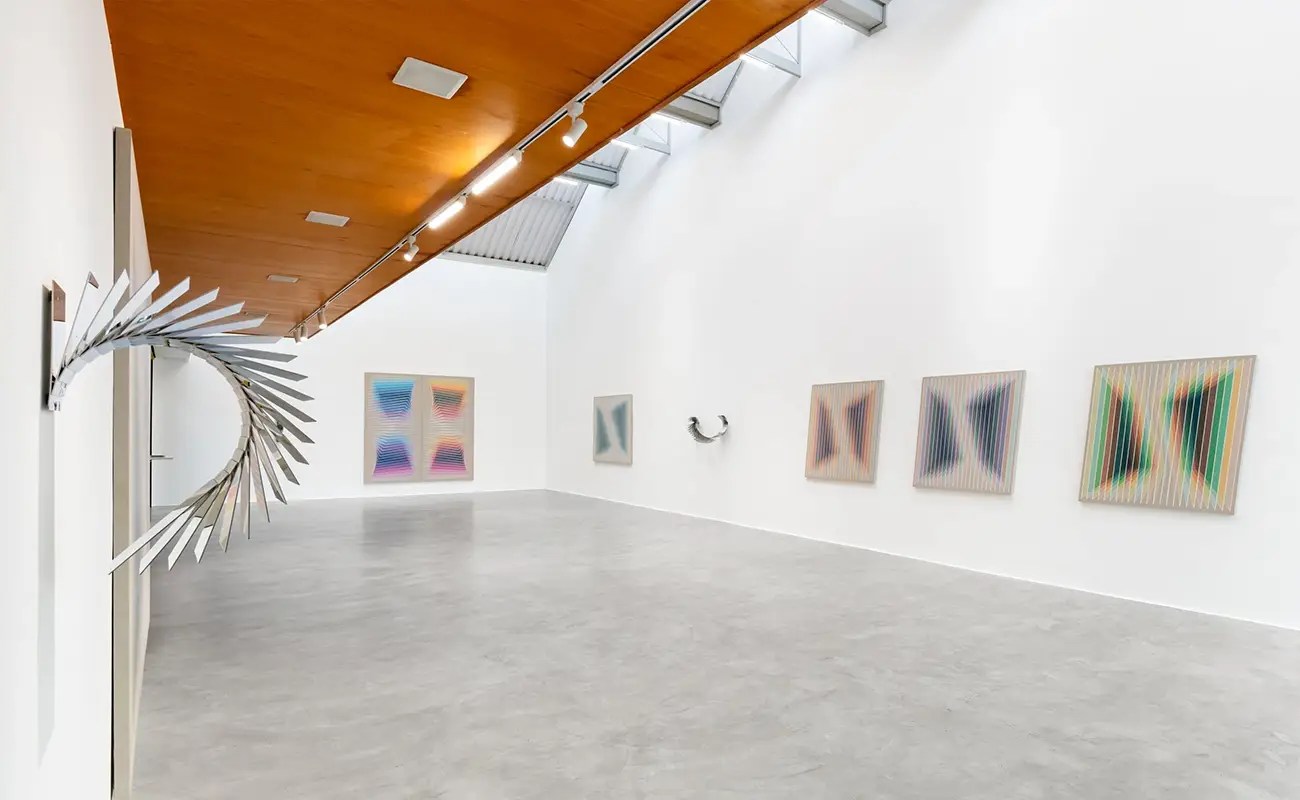
A recent milestone in this direction was the 2025 exhibition Nada Isolado — Nothing in Isolation at Zipper Galeria in São Paulo. There, Mullen assembled a constellation of works—paintings, sculptural constructions, and reliefs—that interacted within a unified spatial composition. The recurring rectangular motif served not as a boundary but as a connector, linking the components through shared geometry and relational placement. Light reflections bounced from steel to canvas, shadows spilled across surfaces, and the architecture of the gallery itself became part of the work. Viewers were not observers but participants, their presence actively shaping the relationships among the works.
This growing spatial openness is particularly evident in series like Responsive Forms and Liminal Suspension, where Mullen pushes his structural vocabulary beyond the two-dimensional frame. Wooden planes stack and pivot, mirrored surfaces capture and distort, and transparency creates visual ambiguity. Each material introduces a different rhythm, a unique tempo of engagement. Despite the precision of construction, these works remain responsive—sensitive to the shifting interplay of light, material, and the moving viewer. In this way, Mullen’s sculptural practice reaffirms his central inquiry: how does perception take form, not in isolation, but through interaction?

Daniel Mullen: The Temporality of Seeing
Across all media, Mullen maintains a rigorous focus on time as a component of perception. His works are never experienced all at once; instead, they reveal themselves gradually, as the viewer moves, lingers, and looks again. Transparency, both literal and metaphorical, becomes a means of engaging with temporality. Layered colors shift in intensity with proximity, reflections expand or collapse based on angle, and structures reorganize themselves through the passage of time. This durational quality underlines his commitment to a practice that privileges presence and attentiveness over spectacle or immediacy.
His process of construction mirrors this emphasis on duration. Each painting unfolds through a slow, deliberate sequence of actions—layer upon layer of pigment, line after line of geometry, each responding to the previous gesture. The presence of the hand remains visible, not in expressive flourishes, but in the subtle rhythms of repetition and deviation. There is a meditative intensity to this approach, a quiet insistence that meaning is not delivered but discovered, emerging through attention and time. This attention to the temporality of making feeds directly into the temporality of viewing, creating a loop between artist and audience that continues to resonate long after the first glance.
In his most recent work, Mullen seems to be embracing an even greater openness. Structures loosen, surfaces fracture, and compositions invite continual reinterpretation. Reflection is no longer confined to mirrored surfaces but becomes a mode of thinking: an oscillation between form and formlessness, between seeing and sensing. Perception becomes not a conclusion but a process, a lived engagement with shifting conditions. By refusing to fix meaning, Mullen’s work holds space for the unstable, the relational, and the shared. In doing so, he offers a compelling answer to his own guiding question: what if seeing itself could be a form of relation?