
“I offer the services of a mediator between imagination and reality.”
When Metal Breathes Light
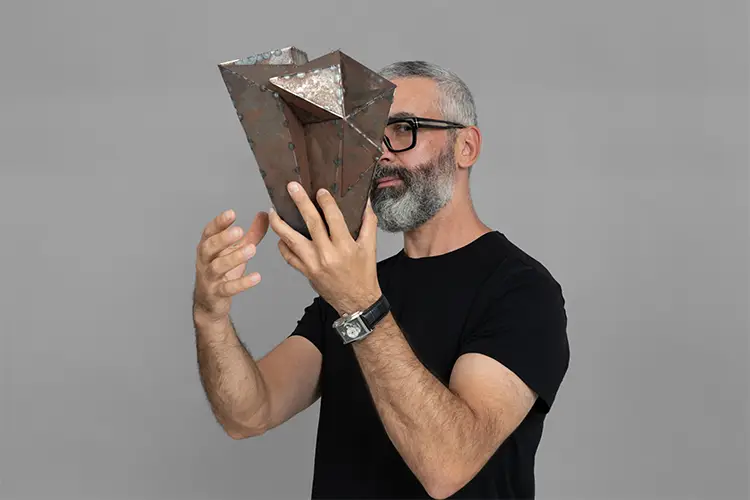
Emerging from a period of personal and national adversity, Teodosio found his calling not merely in artistic expression, but in transformation itself. He refers to himself as a mediator between imagination and reality, a description that mirrors the philosophical underpinning of his work. More than a label, this self-identification reflects a commitment to unveiling hidden beauty through visual perception. His awakening as an artist took place thirteen years ago, during a time of profound uncertainty. Rather than allowing hardship to hinder him, Teodosio saw it as a trigger — a release of creative energy that clarified his life’s purpose. For him, art is as essential as breath, a vital act of existence rather than a profession.
From early childhood, Teodosio had been instinctively drawn to art, often losing himself in hours of drawing. However, it wasn’t until years of reflection and patience that this passion crystallized into professional practice. Today, he identifies more with the role of sculptor than that of painter, choosing to work predominantly with stainless steel and bronze. His primary focus lies in the technique of Shadow Art — a medium that transcends traditional sculptural boundaries. In this process, sculptural fragments are transformed into coherent silhouettes when strategically lit, a metamorphosis that echoes his personal journey. His visual language is deeply informed by nature’s complexity and subtlety, filtered through the eyes of someone who perceives the extraordinary in the everyday.
Teodosio’s conceptual outlook draws from both ancient and modern philosophies. Citing Kant’s idea that one person sees only a puddle while another perceives reflected stars, he challenges viewers to reconsider how they observe the world. His work pushes beyond what is immediately visible, inviting audiences to question their habitual gaze. This philosophical lens not only informs the way he constructs his pieces but also shapes the stories they tell. His sculptures become invitations to re-experience reality — not by altering the world, but by changing how we see it. Through his art, he offers an expanded mode of perception that bridges the material and the illusory.
Teodosio: Where Shadows Speak Poetry
Every source of inspiration that enters Teodosio’s life, whether visual, emotional, or philosophical, becomes a seed for creation. Beauty, for him, is omnipresent — found in a fleeting melody, the contours of a woman’s silhouette, or the intricate movement of a scene in a film. Nature itself functions as both muse and metaphor. Travel also plays a pivotal role in his artistic process, allowing him to absorb the visual and cultural textures of different places, which later reemerge as symbolic forms in his sculpture. Above all, it is the Renaissance Masters who exert the most profound influence on his creative vision. Their rigorous discipline and philosophical foundations continue to shape his dedication to harmony, proportion, and symbolic clarity.
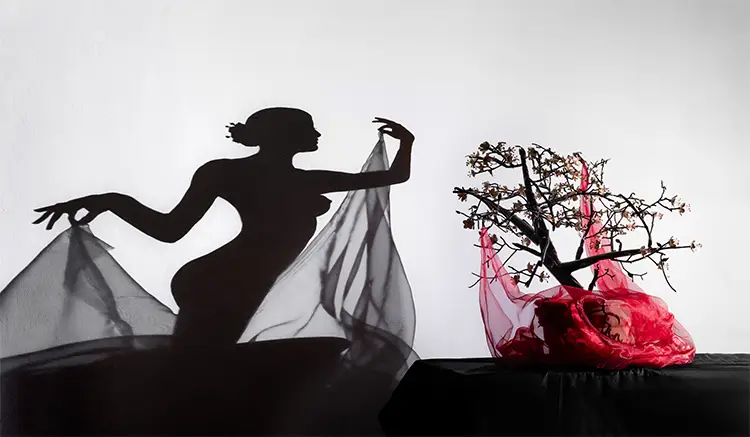
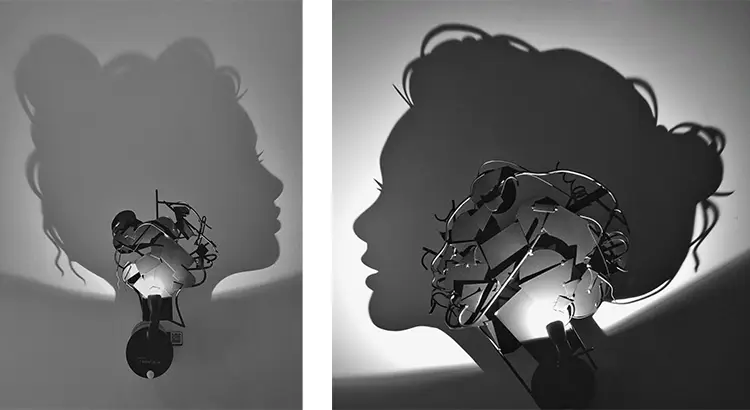
In his sculptural practice, Teodosio orchestrates a conversation between the tangible and the intangible. By fusing metal and light, he engineers moments of revelation. Bronze and steel, shaped into seemingly disordered assemblies, are given a second life when light passes through them to cast strikingly precise shadows. These shadows, often representing feminine forms, mythological beings, or poetic abstractions, reveal stories that the naked eye cannot glean from the sculpture alone. The duality between the chaotic structure and the elegant silhouette encapsulates his belief in hidden order. Each work becomes a visual paradox — raw, jagged matter giving rise to images of serenity and grace.
The themes running through Teodosio’s work are far from arbitrary. Greek mythology, Renaissance ideals, and the symbolism of the feminine form all converge in his creative philosophy. He does not depict women merely as figures, but as emblems of light, inspiration, and vitality. This symbolic approach transforms his sculptures into metaphysical reflections rather than literal representations. The shadow becomes the true art object, the sculpture merely a vehicle for its appearance. In his hands, light takes on a narrative role, functioning not just as illumination but as storyteller. Each composition becomes a moment of balance between reality and vision, matter and idea, light and shadow.
From Chaos to Clarity
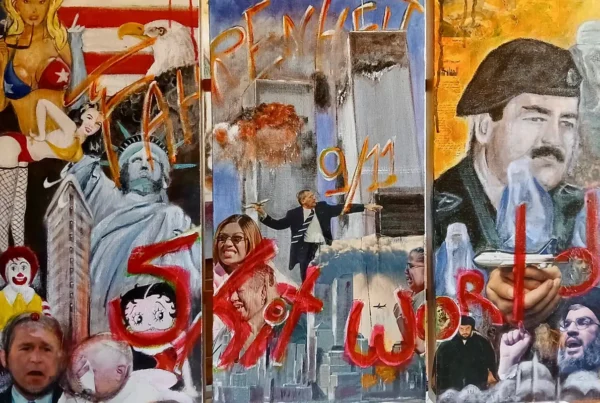
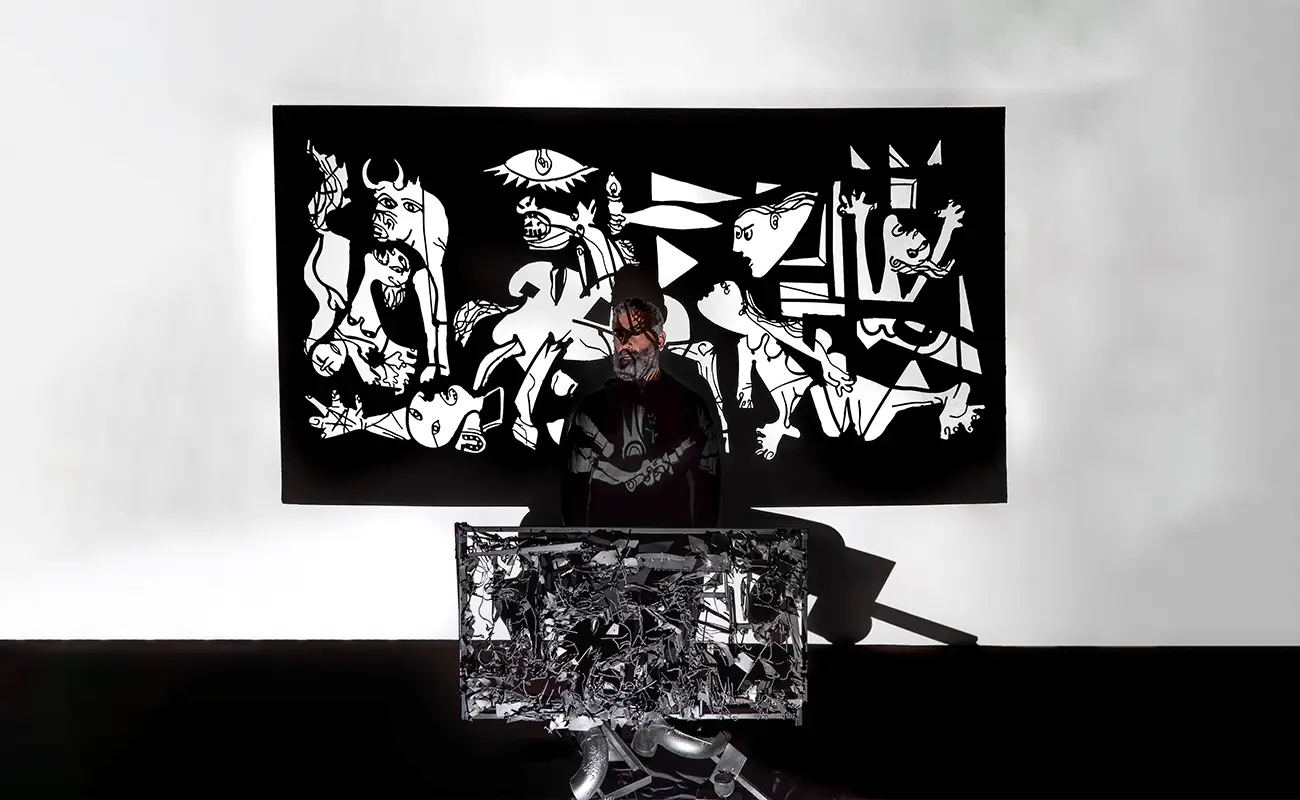
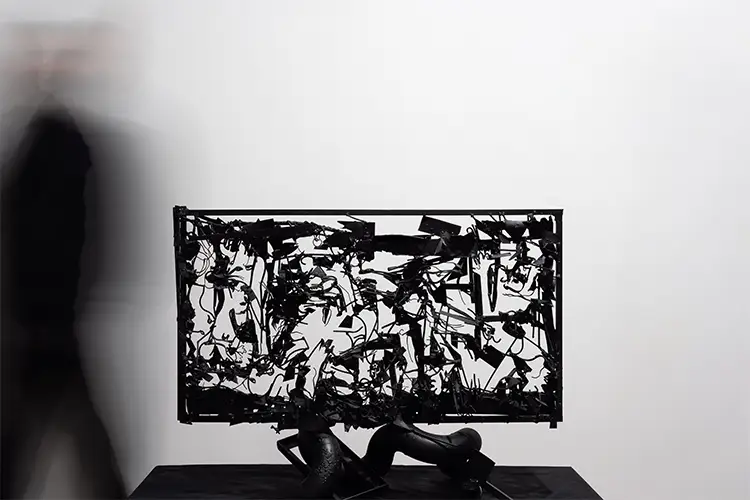
Among Teodosio’s body of work, one creation stands apart — his interpretation of Guernica. Reimagined not through pigment and canvas but through the language of light and metal, this piece encapsulates the scale and ambition of his artistic pursuit. Composed entirely of metal, the sculpture consists of hundreds of intricately arranged components, each carefully positioned to serve a role in the shadow it casts. Inspired by Picasso’s iconic anti-war painting, Teodosio’s version retains the original’s emotional intensity while transforming its method of communication. Light, in this instance, becomes both brush and voice, animating the sculpture into a powerful silhouette that captures the enduring spirit of resistance and suffering.
The creation of this work pushed Teodosio to the edges of his own creative and technical capacities. It demanded not only structural innovation but also an acute sensitivity to light’s behavior and impact. Every metal fragment was arranged with a vision toward what it would become when struck by light — a process that required both meticulous craftsmanship and intuitive insight. Despite its static materials, the final piece carries a dynamic quality; its shadow, once illuminated, evokes a visceral emotional response that photographs cannot fully convey. According to Teodosio, this work cannot be truly understood unless seen in person. Its energy, he says, continues to surprise even him whenever the lights are turned on.
Creating this piece was not a detached process; it was something he lived through. Teodosio filtered the themes of Guernica through his personal experience, allowing the historical and emotional weight of the work to intersect with his own creative journey. In doing so, he not only paid homage to Picasso’s original message but also added a new dimension — one that explores how destruction and hope can be reframed through contemporary sculpture. His rendition becomes a bridge across time, technique, and material, proving that shadow, when shaped with intention, can bear witness to the darkest and most luminous aspects of the human condition.
Teodosio: The Light That Thinks
Teodosio’s daily practice is structured yet fluid, a rhythm shaped by music, solitude, and imagination. He describes each day as a voyage into other dimensions, where raw ideas gradually evolve into fully formed pieces. This creative process is ongoing, informed by both intuition and experimentation. Recent years have seen a shift in his focus, as he explores a wider variety of sculptural forms, including those influenced by steampunk design and natural motifs. Regardless of the subject, the unifying principle remains the same: the dialogue between matter and light. His works are deliberately designed to change with their environment, appearing abstract during the day and revealing hidden figures once illuminated at night.
Among the recent pieces that exemplify this approach is a sculpture inspired by the flamenco legend María Pagés. At first glance, the work appears to be a white marble tree — an olive tree native to Andalusia. However, when a single light is directed at it, the sculpture casts the shadow of a flamenco dancer in motion. This interplay between the solid and the ephemeral illustrates Teodosio’s belief that beauty exists not in form alone but in perception. By embedding a human figure within the geometry of a tree, he weaves mythology, regional identity, and emotion into a unified expression. The piece becomes a tribute not only to Pagés but also to the cultural essence she embodies.
Looking ahead, Teodosio continues to be energized by the potential of light as an artistic collaborator. His upcoming projects promise further explorations into the intersection of sculpture and shadow, continuing his quest to merge visual abstraction with narrative depth. With each new creation, he deepens his commitment to an art form that requires not only craftsmanship, but also philosophical inquiry. His work invites viewers into a contemplative space where they must participate actively — not merely observing, but witnessing. In a world saturated with images, Teodosio offers something far more rare: a vision that demands to be seen slowly, understood deeply, and remembered long after the light fades.