
“The madonna, the modern one, is holding her baby which symbolizes her historical self, sailing between two worlds, the Earth and the cratered moon, circling the womb of time.”
Foundations of Vision and Early Awakening
Ruth Poniarski’s artistic journey emerges from a life shaped by observation, structure, and an early awakening to visual form. Born in Brooklyn, New York in 1956 and raised in Glen Cove on Long Island, she encountered art at a formative age that would permanently influence her perception of the world. Public schooling provided a conventional framework, yet a singular moment at seven years old marked a turning point when her mother brought her to a life drawing class. There, she produced a sketch of a nude woman, an experience that sharpened her attentiveness to the physical presence of bodies, space, and proportion. From that moment forward, she became deeply attuned to visual nuance, finding equal fascination in artistic expression and the constructed environment that surrounds daily life.
This early sensitivity evolved alongside an expanding awareness of architecture as both a practical and expressive discipline. In 1974, she enrolled in an architecture program at a college in upstate New York, committing herself to a rigorous education grounded in discipline, technical precision, and conceptual thinking. These years were not defined solely by academic challenge, but also by personal turmoil that tested her resilience. During her fourth year, an incident involving unknowingly consuming a brownie laced with PCP triggered a period of severe psychological distress. What followed was a succession of destabilizing nervous breakdowns that coincided with the pressure of completing her studies and attempting to establish herself within a competitive and male dominated professional environment.
Despite these hardships, Poniarski completed her education and carried forward a sharpened understanding of form, space, and narrative. The struggle to reconcile creative potential with professional expectation became a defining tension in her life. Alongside searching for meaningful relationships and a sense of belonging, she confronted the realization that her imagination required a different outlet than conventional architectural practice could provide. These formative experiences did not fragment her vision but instead laid the groundwork for an artistic language capable of holding vulnerability, endurance, and reflection within a single frame.

Ruth Poniarski: Architecture as Discipline, Painting as Release
Poniarski earned her Bachelor of Architecture degree from Pratt Institute in Brooklyn in 1982, a milestone that confirmed her command of structural thinking and design methodology. For the following decade, she worked throughout Manhattan in the field of architecture and construction, applying her training to real world projects that demanded accuracy, coordination, and consistency. This professional period reinforced habits of focus and perseverance, yet it also revealed the limitations of a career that left little room for imaginative exploration. While architecture sharpened her analytical skills, it constrained the narrative freedom that increasingly pressed for expression.
A tragic accident became the catalyst that redirected her life’s course. After falling thirty feet and surviving the impact, she faced a long and arduous recovery that confined her to a wheelchair for six months. Under medical guidance, she was encouraged to pursue painting and writing as part of her healing process. This suggestion opened a new path, allowing her to translate accumulated experiences into visual storytelling. In 1988, following her architectural career, she turned decisively toward painting, discovering a medium capable of absorbing both discipline and spontaneity without sacrificing emotional depth.
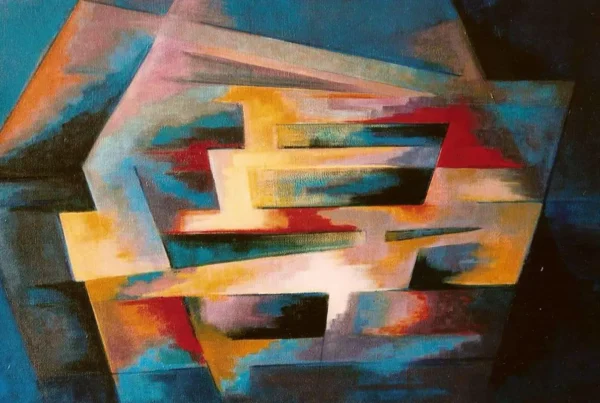
Her architectural education did not recede into the background but instead became a vital framework for her artistic process. The structural clarity learned through years of training enabled her to organize complex compositions while remaining open to chance and intuition. Painting offered a space where control and freedom could coexist, where personal history and cultural memory might surface without constraint. Through this transition, Poniarski forged a practice that honors the rigor of architecture while embracing the expressive potential of art, transforming lived adversity into a source of creative strength.

Surreal Narratives, Materials, and the Passage of Time
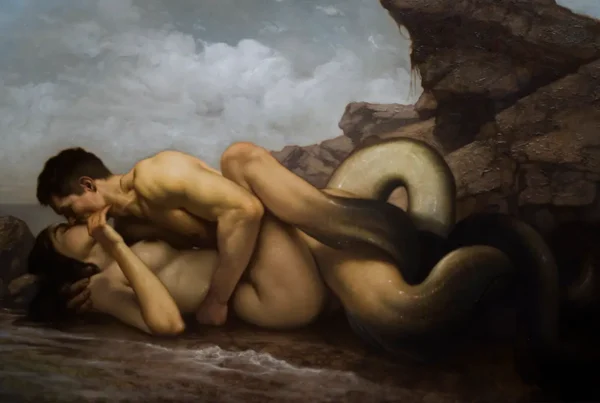
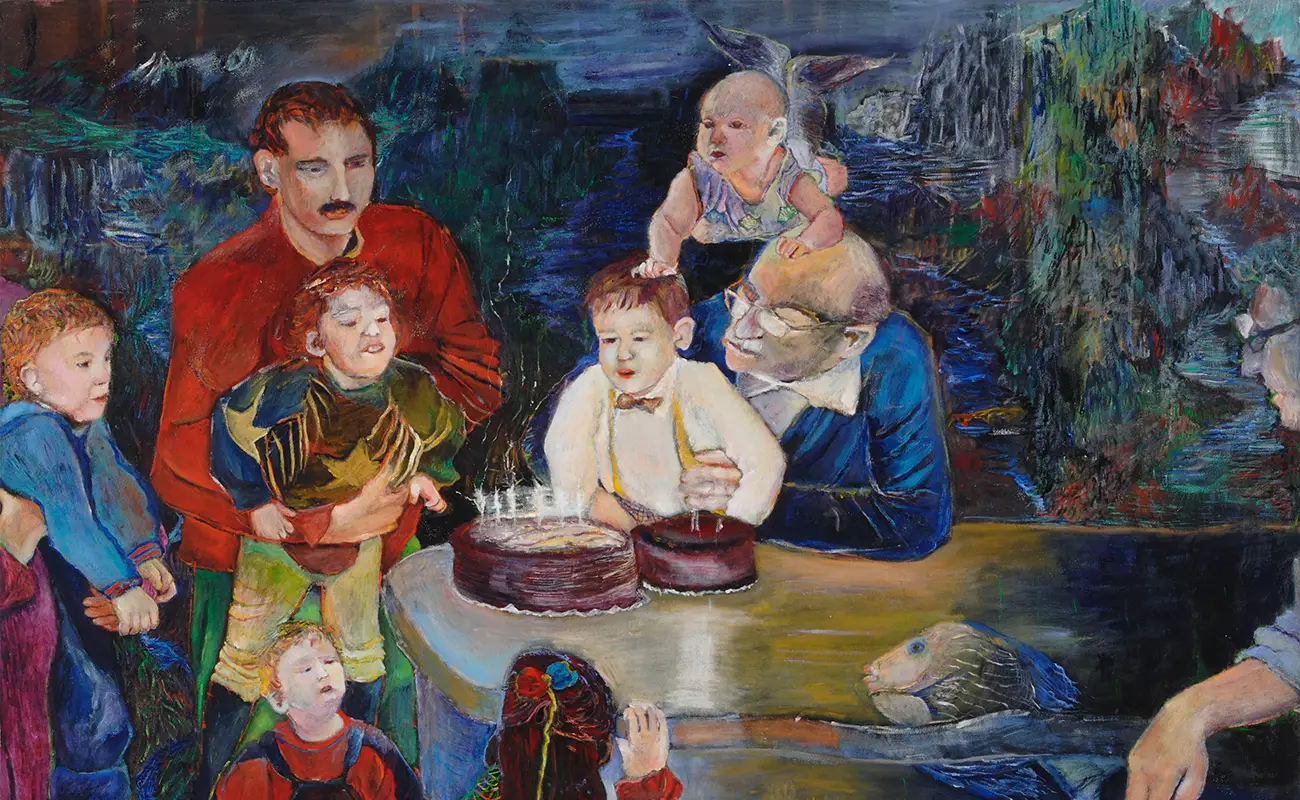
Poniarski’s paintings are distinguished by their surreal narratives and layered symbolism, each composition unfolding like a visual story shaped by time and intuition. Working primarily with acrylic paint, she favors the medium for its fast drying properties, which allow images to evolve in stages. This technical choice supports her narrative approach, enabling successive ideas to emerge organically as the allegory develops on the canvas. She often begins with a single figure and a broad conceptual direction, permitting serendipity to guide the transformation of the scene. Over time, the painting expands into a complex reflection of lived experience, drawing connections between daily life, collective history, memory, and dreams.
The thematic scope of her work incorporates culture, myths, art history, philosophy, and literature, woven together into a poetic visual language that remains accessible and engaging. Rather than offering fixed meanings, her paintings invite multiple interpretations, encouraging viewers to navigate their own emotional and intellectual responses. This openness reflects her intention to communicate an imaginative rendition of the human condition, one that acknowledges uncertainty while affirming continuity across generations. The narratives that arise are neither linear nor static, but instead mirror the fluidity of consciousness and recollection.
Influence from artists of the past plays a significant role in shaping her imagery. Figures and ideas associated with Rembrandt, Rousseau, Magritte, Rodin, and others appear as echoes within her contemporary compositions. At times, she places iconic characters from these historical works directly into her allegories, creating a dialogue between eras. Examples include the appearance of The Bather within her painting Milking of Spring and the figure of Jeremiah in the work titled Dream. By integrating these references, she imports the past into present experience, reinforcing the continuity of artistic inquiry and human reflection across time.

Ruth Poniarski: Meaning, Memory, and the Journey of the Self
Among Poniarski’s body of work, one painting stands as particularly significant for its symbolic depth and personal resonance. Limbo, Journey of the Self presents a modern Madonna holding her baby, a child that represents her own historical self. This central figure sails between two worlds, suspended between Earth and a cratered moon, while circling what she describes as the womb of time. The imagery conveys transition, self recognition, and the perpetual motion between past and present. Through this composition, Poniarski articulates a vision of identity as something carried forward rather than left behind.
The emotional power of this work reflects her broader artistic mission, which centers on communicating states of being rather than isolated events. Her paintings address existence as an accumulation of experiences shaped by memory and imagination, inviting contemplation rather than resolution. By presenting scenes that hover between the familiar and the symbolic, she encourages viewers to reflect on their own journeys and sensuous moments within life’s unfolding narrative. The balance between intimacy and universality allows her work to resonate across personal boundaries.
Throughout her career, Poniarski has remained committed to an approach that values depth, reflection, and continuity. Drawing from architecture, personal history, and a sustained dialogue with art history, she has developed a distinctive voice grounded in resilience and curiosity. Her work does not seek spectacle, but meaning, offering layered visual stories that reward sustained attention. Through surreal imagery and thoughtful composition, she continues to explore the enduring relationship between structure and imagination, affirming art as a vessel for understanding time, self, and shared human experience.