“I hope my paintings encourage people to slow down, look more carefully, and find a little more beauty, compassion, and wonder in everyday life.”
Between Cultures, Nature, and Imagination
Rainy Tang is a Chinese illustrator and painter based in Australia whose work reflects a thoughtful dialogue between Eastern sensibility and Western artistic tradition. Growing up in China before studying in the Mediterranean, New York, and Australia exposed her to a wide range of visual languages while strengthening her connection to her own cultural identity. Rather than treating these influences as separate directions, she allows them to coexist naturally, creating paintings that balance classical inspiration with personal reflection. This cross cultural experience has shaped an artistic voice that values subtle emotion, symbolism, and quiet contemplation over direct explanation, inviting viewers into images that reward careful observation and personal interpretation.
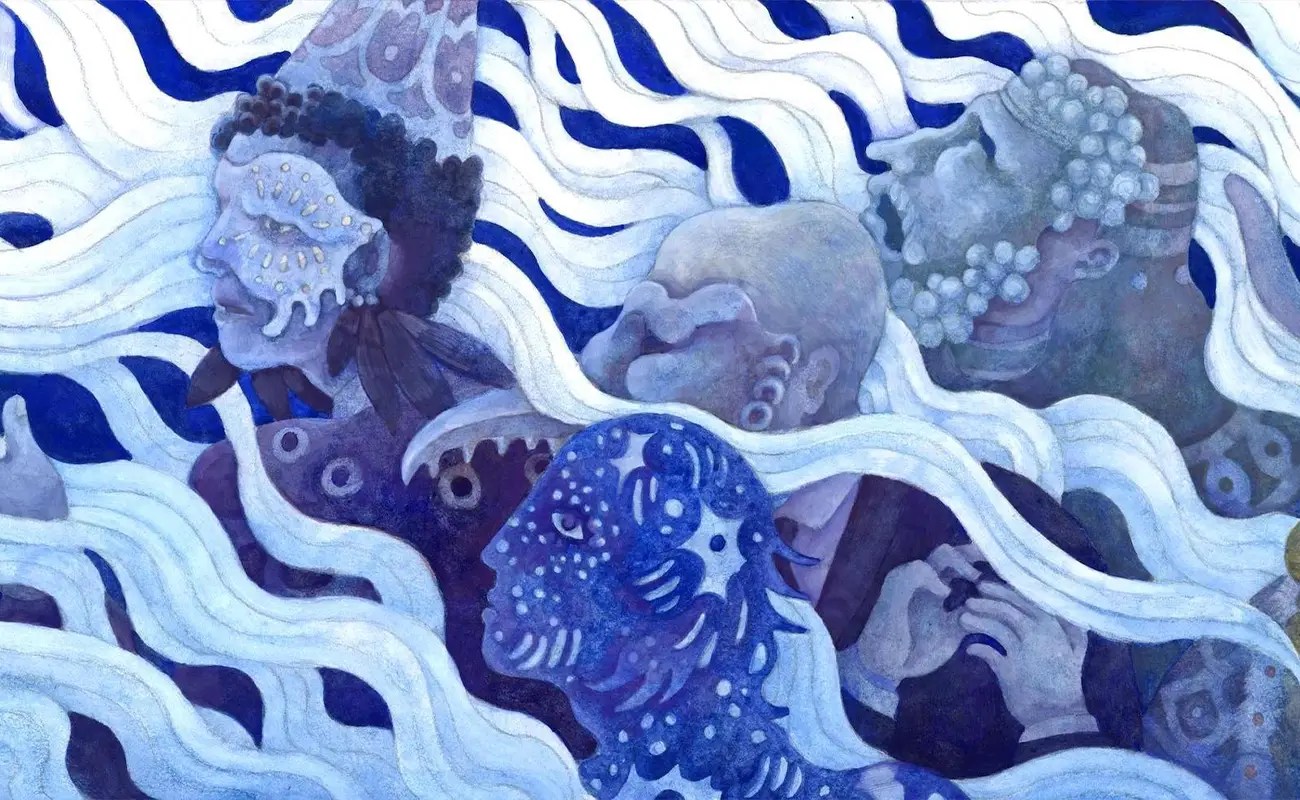
Western art history provides a significant foundation for Tang’s visual language. Early Renaissance frescoes, Greek sculpture, and classical mythology inform her approach to composition, figure painting, and atmosphere. Alongside these references, ancient Chinese murals and Eastern philosophy continue to influence the emotional character of her work. Instead of presenting straightforward narratives, she constructs symbolic worlds where visual metaphors communicate feelings that words often fail to express. This balance between realism and poetic suggestion allows each painting to remain open, encouraging different readings without prescribing a single interpretation.
Nature stands at the center of Tang’s creative process and serves as a constant source of inspiration. Flowers, insects, roots, plants, and countless organic forms appear throughout her paintings, not simply as decorative elements but as meaningful symbols carrying emotional and spiritual significance. She sees the natural world as a place where beauty, mystery, growth, decay, tenderness, and fear exist together rather than opposing one another. That understanding shapes every composition she creates, allowing her paintings to express wonder while acknowledging life’s complexity through delicate watercolor techniques and carefully considered symbolism.

Rainy Tang: Painting Emotion Beyond Narrative
Tang’s lifelong love of drawing gradually developed into a desire to express experiences that cannot easily be translated into language. Rather than focusing on illustrating stories literally, she became increasingly interested in painting emotions, memories, and states of mind that remain difficult to define. This shift established the foundation of her artistic identity, where realistic human figures are combined with symbolic imagery to communicate emotional depth. Decorative patterns, botanical forms, and mythological references weave through dreamlike compositions that invite viewers to pause, reflect, and discover personal meanings hidden within each carefully arranged scene.
Beauty and darker emotional experiences occupy the same visual space throughout Tang’s paintings. She does not separate joy from sadness or growth from loss because she believes these experiences naturally exist together. Nature demonstrates this relationship constantly through cycles of life and death, flourishing and decay, tenderness and uncertainty. Her paintings embrace these contrasts without presenting them as conflicts, allowing emotional complexity to become part of the work’s quiet harmony. This perspective gives her imagery an atmosphere that feels both graceful and deeply reflective, encouraging audiences to consider beauty as something inseparable from vulnerability.
Compassion remains one of the defining principles behind Tang’s creative philosophy. Childhood memories, experiences of living abroad, and the challenges of adapting to different cultures all contribute to the stories she tells through paint. Whenever she develops a character or imagines a narrative, she approaches every subject with empathy rather than criticism or satire. She first considers how a person might feel, what motivates their decisions, and what emotional truths lie beneath their actions. This commitment to understanding others gives her paintings emotional authenticity while reinforcing themes of love, kindness, and shared human experience.

A Meaningful Interpretation Through Watercolor
Among Tang’s most personally significant projects is her illustrated interpretation of Letter from an Unknown Woman by Stefan Zweig. Although the novel follows a tragic protagonist whose choices are deeply flawed, Tang deliberately avoided judgment in her visual response. Instead, she sought to understand the character’s emotional world by imagining her longing, devotion, sorrow, and resilience before translating those feelings into images. This empathetic approach became the emotional foundation of the series and reflects the broader philosophy that guides all of her creative work.
Rather than recreating scenes directly from the narrative, Tang focused on expressing the emotional atmosphere surrounding the story. Symbolism, decorative imagery, and visual metaphors replaced literal storytelling, allowing viewers to experience the inner life of the protagonist through suggestion instead of explicit illustration. The project demonstrates her belief that visual art can expand the emotional possibilities of literature by expressing feelings that remain difficult to communicate through narrative alone. The resulting series invites viewers to engage slowly, discovering emotional layers through careful observation rather than immediate explanation.
The project was created using watercolor and coloured pencil, materials chosen specifically for their gentle and delicate qualities. Their softness reinforced the quiet emotional tone she hoped to achieve while preserving the subtle atmosphere that defines the story. Tang also intentionally worked on a small scale, encouraging viewers to spend time examining each piece closely rather than absorbing the work at a glance. This intimate viewing experience reflects her broader artistic philosophy, where careful attention reveals meaning gradually and every detail contributes to the emotional language of the painting.

Rainy Tang: Building Quiet Worlds Through Careful Observation
Tang’s daily practice begins long before paint reaches paper. Each project starts with extensive brainstorming and numerous preliminary sketches that help her discover the strongest visual direction. Composition often undergoes repeated revision as she experiments with different perspectives and symbolic arrangements before arriving at an image that feels complete. Sketching serves as far more than technical preparation. It functions as a process of thinking, questioning, and refining ideas until the emotional intention behind the work becomes fully clear. Only after this extended exploration does she begin the final watercolor painting.
Once the composition has been resolved, the painting process becomes calm, focused, and meditative. Tang describes this stage as one of the most enjoyable parts of her practice because the greatest challenge has already been overcome during the search for the strongest concept. This careful balance between disciplined planning and quiet execution allows every painting to retain both technical precision and emotional openness. The deliberate pace also reflects her broader belief that meaningful art develops through patience, observation, and thoughtful decision making rather than speed or spontaneity alone.
Looking ahead, Tang hopes to continue collaborating with writers on picture books while expanding her own personal painting series. Her current body of work explores themes of the universe, time, and nature through deeply personal reflections shaped by love, fear, uncertainty, growth, and lived experience. She considers this ongoing series a visual diary that records both her inner life and her attempts to better understand the surrounding world. Ultimately, every project shares the same aspiration: to encourage viewers to slow down, observe more carefully, and discover greater beauty, compassion, and wonder within everyday existence.