
“I try to convey the poetry of place, as tied to the current state.”
Rooted Observation and a Lifelong Commitment to Art
Anne Kinsey Careatti is an artist whose practice emerges from deep attentiveness to place, memory, and the visible traces of human presence within the natural environment. Living in a rural agricultural region, she works from daily proximity to land that bears both beauty and visible strain. Her surroundings are not treated as scenic backdrops but as active participants in her visual language. Fields, waterways, and wildlife appear shaped by both natural cycles and human intervention, creating an atmosphere that informs her subject matter and emotional tone. Careatti’s work occupies a thoughtful position within contemporary art concerned with ecological awareness, yet it avoids slogans or didacticism. Instead, her images function as reflective spaces where viewers encounter the tension between care and neglect, intimacy and distance. Through drawing and watercolor, she constructs scenes that feel personal and observational while addressing issues that extend far beyond the individual.
Her relationship with art began early, rooted in childhood experiences of drawing and sustained curiosity about art history. From the age of six, she found that making images allowed her to disappear into focused attention, a state that became central to her creative life. Books on art offered her an expansive education, exposing her to centuries of visual thought and particularly to representations of nature across cultures and eras. This early immersion shaped her understanding that art could serve as both pleasure and inquiry. Rather than narrowing her interests, this foundation fostered openness to diverse approaches, from classical European drawing traditions to non Western pictorial systems. Over time, this breadth became visible in her compositions, which blend observational drawing with imaginative symbolism and historical reference.
Careatti’s move to a rural agricultural area marked a turning point that sharpened her artistic concerns. What initially felt like a return to an earlier century gradually revealed deeper contradictions. She witnessed the impact of chemical farming, development, and infrastructure on creeks, rivers, and wildlife populations. Birds, insects, mammals, and amphibians appeared less frequently, and the land itself showed signs of stress. A tornado that damaged her home in 2017 further underscored the vulnerability of both human structures and natural systems. These experiences did not push her toward despair but instead clarified her purpose. Her art became a means of articulating the poetry of place as it exists now, shaped by human choices and natural resilience alike.

Anne Kinsey Careatti: Visual Language, Technique, and Artistic Influences
Anne Kinsey Careatti’s artistic language is grounded in drawing and watercolor, media that allow for sensitivity, variation, and responsiveness. Watercolor, in particular, supports her interest in fragility and change. The translucency of pigment and the way washes interact with paper echo natural processes such as erosion, weather, and the movement of water. Rather than controlling every mark, she allows color to spread and settle, creating surfaces that feel alive and contingent. Line plays an equally important role. Often delicate and slightly wavering, it anchors figures and forms without imposing rigidity. This balance between structure and openness reflects her broader perspective on nature as something shaped but never fully mastered.
Her compositions frequently employ flat spatial arrangements and saturated color, drawing inspiration from diverse artistic traditions. Mughal era Indian paintings, Persian miniatures, and Japanese woodcuts inform her approach to space and pattern, offering alternatives to Western illusionistic depth. These influences encourage a visual clarity that supports narrative without literal explanation. She also draws inspiration from the dreamlike imagery of Francesco Clemente and the playful yet pointed humor of Takashi Murakami. At the same time, she admires the directness and honesty found in the drawings of Toulouse Lautrec. This wide range of references does not result in pastiche. Instead, it provides a flexible toolkit that she adapts to her own thematic concerns, allowing her work to feel both historically informed and distinctly personal.
Figuration remains central to Careatti’s practice, though her figures are intentionally simplified. Humans, animals, and hybrid beings appear with expressive restraint, avoiding exaggerated drama. This simplicity creates emotional accessibility, inviting viewers to project their own feelings into the scenes. Symbolism is woven throughout her work, with recurring motifs that carry layered meaning. Mermaids serve as guardians of the sea and as symbols with deep historical roots across cultures, representing the duality of human existence and our entanglement with the natural world. Gnomes appear as sly, abstracted stand ins for human society, offering commentary without overt judgment. Through color, line, composition, and content, she aims to engage and amuse while prompting reflection.

Art as Environmental Witness and Moral Reflection
Environmental concern sits at the heart of Careatti’s work, yet her approach resists simple binaries of blame and innocence. She examines the contradictory relationship between humans and nature, recognizing that solutions often generate new problems. Green technologies and industrial transformations may address immediate needs while introducing long term consequences. In her images, natural landscapes coexist with signs of development and waste, illustrating how nature continues to respond and adapt even as it suffers lasting change. This perspective is shaped by lived experience rather than abstraction. Living in rural Virginia has placed her in close contact with agriculture, energy production, housing, forestry, and systems of disposal, all of which leave visible marks on the land.
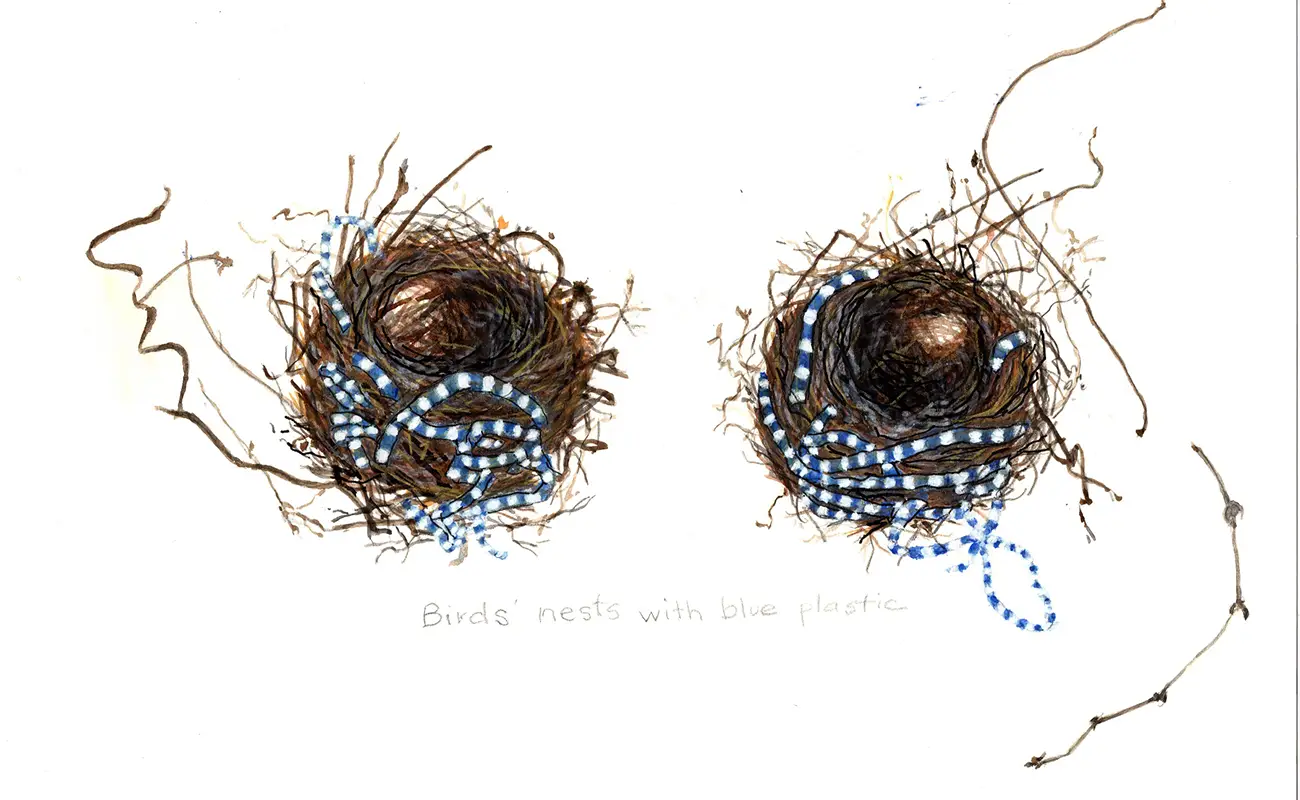
Her artwork seeks to build awareness of these influences without resorting to accusation. The tone of her images is elegiac and contemplative rather than confrontational. Plastic, refuse, and debris appear integrated into ecosystems, rendered with the same care as animals and plants. This equal attention underscores how inseparable waste has become from contemporary environments. By presenting these elements together, she asks viewers to sit with discomfort while also recognizing beauty that persists. The scale of human impact is acknowledged as ever increasing, and her work suggests mitigation as an ethical necessity rather than a distant ideal. Through visual storytelling, she positions herself as a creature living within these conditions, not outside them.
One particularly meaningful work, titled Recycling, exemplifies this approach. Created in watercolor, the piece addresses her own consumer habits with honesty and vulnerability. Haunted by her participation in cycles of consumption, she depicts discarded personal items as part of a colorful landscape. The composition does not isolate waste as an external problem but situates it within lived experience. By transforming refuse into a subject of aesthetic attention, she confronts the viewer with the intimacy of environmental responsibility. The work stands as a quiet confession and an invitation to reflection, demonstrating how personal accountability and broader ecological awareness can coexist within a single image.

Anne Kinsey Careatti: Daily Practice, Community, and Future Directions
Anne Kinsey Careatti’s daily routine reflects a rhythm shaped by contemplation and sustained engagement with art. Afternoons are often spent in her studio, where daydreaming, studying art books, and scribbling ideas form the groundwork for new projects. This period of quiet planning allows concepts to surface organically before she moves to paper. Sketching serves as a bridge between thought and execution, gradually giving way to more developed drawings and paintings. She also revisits older works, sifting through them with a critical eye and making improvements where possible. This practice of return underscores her belief that art is not fixed but open to revision and renewed understanding.
Family plays a meaningful role in her creative life, particularly through shared painting sessions with her nine year old Vietnamese granddaughter. When they work together, they often switch paintings, responding to each other’s marks and ideas. Her granddaughter’s imagination and joy offer a fresh perspective that Careatti finds deeply stimulating. These moments introduce playfulness and spontaneity into her practice, counterbalancing the weight of environmental themes. They also reinforce art making as a communal and relational activity rather than a solitary pursuit. This exchange across generations enriches her work, reminding her of creativity as an ongoing conversation.
Looking ahead, Careatti plans to focus on landscapes and still life drawings, with particular interest in watercolor studies of wild swans that overwinter in nearby riverplains. This project continues her attention to local ecosystems and seasonal rhythms. Alongside her studio practice, her work has reached audiences through exhibitions at institutions such as the Virginia Museum of Fine Art, the National Arts Club in New York City, and the National Wildlife Art Show. Her paintings and drawings reside in numerous private collections, reflecting sustained engagement with viewers. Through consistent observation and thoughtful making, she continues to build an artistic practice that speaks softly yet persistently about care, responsibility, and the fragile beauty of the world we inhabit.