
“Art is not at all like a hobby, I live art one hundred percent of the time, as art is everywhere and in everything.”
Born of Shorelines and Lived Experience
Joe De Haan’s artistic practice emerges from a lifetime shaped by endurance, observation, and an abiding connection to the natural world. Born in 1968, his creative language is inseparable from the accumulation of personal experience gathered across decades of change, challenge, and growth. Rather than separating life from art, his work absorbs the full range of human conditions, including moments of joy, periods of struggle, and the quiet persistence required to move through both. These realities do not appear in his sculptures as literal autobiography but instead surface through mood, posture, and presence. Each piece reflects an understanding that emotional depth is built over time, much like the weathered objects he gathers from the shore. This layered perspective gives his work an uncommon gravity, positioning it as an extension of lived experience rather than a detached aesthetic exercise.
Life on an island along the northeastern coast of the United States has further shaped De Haan’s vision, making the ocean an unavoidable and constant influence. The sea is not simply a backdrop within his work but a dominant force whose beauty, volatility, and mystery demand attention. Daily exposure to tidal rhythms and coastal weather has cultivated an awareness of nature’s authority and unpredictability. These elements feed directly into his subject matter, particularly his fascination with imagined deep sea creatures and maritime history. The ocean’s unseen depths become a metaphorical space where emotion, memory, and imagination converge. Through this lens, De Haan approaches the sea not as a scenic motif but as a living presence that mirrors human complexity and resilience.
Animals and natural forms have long occupied a central place in De Haan’s creative thinking, informed by a lifelong affection for nonhuman life. This influence appears not through idealized representations but through forms that feel weathered, adaptive, and emotionally resonant. His creatures suggest survival rather than perfection, echoing the realities of both marine ecosystems and human existence. By drawing parallels between human experiences and the lives of ocean inhabitants, De Haan creates a quiet sense of empathy across species. These connections establish the foundation for a body of work that feels instinctive and sincere, grounded in observation and shaped by respect for the natural processes that influence all living things.

Joe De Haan: An Unexpected Beginning Along the Tides
De Haan’s formal entry into an art career occurred in 2023, arriving unexpectedly and without traditional planning. Time spent walking rocky shores and beaches initially centered on curiosity rather than artistic intent. Objects carried in by unknown currents caught his attention, particularly pieces of sea glass shaped by years of movement and erosion. Collecting these fragments became a quiet ritual until a strong internal pull toward creation emerged. This impulse led to early experiments with small mosaics and handcrafted jewelry, modest in scale yet significant in direction. What began as casual exploration quickly revealed itself as a natural extension of his way of seeing, opening a path that felt less like a new pursuit and more like a long delayed recognition.
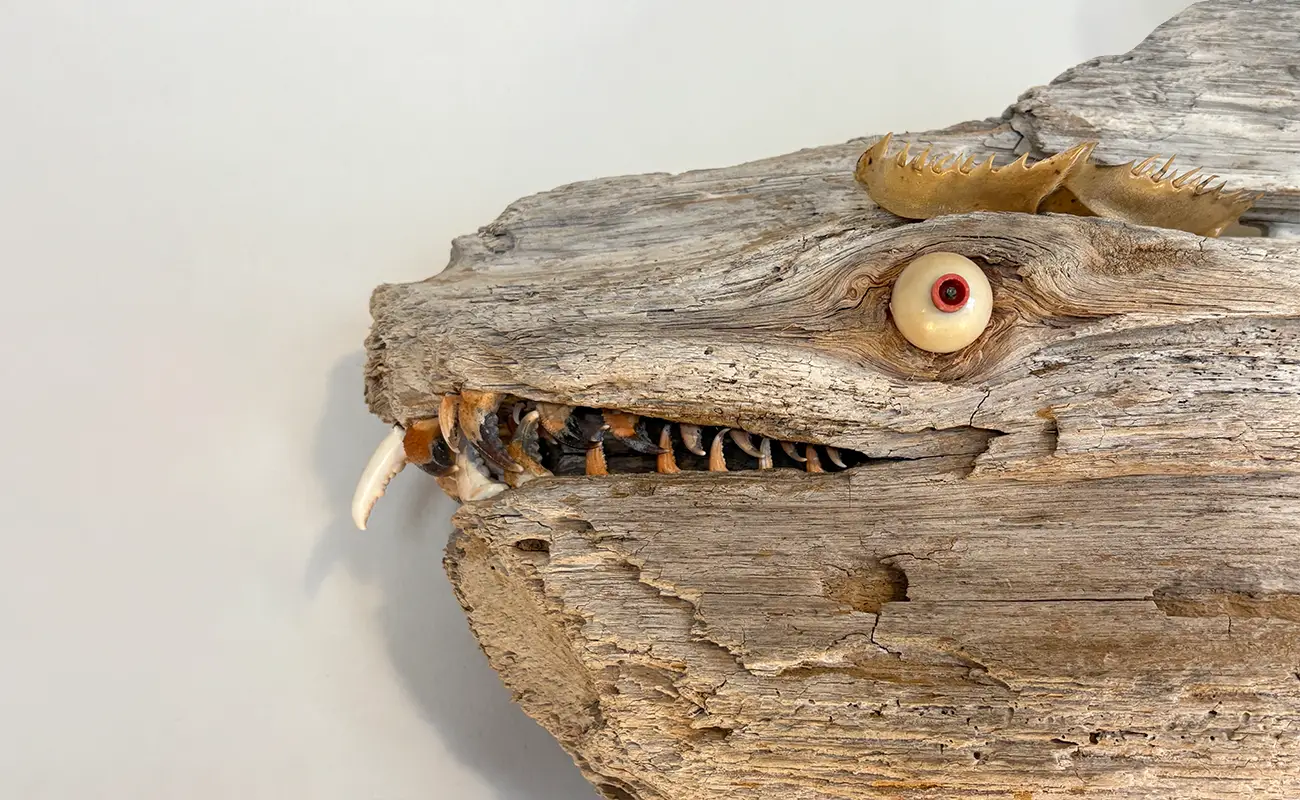
The practice soon expanded beyond sea glass to include a wide range of shoreline materials, including driftwood, shells, fibers, and marine remnants. Some materials used include unmodified driftwood, salt marsh hay, crab parts, oyster shells, periwinkles, lobster parts, fishing gear, beach sand, and fish bones. Through assemblage, De Haan began forming abstract sea creatures that felt both invented and discovered. The process unfolded intuitively, guided by experimentation rather than formal instruction. Each new material introduced unfamiliar possibilities, encouraging further exploration and risk taking. This openness allowed his style to take shape organically, defined by the distinct character of each found object. Central to this approach is a commitment to minimal alteration, preserving original textures, shapes, and signs of wear. The materials retain their histories, becoming collaborators rather than raw resources.
De Haan’s sculptural forms occupy a space between abstraction and figuration, where recognition remains suggestive rather than fixed. These works often hint at marine life without resolving into literal depiction, allowing viewers to engage imaginatively. Personality emerges through subtle choices, such as the placement of shell eyes or the tilt of a form that suggests curiosity or humor. The resulting creatures feel animated and emotionally accessible, reflecting shared circumstances and feelings across species. By infusing humor and character into these forms, De Haan creates an entry point that invites reflection without instruction, allowing meaning to arise through connection rather than explanation.

Art as Sustenance, Constraint, and Commitment
For De Haan, art functions as a deeply therapeutic force, playing a crucial role in supporting his mental health. Discovering this mode of expression later in life brought a profound shift in how he experiences the world and himself. Art has altered the way he thinks, feels, and communicates, offering a language that extends beyond words. This transformation is not confined to studio hours or specific projects. Creativity permeates his daily existence, shaping perception and intention at all times. He does not approach art as a pastime or distraction but as a fundamental way of being, inseparable from identity and purpose.
The practical realities of his process introduce unique challenges that further define his commitment. Unlike artists who can readily acquire materials, De Haan depends on what the tides deliver and what careful searching reveals. The availability of materials dictates the pace of production, often preventing immediate realization of ideas. Significant time is spent walking shorelines, observing conditions, and waiting for the right elements to appear. This limitation can be frustrating, yet it reinforces the integrity of his practice. Accepting these constraints is essential to remaining truthful to both the work and himself, even when it demands patience and uncertainty.
Within these conditions, the act of making becomes an exercise in trust and responsiveness. Each piece begins only when the necessary materials present themselves, allowing form and concept to develop together. This approach resists convenience in favor of authenticity, ensuring that every sculpture remains grounded in direct engagement with place. The ocean’s rhythms determine not only subject matter but also workflow, reinforcing the idea that art and environment are in continuous dialogue. Through this ongoing exchange, De Haan maintains a practice that honors origin, process, and personal alignment above efficiency or expectation.

Joe De Haan: Recognition, Reflection, and Conceptual Depth
A recent work titled Deep Sea Creature Looking at Mother Nature’s Art holds particular significance within De Haan’s evolving body of work due to its conceptual focus. Constructed from driftwood, seaweed, a piece of crab claw, and naturally fused oysters, the piece poses a quiet yet profound question. It invites viewers to consider whether animals perceive beauty within nature in ways comparable to human appreciation of art. This inquiry reframes observation as a shared experience across species, positioning the creature not as an object to be viewed but as a viewer itself. The materials, left largely unaltered, reinforce the idea that nature both creates and contemplates its own expressions.
Since 2024, De Haan’s work has received notable international recognition, signaling a growing resonance beyond his immediate environment. Honors include a Masterful Minds Award from the Circle Foundation for the Arts, a Merit Award from Fame Frame Gallery, and acknowledgment as one of The New Protagonists of Contemporary Art by the Effetto Arte Foundation. He has also received eight consecutive International Prize awards from Effetto Arte; although not connected to exhibitions or competitions, the award ceremonies were held in Rome, Florence, New York, Nice, Milan, and Venice. These distinctions reflect the strength of his vision and the universal appeal of a practice rooted in authenticity and place.
Exhibition opportunities have accompanied this recognition, beginning with a local solo exhibition at Abi’s Art Studio in Gloucester, Massachusetts, and participation in the Annisquam Arts and Crafts Show. An upcoming group exhibition at the Amsterdam Whitney Gallery in Chelsea, New York City, scheduled from January 31 through March 31, 2026, will provide eleven feet of horizontal wall space for his work. These platforms extend the reach of his coastal narratives, allowing broader audiences to encounter sculptures shaped by tide, time, and lived experience. Through continued dedication to process and concept, De Haan’s work stands as a testament to the power of remaining attentive to both inner necessity and the natural world.
Overall, Joe De Haan’s style is defined by restraint, sensitivity to material, and a deep trust in natural form. His sculptures feel less constructed than coaxed into being, occupying a space where nature, memory, and imagination converge.