“Applying thick daubs of paint in large sweeping strokes allowed me to move away from reality, so that the process could become the star of the show.”
Fragments of Landscape and Memory
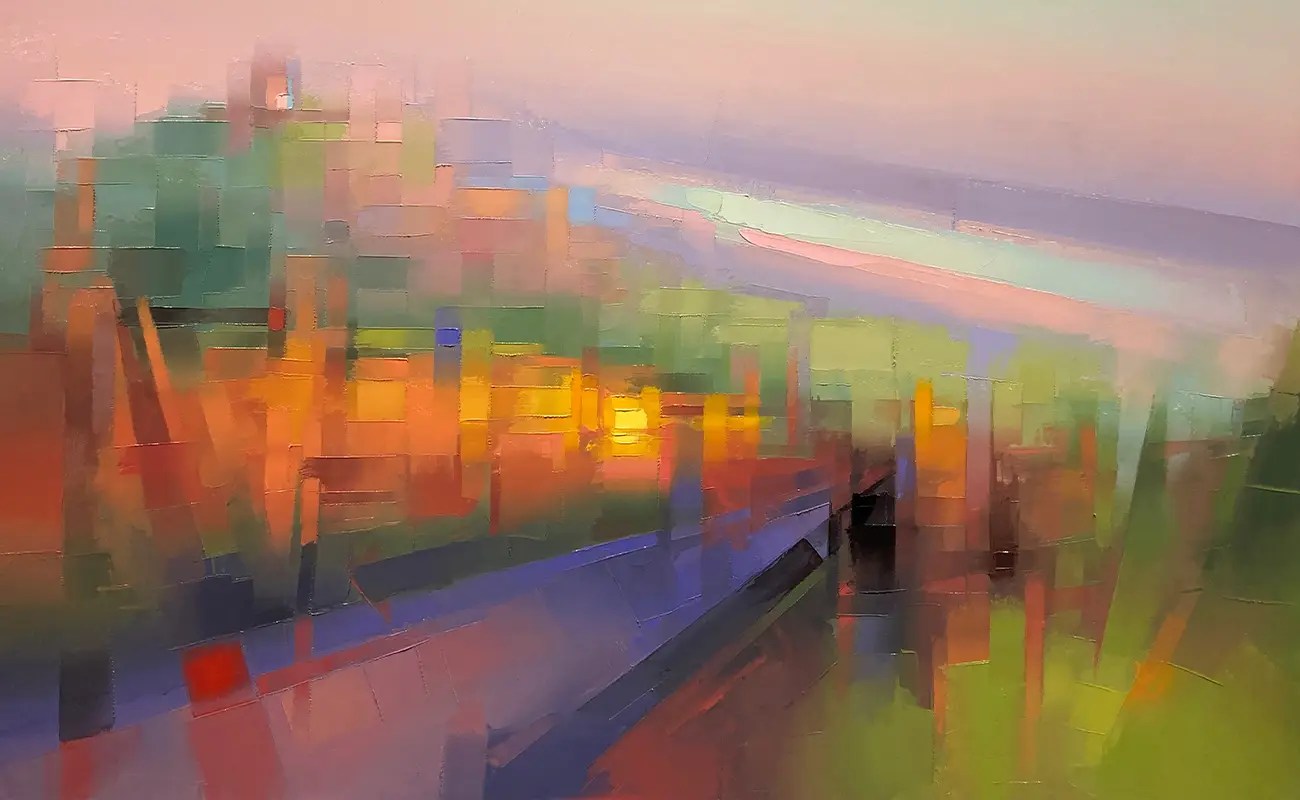
Jason Anderson has built a distinctive visual language through paintings that blur the boundaries between abstraction and landscape. Based in the south west of the United Kingdom, he transforms coastlines, reflections, and expansive skies into luminous compositions charged with movement and atmosphere. His canvases pulse with thick applications of oil paint, creating surfaces that appear both sculptural and fluid at the same time. Rather than striving for exact representation, Anderson pursues emotional resonance through texture, color, and gesture. This approach gives his work a sense of immediacy, inviting viewers to experience landscapes as sensations rather than fixed locations. The result is a body of work that captures fleeting shifts in light and weather while also reflecting a deeply personal response to the natural environment.
Before committing fully to painting, Anderson trained as a stained glass artist, a formative experience that continues to shape the structure and rhythm of his compositions. Working with colored glass taught him to simplify forms into interconnected fragments, an influence that remains visible in the way he constructs landscapes through layered blocks of color and energetic palette knife marks. Instead of outlining details in a traditional manner, he assembles scenes almost like mosaics of light, allowing separate tones and textures to merge into cohesive impressions from a distance. This background gave him a sharper understanding of how color defines shape and emotion, encouraging him to approach painting with both restraint and freedom. The stained glass discipline also introduced an appreciation for luminosity, something that continues to animate his work today.
The transition into becoming a full time artist arrived after Anderson relocated from London to the south coast in 2015. That move proved transformative, offering not only physical distance from the intensity of city life but also a closer connection to the coastal scenery that now dominates his practice. In the beginning, he worked on portrait commissions and exhibited more conventional figurative landscapes in galleries. Yet a pull toward abstraction and the expressive possibilities of the palette knife steadily became impossible to ignore. Thick sweeps of paint allowed him to loosen his relationship with realism and prioritize the physical process of painting itself. Through this evolution, Anderson discovered a style that could simultaneously suggest recognizable landscapes while remaining open, atmospheric, and emotionally charged.

Jason Anderson: Painting the Atmosphere Between Land and Sea
The landscapes surrounding Anderson provide constant inspiration, particularly the shifting conditions of the coast. Water, cloud formations, reflections, and expansive skies become recurring elements that shape the mood and structure of his paintings. He sees the natural environment as an endless source of abstraction, where changing weather patterns and light conditions create compositions that are already dynamic before paint even touches the canvas. Rather than depicting nature with strict accuracy, Anderson interprets these scenes through emotional and sensory responses. His paintings often include a subtle human presence somewhere within the composition, a detail that reflects his ongoing interest in humanity’s relationship with the environment. These figures are rarely dominant. Instead, they act as quiet reminders of scale, vulnerability, and connection within vast natural spaces.
Light plays a central role in Anderson’s practice, and the influence of J.M.W. Turner can be felt strongly throughout his work. Turner’s dramatic treatment of atmosphere and his innovative depictions of landscape left a lasting impression on Anderson’s understanding of painting. What resonates most deeply is Turner’s ability to dissolve physical forms into light, motion, and mood while still retaining emotional clarity. Anderson channels a similar energy through his own techniques, using layers of oil paint to create shimmering transitions between sky, land, and water. Thick impasto surfaces catch and reflect light in ways that shift depending on the viewer’s perspective, giving the paintings an almost living quality. Through these methods, he creates works that feel immersive and emotionally expansive rather than static or descriptive.
Equally important is Anderson’s commitment to process. The physical act of applying paint remains central to his artistic philosophy, especially through the use of sweeping palette knife gestures and richly textured surfaces. He embraces the unpredictability that comes with manipulating heavy oil paint, allowing spontaneous marks and interactions between colors to shape the final image. This approach introduces a sense of movement and freedom that aligns closely with the changing landscapes he portrays. Instead of controlling every detail, Anderson allows the painting to evolve organically, balancing intention with instinct. That openness gives his work a distinctive vitality and prevents the compositions from becoming overly polished or rigid. Every mark contributes to the emotional rhythm of the painting, reinforcing his belief that the act of creation itself can become the focal point.

A Practice Guided by Rhythm and Exploration
Daily structure plays an important role in sustaining Anderson’s evolving body of work. He spends most weekdays in the studio painting, while also dedicating time to framing, administration, and preparing works for collectors and exhibitions. This disciplined routine allows him to maintain consistency while still leaving room for experimentation. Painting in focused collections has become one of the defining strategies within his practice, giving him the opportunity to investigate a subject, palette, or technique over an extended period. By revisiting similar motifs repeatedly, Anderson deepens his understanding of how subtle variations in color, texture, and composition can transform emotional impact. This method also supports continuous artistic growth, allowing each collection to become a stepping stone toward new discoveries.
Working in series encourages Anderson to push beyond repetition and continually refine his visual language. Coastal scenes, reflective waters, and expansive skies may recur throughout his paintings, yet each body of work introduces different emotional tones and technical explorations. Some collections lean toward brighter and more energetic palettes, while others embrace quieter atmospheric moods. The process becomes a dialogue between observation and experimentation, with Anderson constantly testing how far abstraction can stretch while still maintaining a recognizable sense of place. This balance between familiarity and transformation is one of the qualities that makes his paintings resonate with a broad audience. Viewers are offered landscapes that feel emotionally accessible yet visually open enough to invite personal interpretation.
Despite the recognition his work has received, Anderson remains focused on progression rather than fixed achievements. He speaks less about grand future projects and more about the desire to continue improving as an artist. That perspective reveals a practice rooted in curiosity and persistence rather than spectacle. For Anderson, growth comes through sustained engagement with painting itself, through the daily act of returning to the canvas and responding to color, texture, and atmosphere in new ways. This commitment to refinement ensures that his work continues to evolve naturally over time. Each painting becomes part of a larger exploration into how landscapes can be transformed into emotional experiences through abstraction, movement, and light.

Jason Anderson: A Defining Moment in Color and Sound
Among the many works Anderson has created, one painting remains especially significant because of the moment it represented in his career. In 2019, he produced the artwork for Billie Eilish’s single “everything i wanted,” a collaboration that connected his atmospheric painting style with the emotional tone of contemporary music culture. The piece stood out not only because of its visibility but because of the delicate visual language Anderson employed. Using a restrained pastel palette, he crafted an image that reflected the ethereal and introspective mood of the song. The softer tones marked a subtle shift within his work and demonstrated his ability to adapt his painterly techniques to evoke a more fragile emotional atmosphere without losing the energy and texture that define his style.
The experience carried personal significance because it represented a convergence of artistic instinct, timing, and wider cultural recognition. Anderson recalls the project as a very specific moment in his development, one that still resonates emotionally whenever he encounters the image connected to the song. That lingering excitement speaks to the deep attachment artists often form with works that capture a turning point in their creative journey. While he values all of his paintings for different reasons, whether because of a successful process, an unexpected interaction in the paint, or a particular color palette, the Billie Eilish artwork remains uniquely memorable because of the emotional response it continues to provoke years later.
What makes this story compelling is the way it reflects Anderson’s broader philosophy toward painting. He does not separate emotional meaning from technical execution. A shift in palette, a single brush movement, or the atmosphere created by layered oils can carry just as much importance as the finished image itself. This sensitivity to process allows his work to retain authenticity even when connected to globally recognized projects. The painting for “everything i wanted” ultimately reinforced the strength of Anderson’s visual identity, proving that his textured abstractions could communicate across different artistic mediums while remaining unmistakably his own. Through color, movement, and light, he continues to create paintings that feel suspended between memory, sensation, and landscape.