A Childhood of Images and the Making of a Visual Mind
James Jean stands among the most distinctive artists of his generation because his practice refuses confinement. Painting, drawing, illustration, sculpture, publishing, design, and large-scale commissions all sit within a body of work that remains unmistakably his. Born in Taipei in 1979 and later raised in New Jersey after moving to the United States at the age of three, he grew up at a distance from the traditional art centers that often shape early careers. Yet that physical remove did not prevent imagination from taking root. Long before public recognition arrived, drawing already occupied a central place in his life. Everyday materials became invitations to create, and ordinary surroundings became sources of visual possibility. That early habit of turning observation into image still echoes through his mature work, where the familiar can suddenly transform into something mysterious, lyrical, or emotionally charged. His art often feels like a bridge between childhood wonder and adult reflection, joining precision with instinct in equal measure.
During those formative years, Jean explored more than one creative discipline. He studied instruments such as piano and trumpet, experiences that may help explain the rhythm and pacing visible in his later compositions. Repetition, variation, pauses, crescendos, and movement across a surface resemble musical thinking translated into visual form. At the same time, comic books became a defining influence during adolescence. They offered not only graphic excitement, but also a direct lesson in narrative sequencing, atmosphere, and character psychology. For a young artist, comics demonstrated that drawings could tell stories with emotional force. Jean copied advertisements, photographs, and printed imagery that captured his attention, sharpening both hand skills and visual memory. Those exercises were more than imitation. They formed a private education in composition, gesture, and symbolic suggestion. What later appeared as highly original language was built on years of disciplined looking and constant experimentation.
His formal studies at the School of Visual Arts in New York concluded with a B.F.A. in 2001, but education did not end with graduation. Jean has spoken about sketchbooks as a vital counterbalance to academic structure, a place where invention could remain free from rigid expectations. In these pages, rough doodles could exist beside polished studies, journal fragments beside strange creatures, monochrome line work beside bursts of color. That spirit of open inquiry remains essential to understanding his art. Even when finished paintings appear exquisitely controlled, they often preserve the freshness of a sketch discovered in motion. Rather than separating practice from product, Jean treats exploratory drawing as the foundation of everything else. This helps explain why his later works feel alive rather than static. They carry traces of searching, revision, and surprise. From childhood marks on paper to professional mastery, the same impulse continues: to follow images wherever they lead and trust what emerges.

James Jean: From Comic Covers to Cultural Recognition
After graduating in 2001, Jean entered professional life through commercial illustration and quickly became one of the most celebrated image makers in that field. His cover work for DC Comics, Marvel Comics, and especially series such as Fables and The Umbrella Academy brought immediate attention. These commissions demanded narrative clarity, dramatic tension, and memorable design, yet Jean consistently introduced a richer emotional texture than standard genre expectations required. His covers did not merely advertise stories inside the book. They became visual events in themselves, layered with symbolism, atmosphere, and elegant complexity. Recognition followed through multiple Eisner Awards, Harvey Awards, honors from the Society of Illustrators, and other distinctions. Such accolades confirmed technical brilliance, but they also revealed something more important. Jean had found a way to merge popular culture with sophisticated visual intelligence, proving that illustration could operate at the highest artistic level while still speaking to a broad audience.
Commercial success soon expanded beyond publishing. Jean produced work for clients that included Prada, Atlantic Records, A24, Time Magazine, The New York Times, ESPN, Rolling Stone, Maharam, and many others. He also created the album art for My Chemical Romance’s The Black Parade, a project that introduced his imagery to a different audience through music culture. What makes these collaborations notable is not simply the prestige of the names involved, but Jean’s unusual ability to preserve artistic identity within commissioned contexts. Whether designing for fashion, magazines, or entertainment, his signature language of flowing forms, intricate line, and dreamlike transformation remained intact. Many artists adapt to commercial demands by diluting their vision. Jean instead used each platform to extend it. This rare consistency helped establish him as a creator whose hand could be recognized across media, regardless of scale, purpose, or audience.
Even while receiving professional acclaim, Jean continued building a more personal direction that would eventually redefine his career. In 2008, he stepped away from routine illustration assignments in order to concentrate on painting and independent studio practice. That transition was significant because it did not reject earlier achievements. Rather, it absorbed them into a broader ambition. The narrative instinct learned through comics, the discipline shaped by deadlines, and the precision sharpened by client work all entered his evolving fine art practice. His later paintings retain cinematic immediacy and storytelling charge, yet they are no longer bound to explicit plots. They invite viewers into open-ended psychological spaces where meaning remains fluid. Jean’s path demonstrates that commercial and personal art need not exist in opposition. In his case, one prepared the ground for the other, allowing a celebrated illustrator to become a major contemporary painter without losing continuity.

Imagined Worlds, Shifting Identities, and the Power of Symbols
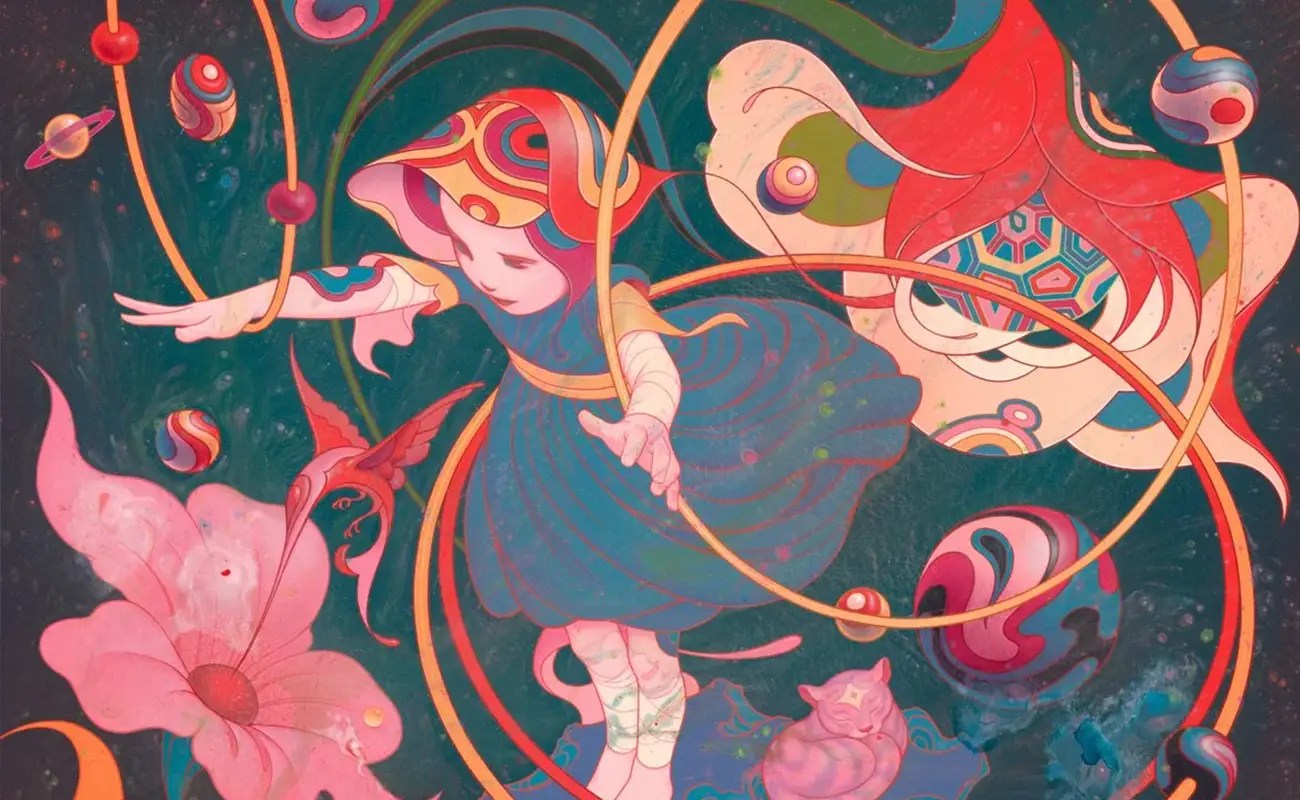
At the center of Jean’s art lies a profound trust in intuition. He has often described his process as organic rather than strictly planned, preferring not to begin with a fixed thesis that must be illustrated. Instead, images develop through making, and themes may reveal themselves only after the work is complete. This method gives his paintings their remarkable sense of instability and discovery. Figures merge with animals, plants coil into bodies, ornamental patterns become emotional weather, and familiar objects slip into dream logic. Viewers sense narrative possibilities, yet no single explanation closes the image. That openness is one reason his work remains compelling over time. Rather than delivering solved messages, it creates spaces where memory, desire, fear, tenderness, and transformation can coexist. The paintings seem less like statements than living environments in which symbols continue changing long after the brush has dried.
Jean’s visual vocabulary is both recurring and endlessly renewable. Butterflies, frogs, deer, spiders, droplets, children, phantoms, hybrid beings, blossoms, and webs appear across many periods of his career. These motifs are never mere decoration. They function as emotional carriers that connect one body of work to another. A spider’s web may signify continuity, entanglement, or the passage of time. A butterfly can suggest beauty, fragility, metamorphosis, or fleeting presence. Because the meanings are not fixed, each return of a motif deepens rather than repeats. Saturated color and elegant line intensify this effect. His compositions often shimmer between delicacy and unease, drawing viewers in with beauty while hinting at vulnerability or loss. This balance gives Jean’s art unusual psychological range. The seductive surface does not hide complexity. It becomes the very means through which complexity is felt.
Questions of identity and migration also move quietly through his practice. Raised in a Taiwanese family within the United States, and later living between Los Angeles and Japan, Jean experienced culture not as a single stable category but as layered and shifting experience. Language itself could feel partial, divided, or incomplete. This history helps explain his devotion to images as another form of communication. East Asian painting traditions, Japanese woodblock prints, Chinese silk scrolls, global mythology, comics, cinema, anatomy studies, historical European printmaking, and contemporary media all pass through his art. Yet these influences are not displayed as quotation or citation. They are transformed into a personal symbolic system shaped by memory and instinct. Identity in Jean’s work is therefore never presented as a slogan. It appears as something continually rebuilt through fragments, inheritance, imagination, and change.

James Jean: Exhibitions, Expansion, and a Living Legacy
Jean’s exhibition history reveals an artist whose audience spans continents while his practice continues to evolve. Solo presentations in New York, Los Angeles, Tokyo, Seoul, Shanghai, Chengdu, Shenzhen, Beijing, and Vancouver chart a career of sustained international interest. Bodies of work such as Rebus, Kindling, Azimuth, Eternal Journey, Seven Phases, Eternal Spiral, and Meadowlark show recurring concerns with metamorphosis, mythology, intimacy, and visual wonder. Museums and collections including the Museum of Modern Art in New York, the Asian Art Museum in San Francisco, LOTTE Museum of Art in Seoul, and Colección SOLO in Madrid hold his work, confirming institutional recognition alongside popular admiration. Yet Jean’s exhibitions do more than present finished objects. They often create immersive atmospheres where drawing, painting, light, and sculptural elements interact. This approach reinforces a central truth of his career: he is not confined to a single medium, but guided by an expanding image-world.
Among his major public presentations, the 2019 retrospective Eternal Journey at LOTTE Museum of Art in Seoul demonstrated the breadth of that image-world with striking scale. More than 500 works were included, ranging from large paintings and installations to comic covers and hundreds of drawings that revealed the generative roots of later pieces. Nine monumental paintings explored obangsaek, the five cardinal colors associated with traditional concepts of cosmic order. A particularly significant work from this period was Gaia – Yellow Earth Center (2019), an illuminated stained-glass sculpture created with Judson Studios. Rising over eight feet tall, the piece depicts the goddess Gaia accompanied by a tiger within a dense field of natural and geometric forms. Through hand painting, fused glass, and contemporary fabrication methods, Jean translated his intricate vocabulary into a historic medium while preserving emotional immediacy.
His collaborations beyond galleries further display how adaptable his language can be. With Prada, Jean created murals for Epicenter stores, runway environments, prints for later collections, and the animated short Trembled Blossoms, whose title references John Keats. In cinema, he designed memorable poster art for mother!, The Shape of Water, Blade Runner 2049, and Everything Everywhere All At Once, tailoring each image to the emotional atmosphere of the film rather than simply summarizing plot. He also entered emerging digital markets when his NFT Slingshot sold in 2021. Across these varied contexts, what distinguishes Jean is not only virtuosity in line, color, and composition. It is his ability to make images feel discovered rather than manufactured. Beauty in his work never becomes empty ornament, and fantasy never escapes feeling. Through every medium, he continues to show that images can think, remember, and transform.