
“It took five years to throw off the commercial mindset and channel my vision into unique, personal works and finally rebrand myself as an artist.”
From Chemical Trays to Conceptual Freedom
Photography entered Hugh St.John Burden’s life through a moment of quiet wonder in an improvised school darkroom. What had once been a chemistry storage space became a site of revelation. Watching a black and white print slowly develop under amber light imprinted a sense of magic that never faded. That early encounter established photography not simply as a skill to be learned, but as a lifelong language through which observation, patience, and curiosity could coexist. From those formative experiences, image making became inseparable from Hugh’s identity, shaping how he perceived the world long before he understood where the medium might eventually lead him.
His academic grounding reflected an unusually broad curiosity, combining Sciences and Art. This mix fostered both analytical discipline and visual sensitivity. Entering professional life at nineteen, he moved through roles that exposed him to photography from the inside out, working first in camera retail and later as a darkroom technician within an advertising agency. These early commercial environments sharpened his technical precision and taught him how images function within systems of communication. Yet they also planted the seeds of creative restlessness that would later drive him to seek experiences beyond familiar professional boundaries.
Travel became a turning point rather than a detour. Relocating to New Zealand, he found himself absorbed into graphic design and medical illustration, disciplines that demanded clarity, structure, and restraint. Years later, returning to the United Kingdom, he channelled this layered experience into building a freelance photography practice. What began alone expanded into a studio-based operation, producing still life, food, room sets and later industrial and editorial work. The studio serviced clients across the country and abroad. When digital photography emerged in the late 1990s, the sense of discovery he had known as a schoolboy resurfaced, replacing chemical processes with glowing screens and software, a new universe of creation that Hugh embraced wholeheartedly.

Field of Flowers
Wildflower meadows and land left uncultivated create rich biodiversity, offering vital habitats for insects, small animals, and other pollinators. These living ecosystems help improve soil health, which in turn supports natural carbon storage and contributes to climate change mitigation. Pesticide-free, organic farming principles are imperative to sustain our planets health.
Hugh St.John Burden: Breaking Away from the Commercial Eye
After decades immersed in advertising and editorial assignments, semi-retirement offered something unfamiliar and unsettling: complete freedom. Without art directors, briefs, or deadlines, Hugh St.John Burden faced the challenge of creating purely for himself. What initially appeared liberating quickly revealed itself as a demanding transformation. Years of commercial problem solving had conditioned his thinking toward persuasion and clarity of a sales message; letting go of that mindset required patience and persistence. The absence of external direction forced him to confront questions about authorship, intention, and personal voice that commercial work had restrained.
Hugh describes the shift from applied photography to artistic practice as a slow shredding of ingrained habits, taking several years before genuine change occurred. During this period, experimentation was not always comfortable or productive. False starts, hesitation, and frustration accompanied the gradual emergence of his new visual language, moving away from illustration toward interpretation, and from instruction toward suggestion.
Eventually, this internal reorientation enabled him to redefine fully as an artist rather than a service provider. The rebranding was grounded in a fundamental change in how images were conceived and evaluated. Success is now measured by resonance and integrity, where intuition, observation, and personal conviction guide decision making to make his art reflective and quietly insistent.


Fate & Power
When wealth, authority, and power are used selfishly, the impact on the planet is profoundly destructive. The capitalist industrial system must begin to yield space and attention to ecological realities. At the bottom of the image, the mushrooms—an unstoppable, quiet force—suggest that nature can still find a way to endure, if given the chance.
Seed – “Mighty oaks from little acorns grow.”
In a world waking up to the need to reverse deforestation, each new tree becomes an act of repair. Planting and protecting forests offers one of the most tangible ways to draw down carbon and let damaged ecosystems breathe again
Reading Stories in Surfaces and Silence
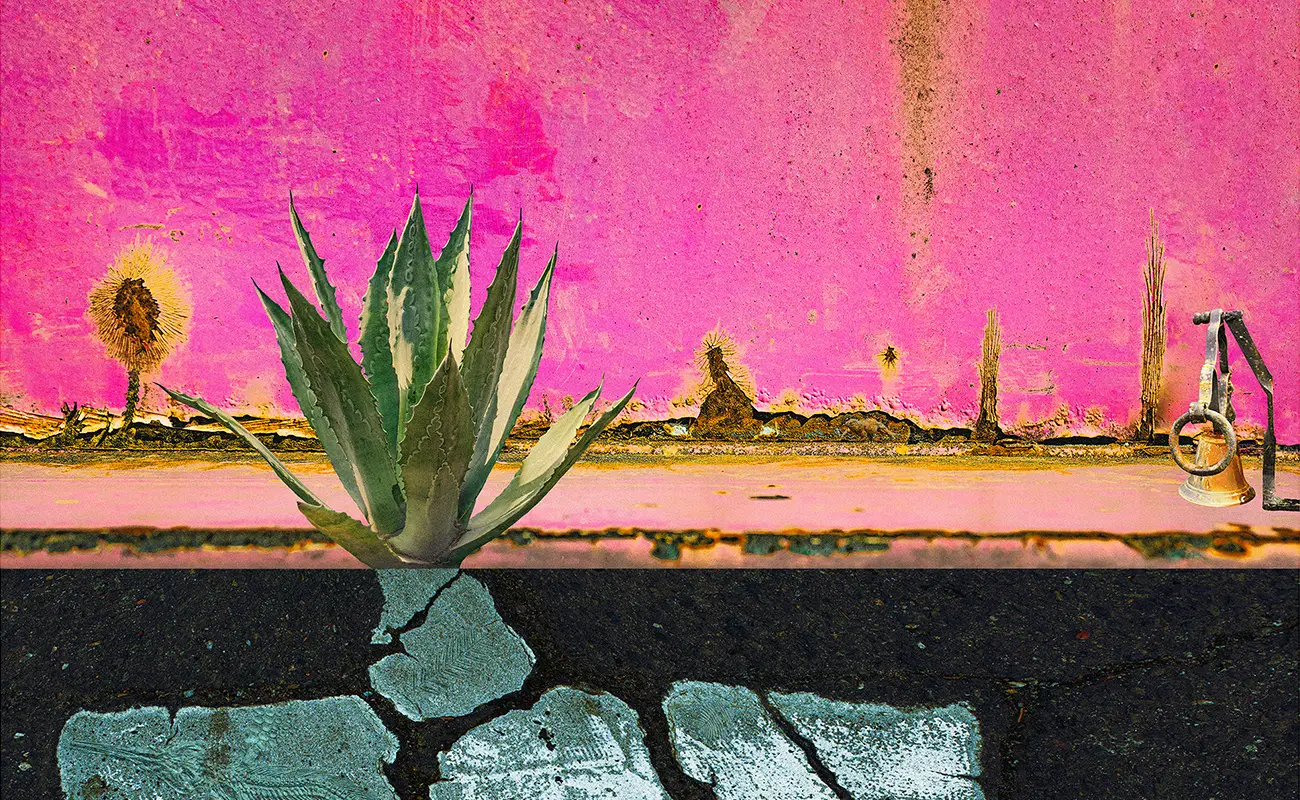
At the heart of Hugh St.John Burden’s current work lies an attentiveness to surfaces most people overlook. Weathered walls, peeling paint, stains, cracks, and crumbling textures become starting points rather than backgrounds. He observes these marks not as signs of decay alone, but as visual prompts capable of suggesting landscapes, figures, or unfolding events. Through a process shaped by serendipity and pareidolia, he identifies latent imagery embedded within these surfaces, responding to what they appear to offer rather than imposing a predetermined narrative.
These initial texture photographs serve as the foundation for layered constructions developed digitally. Using enhancement and compositing techniques, additional imagery is carefully integrated to clarify the visions he perceived. The result is not a literal depiction but an amplified suggestion, familiar enough to ground the viewer, abstract enough to invite interpretation. These chance discoveries form the basis of Hugh’s creative process, embodied in the concept The Writing Is On The Wall, by positioning surfaces as carriers of concealed truths. Environmental concerns emerge as a recurring subject, embedded within visual relationships rather than overt declarations.
Hugh St.John Burden creates images that feel welcoming and intimate, drawing viewers in through beauty and texture, while offering expansiveness, abstraction, and contemplation. Influences from his youth, including Bill Brandt’s photographic sensibility and the abstract painters Kandinsky and Mondrian alongside surrealist figures such as Dali and Miró, can be felt in the way form, suggestion, and ambiguity coexist. In more recent years, growing frustration with environmental inaction and climate warming denial has deepened Hugh’s resolve to produce environmental narratives.

Forest 01
Trees appear to communicate with each other through vast fungal networks that help them share resources and respond to threats, a phenomenon researchers have nicknamed the “wood wide web.” In this work, images of pine trees are merged with close-up photographs of fungi to explore the visual and symbolic echoes between the trees and their symbiotic partners. Together they form reimagined, surreal forest landscapes that celebrate a deeply cooperative ecosystem.
Hugh St.John Burden: Process, Persistence, and What Comes Next
One particular artwork (FOREST 01) holds deep personal significance within his body of work, not because it was planned, but because it revealed a direction he had not yet recognised. While tidying his garden, he noticed clusters of fungus growing across decaying wooden planks and photographed them, encouraged by his partner’s insistence that their appearance was extraordinary. Only weeks later, during post-production, did their resemblance to forest landscapes become apparent. By integrating images of trees, he transformed these images of decay into forest scenes.
Researching into forest ecosystems, Hugh discovered trees appear to communicate with each other via fungal networks to combat threats, nicknamed by researchers the “wood wide web.” That first completed image became the catalyst, establishing the stylistic approach that would inform much of his subsequent work.
His working rhythm today is irregular, shaped as much by pauses as by periods of intense focus. Creative blocks are an accepted part of his practice, endured rather than resisted. Unlike commercial environments where deadlines enforce productivity, artistic work unfolds according to less predictable rhythms. When momentum arrives, Hugh finds it all-consuming, with long nights at the screen, obsessive refinements, and exploratory detours.
The digital tools Hugh uses are primarily Adobe Lightroom and Photoshop to construct his layered compositions. Texture and collected photographs may remain dormant in his archive for weeks or months before finding their place within a developing narrative.
Looking ahead, Hugh continues to expand the Environmental collection through new wall texture concepts already forming in his mind. At the same time, he is considering a gradual shift toward themes centred more directly on human experience, reflecting life in its complexity and emotional range. Recent works have moved toward increased abstraction, a direction he intends to pursue further. Rather than abandoning environmental concerns, this evolution suggests a broadening of focus, where personal, collective, and ecological realities intersect. His practice remains open ended, guided by observation, patience, and a willingness to follow images toward meanings that reveal themselves slowly.