
“Filled with tension between myth and vulnerability is the centre of the work.”

Between Vast Horizons and Constructed Realities
Dean West is an Australian photographer based in the United States whose work occupies a charged space between lived geography and psychological inquiry. Born in 1983 and raised in a small town in New South Wales, he grew up surrounded by farming and mining landscapes defined by immense horizons and uncompromising light. That early environment left a lasting imprint on his visual language. Australia, with its physical expanses and social distances, fostered an acute awareness of isolation, scale, and the emotional weight carried by open space. After relocating to North America, West encountered a different kind of vastness, one shaped not only by land but by layered histories and cultural mythologies. His photographs emerge from this intersection, where physical environment and internal narrative converge in carefully orchestrated scenes.
The influence of distance continues to inform his practice. In Australia, space often separates people as much as it defines place, and that sensibility carries through his compositions. Figures in his images frequently appear suspended within expansive settings, suggesting both autonomy and estrangement. Upon settling in the United States, West became increasingly attentive to how national myths permeate daily life. The American West, suburban leisure culture, and masculine archetypes entered his visual vocabulary, not as straightforward documentation but as subjects to be examined through constructed imagery. This dual perspective, shaped by migration and cultural negotiation, enables him to observe American iconography with both intimacy and critical distance.
West’s academic training at the Queensland College of Art further sharpened his technical and conceptual approach. His commitment to digital photography reflects an understanding of the medium not only as a tool but as a defining language of contemporary culture. Over time, his images have moved beyond straightforward representation into complex stagings that challenge the boundary between fact and invention. Exhibitions at institutions such as the Columbus Museum of Art, Discovery Times Square Museum in New York City, and Paris Expo Porte De Versailles have affirmed the international resonance of his work. Through these platforms, his photographs continue to articulate a dialogue between landscape and identity, between surface perfection and psychological depth.

Dean West: Cinema in Stillness
West’s relationship with photography began early. At seven years old, he asked for a camera, and from that point forward he approached image making with an instinctive confidence. That assurance matured into a practice defined by deliberate construction. His photographs are staged with precision, borrowing the visual grammar of cinema while remaining firmly within the still image. Lighting is carefully calibrated, compositions are balanced, and gestures are choreographed to produce a sense of suspended action. The resulting images appear both hyperreal and theatrical, inviting viewers to question what is authentic and what has been carefully arranged. Beneath their polished surfaces lies a persistent inquiry into performance, especially the performance of masculinity and cultural identity.
Influences from painting and film are central to his aesthetic development. Artists such as David Hockney and Edward Hopper inform his sensitivity to color, architecture, and mood, while the tableau strategies of Stan Douglas and Jeff Wall shape his understanding of photography as a constructed narrative form. Cinema and advertising also contribute to his visual vocabulary, offering lessons in spectacle, pacing, and visual persuasion. Strong directional lighting, often reminiscent of classic studio portraiture or film noir, sculpts figures and intensifies atmosphere. In certain cowboy portraits, shadow nearly erases individuality, leaving the silhouette of a hat or stance as the primary signifier. Through such techniques, West transforms recognizable symbols into psychological studies.
Recognition from both commercial and fine art sectors underscores the breadth of his impact. International brands including Disney, Samsung, MTV, Starburst, Bombay Sapphire, and Fox Sports have collaborated with him, drawn to his ability to merge narrative sophistication with visual clarity. His accolades include being named among Saatchi and Saatchi’s Top 100 Emerging Photographers in 2008, receiving Advertising Photographer of the Year at the International Loupe Awards, inclusion in Lürzer’s Archive 200 Best Ad Photographers in 2019, and the Arte Laguna Prize in Venice. Despite these achievements, the core of his work remains anchored in critical exploration rather than pure spectacle, using refinement and control to probe the myths embedded in contemporary culture.

Myth, Masculinity, and the Hyperreal Surface
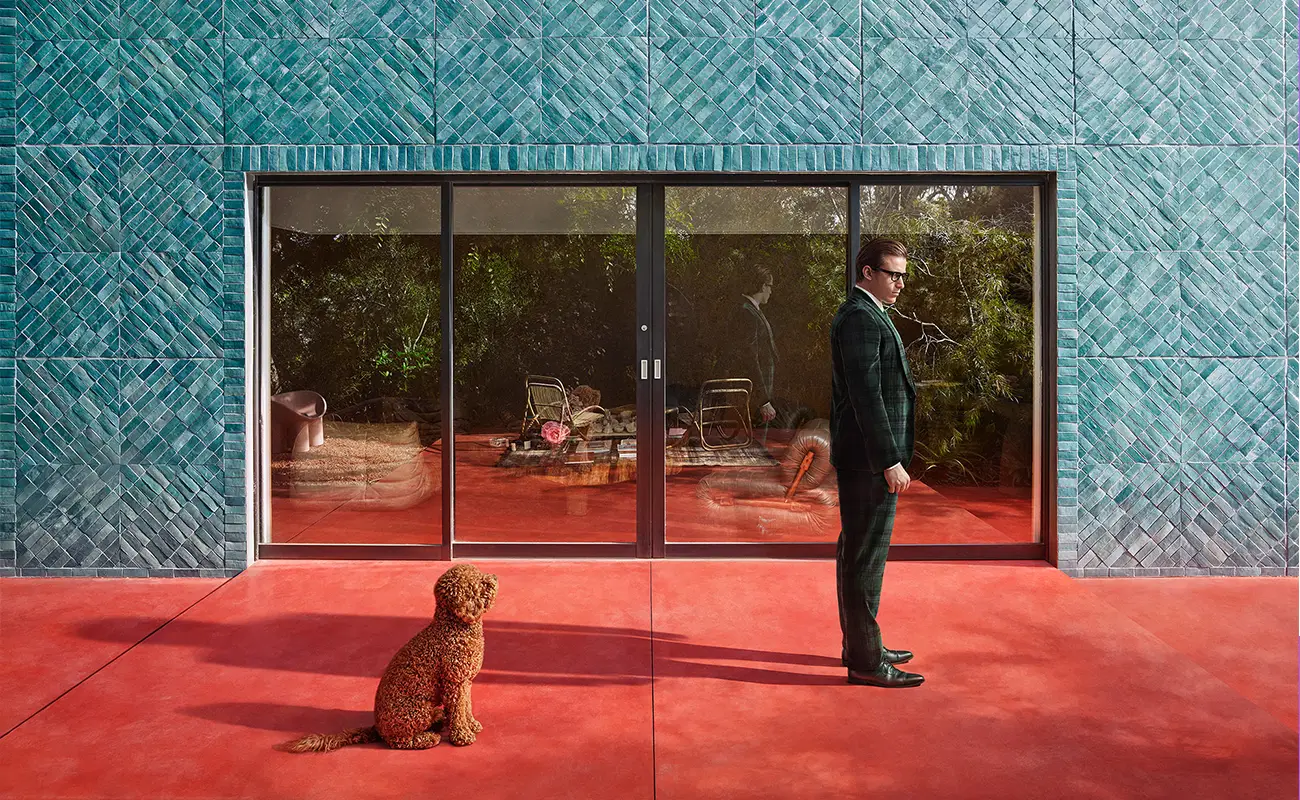
A defining feature of West’s practice is his examination of masculine archetypes within highly controlled environments. Cowboys, suburban patriarchs, and rugged outdoorsmen populate his compositions, yet they rarely perform dramatic action. Instead, they stand poised, contemplative, or momentarily suspended, as though awaiting a cue that never arrives. This stillness generates tension. Heroism is implied but postponed, and confidence appears tinged with uncertainty. By placing these figures within pristine architectural settings or expansive landscapes, West highlights the contrast between cultural expectation and personal vulnerability. The mythology of the American West, in particular, becomes both subject and stage, examined through images that feel simultaneously nostalgic and contemporary.
Color and light operate as conceptual tools rather than mere aesthetic choices. West frequently alternates between restrained monochrome palettes and saturated hues such as turquoise pools, terracotta earth, and manicured greens. These vivid tones amplify the artificial quality of the scene, suggesting a world that is almost too perfect to be entirely believable. In poolside compositions and modernist domestic settings, immaculate surfaces coexist with subtle disruptions. An alligator glides beneath calm water, a bull occupies a sunlit arena, or a diver hangs suspended midair. Such elements introduce quiet unease into otherwise idyllic environments. The tension between control and unpredictability becomes a central narrative thread.
Digital craftsmanship plays an essential role in achieving this effect. West often combines multiple exposures and compositing techniques to create seamless yet slightly uncanny images. Reflections align precisely, shadows fall with intention, and spatial relationships feel carefully engineered. This approach lends his photographs a painterly presence, akin to contemporary history paintings disguised as lifestyle imagery. The viewer is drawn in by visual seduction, then prompted to question the authenticity of the scenario. Through this interplay of surface perfection and conceptual depth, West constructs visual parables about desire, aspiration, and the fragile foundations of cultural myth.

Dean West: Luis and the Evolution of Vision
One of the most pivotal works in West’s career is Luis (The Wrangler) # 1, Boca Raton, 2021, from The Palms series. This photograph marked his first collaboration with a full film crew and the use of continuous light, signaling a significant shift in his process. Working alongside a director of photography introduced him to a new method of seeing, one grounded in cinematic continuity and atmospheric control. The experience expanded his understanding of how sustained lighting could shape narrative tension within a single frame. The resulting image oscillates between an everyday scenario and a scene charged with cinematic anticipation, reinforcing his ongoing investigation into the construction of myth.
Within Luis (The Wrangler) # 1, tension resides at the intersection of mythology and vulnerability. The figure embodies the symbolic weight of the wrangler, an emblem of Western masculinity, yet the presentation invites closer scrutiny. The atmosphere suggests performance rather than spontaneous action, heightening awareness of the roles individuals inhabit. Through the collaboration with a film crew, West refined his capacity to balance narrative suggestion with visual restraint. Continuous light allowed for nuanced tonal transitions and a heightened sense of immediacy, qualities that have since influenced subsequent projects. This work stands as a turning point, demonstrating how technical experimentation can deepen conceptual clarity.
West’s daily practice reflects the same patience and intentionality evident in that photograph. His routine moves between research, collaboration, casting, and set construction, with careful attention to light, scale, and context. Projects often unfold gradually, and he frequently revisits earlier ideas or pauses major undertakings to explore parallel concepts. Currently expanding his American West series into a book, he continues to interrogate the symbols and environments that define national identity. The slow pace of production is not a limitation but a deliberate strategy, ensuring that each image sustains the layered dialogue between geography, psychology, and the enduring power of myth.