“I remain fascinated by the unfolding emergence of a painting: its first moments, the unexpected appearance of its forms, the gradual build-up of its intensity.”
The Painting as an Event
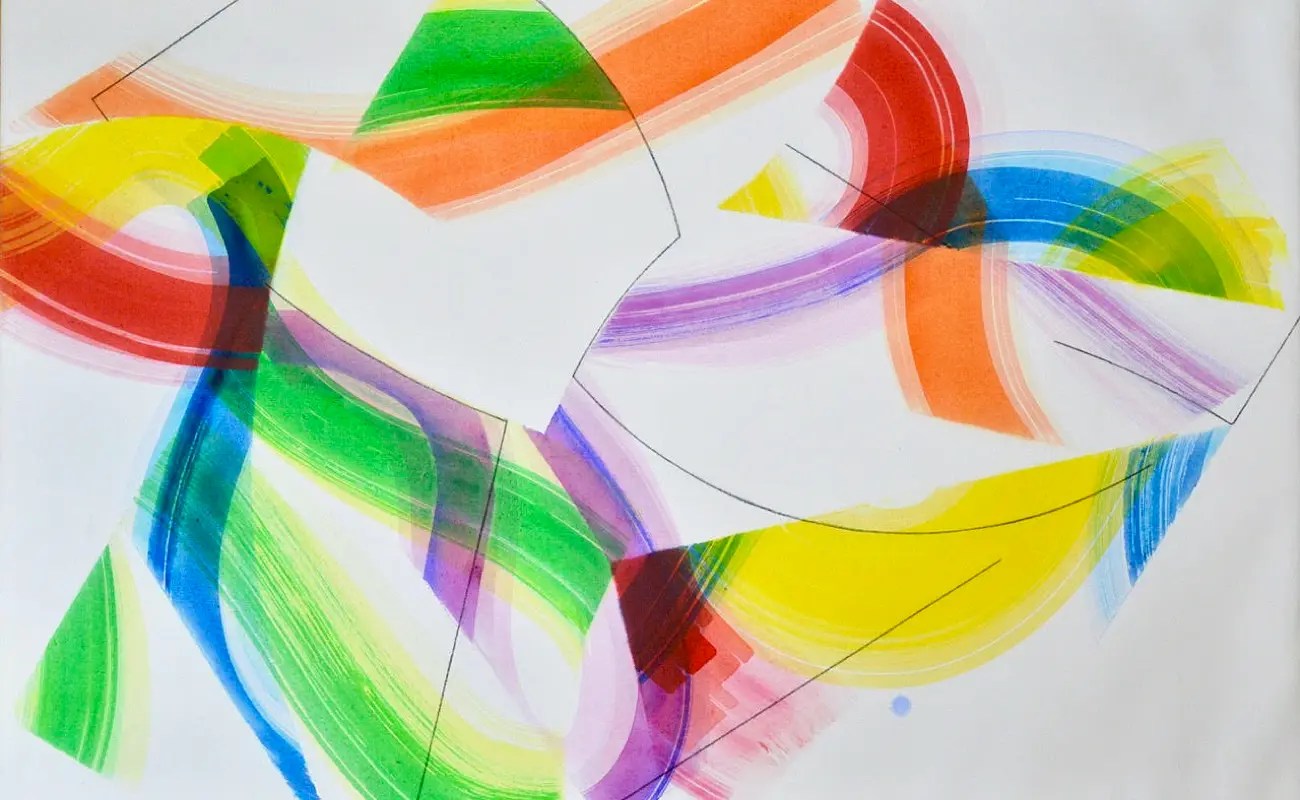
For Yohanan Delaunay Israël, painting is less a fixed image than a process that remains visible after the work is complete. His abstract compositions are built from geometric systems, free gestures, flat fields of color, and transparent layers that preserve traces of earlier decisions. Rather than beginning with a fully determined image, he allows forms to emerge through a controlled encounter between structure and unpredictability. That tension has shaped a practice extending from his art studies in France to his current work in Jerusalem, where he has lived and worked since 2015.
Born in France in 1955, Delaunay Israël grew up in a home surrounded by books, music, and paintings by local artists. School itself held little appeal, but encounters with theatre, poetry, and painting during adolescence gave direction to his restlessness. His earliest works moved between expressionist figuration and geometric abstraction. At the Institute of Visual Arts in Orléans and later at Villa Arson, National Higher School of Art in Nice, where he studied from 1976 to 1979, he encountered twentieth-century abstraction, American Minimalism, Supports/Surfaces, prehistoric and parietal art, the Quattrocento, and Chinese painting.
Those studies did not lead him toward a single historical model. Instead, they established a way of thinking about painting as a field in which earlier art remains active. He has described the expectation at art school that students should know the works that preceded them and, in a sense, answer for their own work in their presence. While many routes through contemporary art were available, he chose to continue with painting. That decision finally brought him back to the geometric questions he had explored as a student, but with a slower gesture, more fluid color, and a stronger interest in the time contained within each layer.

Yohanan Delaunay Israël: Geometry, Chance, and Free Association
After art school, Delaunay Israël trained as a house painter before studying psychiatric nursing from 1980 to 1983. The hospital was already familiar to him because he had worked there during summers while studying art. His later career as a psychiatric nurse and nursing supervisor developed alongside his studio practice, and the two remained closely connected. During this period, he met André Robillard, whose drawings, constructions, collected objects, and independent working methods introduced him directly to Art Brut and to forms of expression that resisted conventional artistic filters.
That encounter reinforced an idea already important to his work: a painting can have structure without being entirely predetermined. His visual vocabulary combines lines, gestures, and flat areas of color with compositional systems drawn from geometry and art history. Over the years, these have included circular symmetry, Borromean knots, harmonic progressions of the square, geometric constructions of the Golden Ratio, harmonic decompositions of the square, and Matila Ghyka’s spiral of harmonious growth. The system provides a framework, but the placement of forms begins with something closer to a throw of the dice.
From those first placements, the composition develops through interdependence. Each geometric element suggests several others, while lines and color fields attach themselves to the emerging structure through a process Delaunay Israël associates with free association. He often imagines an element first by drawing or painting it “in white,” sensing where it might belong before fixing it more fully. He then paints while blocking out neighboring areas, discovering only afterward what new forms have been created by juxtaposition. Geometry is therefore not a means of eliminating uncertainty. It becomes the condition through which uncertainty can remain active.

Layers That Keep Their History
Delaunay Israël’s working method is built around continuity rather than correction. He generally works on several paintings or drawings at once, sometimes five or six, moving each one forward through a small intervention during every session. There are no preparatory studies, and once a decision has been made, he avoids correcting it or painting over it as a mistake. Working across multiple pieces helps him forget them temporarily and return with enough distance to see what has changed. The daily rhythm is regular, ideally beginning each morning, but the development of each work remains open.
Transparency plays a central role in this process. Layers accumulate without erasing what came before, allowing earlier stages of the painting to remain perceptible within later ones. In notes written in 1989 for an exhibition of his Compositions series, he reflected on his fascination with the minute changes caused by one layer passing over another. What began as an interest in producing unique colors gradually became something more fundamental: the possibility of painting with the very process of change that had captured his attention. He says that this still describes his work today.
His current series extends that long investigation through the geometric construction of the spiral. The form introduces changes of scale within the painting and creates an expanding movement that he is exploring across different media. On paper, he works with watercolor or ink in combination with pastel and charcoal. On canvas, he uses acrylic or oil. The recent painting “Reading Akhmatova,” DHC 1, was his first work based on a spiral drawing. Its outward movement is linked, for him, to the memory of discovering the poetry of Anna Akhmatova, whose writing holds exceptional personal importance.

Yohanan Delaunay Israël: When the Present Enters the Composition
A different kind of urgency entered Delaunay Israël’s work with “7 October 5784,” a triptych of diamond-shaped canvases made after the October 7, 2023 massacre. He describes it as the first work he created in direct response to contemporary reality. Painted in oil, the three canvases are distinct in treatment and color while forming a chronological sequence: blue for the period before, red for bloodshed and barbarity, and yellow for light returning to life. The work brought a specific historical event into a practice more often organized around internal structures, duration, and formal emergence.
The triptych also shows how a geometric format can carry emotional and temporal meaning without abandoning the principles that have guided his painting for decades. The diamond shape connects to compositions he first explored in Nice in the 1970s and returned to in 1984 after a period devoted to landscape, still life, and self-portraiture. Since then, his practice has repeatedly combined inherited geometric frameworks with decisions made in the moment. The result is not a closed system but a surface where memory, experience, and formal construction can occupy the same space.
Delaunay Israël has exhibited in France and Israel, and two catalogues published by the Centre d’Art Contemporain de la Scène Nationale d’Orléans have focused on his work, with texts by painter Christian Bonnefoi and art historian Tristan Trémeau. He has also written about his own practice and about artistic workshops and cultural projects developed during his hospital career. Across these different activities, one concern persists: the emergence of form itself. He continues to paint so that viewers can perceive not only the finished composition but also something of the sequence of decisions, accidents, layers, and intensities through which it came into being.