“I am not interested in reconstructing what once was, but in discovering what it can still become.”
What the Surface Remembers
Anna Montanaro‘s practice occupies an unusual meeting point between contemporary art and conservation. Living and working near Milan, she moves across painting, photography, drawing, fine art printmaking, digital collage, image transfer and restoration, allowing each discipline to inform the others. Her training in Painting Conservation and Restoration at the Brera Academy of Fine Arts did more than provide technical knowledge. It changed the way she understands an image, teaching her to look beyond what is immediately visible and to read layers, losses, materials and the physical evidence of time. That dual perspective gives her access to the image both as an object with a history and as material that can be actively transformed.
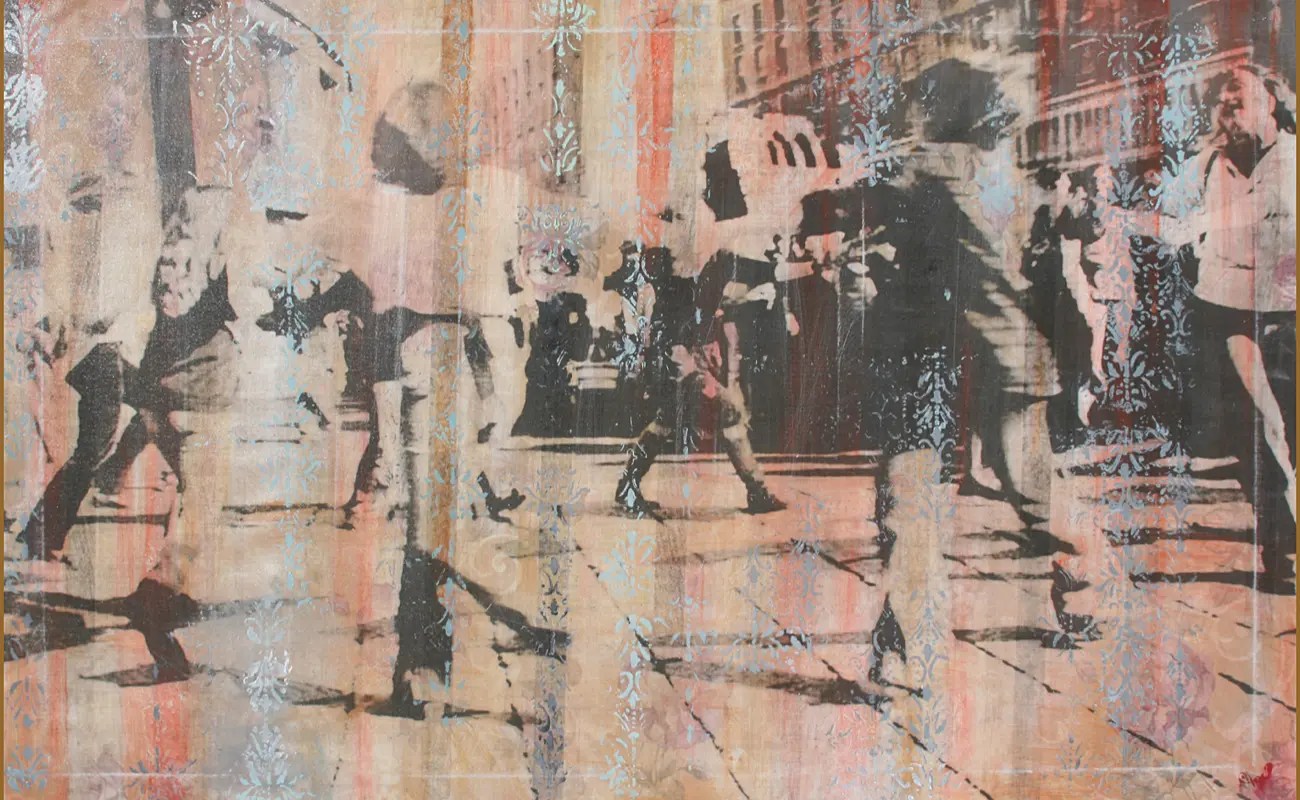
That education still structures the logic of her work. Rather than treating a picture as a fixed surface, Montanaro approaches it as something accumulated and unstable. Photographic or printed images are transferred onto canvas, then scraped, incised, veiled, erased, painted over and brought back into view. The resulting surface records a sequence of actions in which appearance is never final. Forms may survive intact, dissolve into partial traces or return after having been obscured, so that the work carries its own history of disappearance and recovery.
Memory sits at the center of this process, not as a complete archive but as something fragmentary, selective and continuously revised. Montanaro condenses this idea into three words: Memento. Psyché. Prospice. For her, they suggest remembering, giving a soul to traces and looking forward. The sequence also clarifies why preservation alone is not enough for her. The past matters because it can be transformed. A surviving fragment becomes valuable not by remaining untouched, but by acquiring another presence in the present.

Anna Montanaro: Between Conservation and Destruction
A productive contradiction drives Montanaro’s studio practice. Her professional formation taught her to protect artworks from loss, while her artistic instinct often asks her to do the opposite. She scratches images, abrades them, covers portions of them and creates deliberate ruptures in their surfaces. These gestures are not acts of rejection. They are ways of testing what an image can retain after its apparent wholeness has been disturbed. Conservation and erosion therefore operate side by side, creating a language in which damage can reveal rather than simply remove.
The process often begins with a photograph, printed fragment, material texture, sensation or memory rather than a fully determined composition. Montanaro builds through addition and subtraction, transferring and painting before scraping, incising, covering and uncovering. Each stage changes the relationship between the visible and the hidden. Her experience in restoration has also sharpened her attention to the moment when an object reaches equilibrium. Knowing when to stop becomes part of the work, particularly when another intervention might destroy the tension between what remains legible and what has begun to disappear.
Recurring images give this physical process an emotional vocabulary. Roses, butterflies and the human body appear as vehicles for fragility, metamorphosis, loss and rebirth. The butterfly is especially important through its association with Psyché, suggesting transformation without the erasure of what came before. Montanaro is less interested in restoring an earlier state than in seeing what a changed image can become. That distinction allows the work to move beyond nostalgia. It acknowledges loss while refusing to treat the past as a condition that can simply be reconstructed.

Presence Becoming Absence
The personal origins of Montanaro’s concern with memory are inseparable from experiences of loss. Her father died when she was nineteen, an event that made her acutely conscious of the way physical absence can coexist with continued presence. A person may no longer be there, yet photographs, objects, gestures and remembered details keep producing contact across time. This tension between disappearance and persistence became a powerful reference point for a practice already attentive to damaged surfaces and incomplete images.
Photography offers a particularly useful model for that tension. A photograph preserves a fraction of time, but it cannot contain the fullness of a lived experience. Montanaro responds to that limitation by refusing the idea of the photograph as a complete record. Once transferred to canvas, an image becomes material that can be interrupted, wounded or partially concealed. Scratches, gaps and lacunae are not treated as defects to be corrected. They become active elements that expose the instability of remembrance and the distance between an event and what remains of it.
Her 2018 work Ophelìe, a mixed media canvas measuring 160 × 80 cm, marked a significant point in this development. Montanaro did not set out to illustrate Shakespeare’s Ophelia literally. Instead, she focused on the threshold at which presence begins to turn into absence. The figure emerges through transparencies, glazes and fragmentation, seeming to appear and recede at once. In making the work, Montanaro understood more clearly that an image could be approached as a space to enter and alter rather than simply something to depict. The concerns visible in Ophelìe, including the body, memory, fragility, time and transformation, continue to shape her work.

Anna Montanaro: Giving the Fragment a New Identity
Montanaro’s recent direction expands the scale of memory from the individual toward the collective. Many works begin with images that are intimate or personal, but the studio process gradually loosens them from their original context. Once fragmented, transferred and reworked, they can operate less as private documents and more as testimonies or symbols. The shift allows a particular image to carry meanings that are no longer restricted to the circumstances in which it originated, turning personal memory into a possible point of shared recognition.
This evolving research has accompanied more than a decade of exhibitions, publications and international recognition. Montanaro received the Diploma of Honor at the Premio Arte, Cairo Editore, in 2016, the Overall First Prize for Digital Art at the Premio Città di Novara in 2018, the First Prize for Graphic Art at the OSTEN Biennial of Drawing in Skopje in 2022, and the First Prize of the Technical Jury at the Biennale di Sondrio in 2024. These distinctions span different media, reflecting the interdisciplinary structure of a practice that resists being confined to a single technique. They also trace the continuity of an inquiry that has developed through digital art, graphic processes and mixed media while remaining focused on the same questions of time, memory and change.
What remains consistent is the movement between image and matter, preservation and transformation, private experience and shared memory. Montanaro reads the marks left by time through the discipline of conservation, then creates new marks through her work as an artist. The fragment is never presented merely as evidence of what has been lost. It is treated as a starting point capable of another life. Memento. Psyché. Prospice. The phrase returns as both method and direction: remember what remains, animate the trace, and allow it to move forward under a new