“The project reflects my observations of contemporary life, especially the relationship between comfort, technology, isolation, and the way people adapt to a rapidly changing world.”
Between Production and Personal Vision
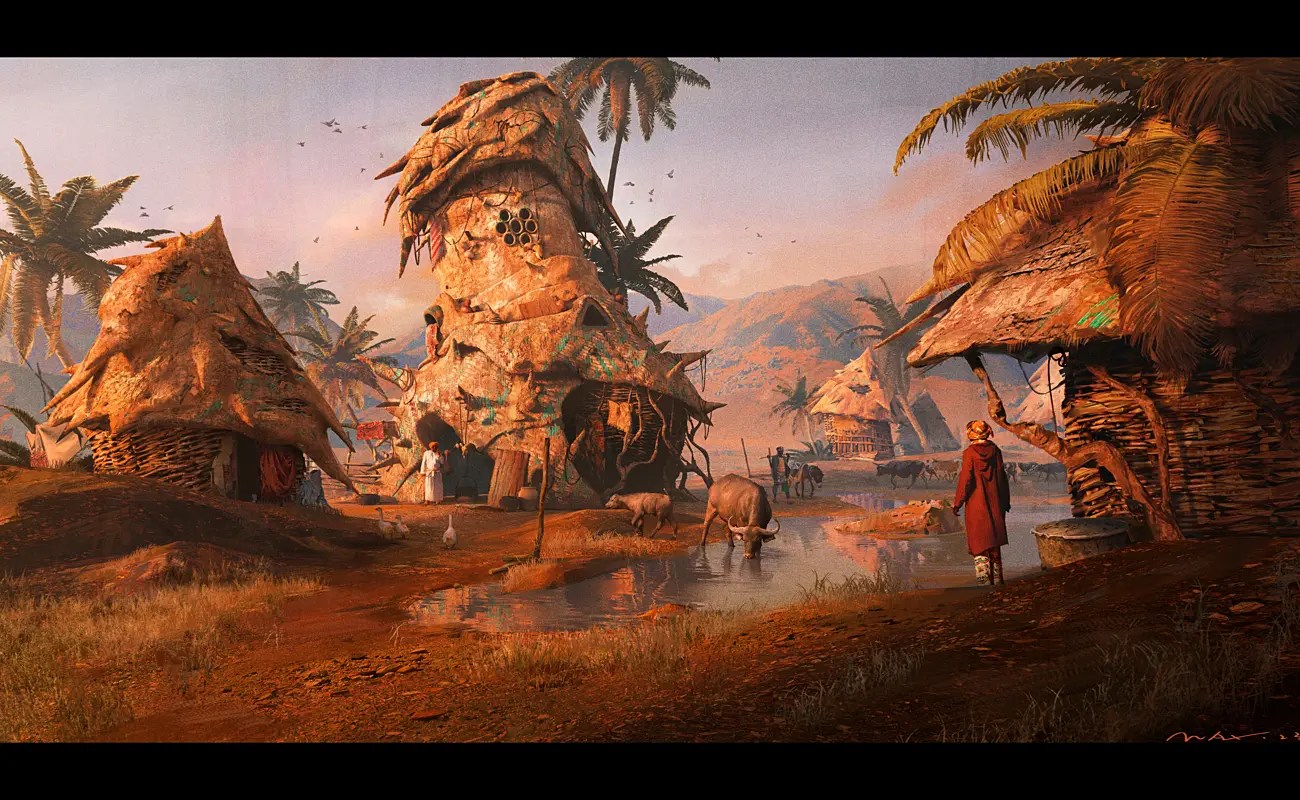
Chong Liu moves between two closely connected forms of image making: professional concept design for the game industry and personal digital painting. Now in his fifth year working professionally in entertainment and currently at Activision Blizzard, he has built a practice around visual clarity, atmosphere, storytelling, and the ability to turn ideas into convincing worlds. Outside studio work, however, his personal images give him a different kind of space, one where observation and emotion can take precedence over a production brief. The contrast between those modes has become central to how he understands his own development.
His path toward concept art was not immediate. Art had been part of his life from childhood, and his formal education at the China Central Academy of Fine Arts and the School of Visual Arts in New York gave him experience across both academic study and practical training. During college, he imagined becoming an animation director and completed two independent animated short films. That period shaped more than a possible career path. It trained him to think through sequence, staging, composition, character, environment, and the visual logic that holds a story together.
The decisive turn came in 2020, during his final year at SVA. While developing his thesis animation, Liu found himself especially engaged by the design of its characters, environments, and sets. Those tasks gradually clarified the direction he wanted to pursue professionally. Rather than leaving animation behind, he carried its lessons into concept design, where a single image often has to communicate narrative, space, mood, and practical information at once. The change in career direction was therefore less a break than a narrowing of focus toward the part of animation he found most compelling.

Chong Liu: Realism as a Working Language
Liu describes his visual approach as mostly realistic, a quality closely connected to the demands of concept art. In production settings, images need to communicate efficiently to teams and directors, often before a finished world exists. Realism therefore functions less as an aesthetic rule than as a shared visual language. It allows designs to be read quickly, understood spatially, and evaluated in relation to a larger project. For Liu, years of working this way have naturally carried realism into the visual vocabulary of his personal images.
That professional discipline has also sharpened his sense of composition and storytelling. His animation background remains active in the way he organizes images, even when the work is not moving. A scene can imply what happened before, what might happen next, and how a viewer should travel through the frame. Years of drawing and design practice have reinforced his attention to structure, but Liu does not treat professional fluency as the final goal of his personal work. The skills are a foundation rather than a boundary.
Instead, he uses personal projects to test what might exist beyond the expectations of concept design. He does not identify one permanent subject or fixed theme. The work changes with different periods of his life and often emerges from his observations of people, society, and his own uncertainty, thoughts, and emotions. That flexibility is important to him because personal art offers a place to search for forms of expression that do not need to solve the same problems as his industry work. It can remain open ended, responsive, and closely tied to what he is experiencing at a particular moment.

Future Comfort and the Unease of Contemporary Life
One of Liu’s most meaningful personal projects is Future Comfort, a series created through digital painting. The work examines contemporary life through a set of tensions that have become increasingly visible to him: comfort and technology, adaptation and isolation, convenience and emotional distance. Rather than functioning as a production design exercise, the series gives him a way to process how rapid social and technological change affects everyday experience. Its importance lies in that shift from designing for an external objective to using images as a means of personal reflection.
The project is significant precisely because it is more personal than his professional concept work. In an industry context, a design usually serves a defined production goal, whether that means communicating a character, environment, object, or visual direction. Future Comfort begins somewhere else. Liu uses the images to work through his own response to the environment and society around him, allowing uncertainty and feeling to remain part of the final work rather than resolving them into a single message. Digital painting remains familiar territory, but the purpose behind the image has changed.
His attention to change is shaped by the period he is living through. He points to the pandemic and the rise of AI as examples of how quickly the conditions around artists and audiences can shift. These developments do not appear in his account as isolated topics but as part of a broader awareness that the world is unstable and continuously being reorganized. Future Comfort gives that awareness a visual form while also helping Liu build a personal language that can stand apart from his daily role as a concept designer. The series becomes both an observation of contemporary life and a step toward greater independence in his art.

Chong Liu: Looking at Los Angeles from the Ground
A recent move to Los Angeles has opened another direction in Liu’s personal practice. The city presented him with a striking contradiction between its glamorous image and the social realities he encountered after arriving. He was particularly affected by the number of people living on the streets and by a sense of separation between individuals in what he calls a “city on wheels.” These observations have begun to feed a new group of digital paintings. His interest lies not in reproducing the city as scenery, but in responding to the social and emotional conditions he noticed within it.
For Liu, relocation is not simply a change of scenery. Moving from place to place alters what he notices and therefore what enters the work. Los Angeles has made loneliness, homelessness, social isolation, comfort, and public image more immediate subjects. He is interested in the distance between how a city is imagined and how it can feel when experienced at street level, especially when apparent prosperity exists beside visible vulnerability. That tension connects naturally with questions already present in Future Comfort, but it gives them a specific location and a new set of lived observations.
His working rhythm leaves personal art to evenings and weekends, outside the demands of his office schedule. Films, video games, exhibitions, galleries, and travel remain part of how he relaxes and replenishes his visual thinking. The next series he wants to realize will grow from those recent experiences in Los Angeles, translating impressions of glamour, comfort, loneliness, and social fracture into personal digital paintings. In that work, the skills of the concept artist remain present, but the purpose shifts toward observation, interpretation, and a more individual visual voice, one shaped by the changing places and conditions around him.