“Since my final years at art school, I have been obsessed with surrealism, with René Magritte as my great inspiration.”
The Discipline of Looking
Leo Van Hullebusch has built his practice on a long commitment to observation, technical study, and sustained contact with traditional media. Born in Westmalle in 1940 and based in Ekeren, Belgium, he has spent decades drawing and painting figures, portraits, still lifes, landscapes, and constructed subjects. His work is grounded in recognizable form, yet recognition is rarely the final destination. Even at its most observational, the image remains open to alteration. This combination of discipline and imaginative freedom has become especially important as surrealism has moved closer to the center of his practice.
His training established a broad technical foundation. Van Hullebusch studied painting at the academy in Brasschaat and later trained in the restoration of paintings, frescoes, mosaics, and sculptures. He also spent many years drawing from the model, making portraits, and working directly from nature. That experience sharpened his attention to proportion, weight, contour, surface, and tonal structure. Restoration added another way of looking, one concerned not only with what an image represents but also with how it is physically made, preserved, layered, and supported.
The range of media he uses reflects that foundation. Watercolor offers transparency and speed, Chinese ink concentrates attention on gesture and line, while oil allows a slower process of construction and revision. Acrylic, pastel, charcoal, and pencil extend the vocabulary further. Van Hullebusch does not treat these materials as interchangeable effects. Each creates a different kind of pressure on the image. His weekly routine, divided among art school, painting groups, and evening instruction, keeps that technical knowledge active through repetition, exchange, and continued study.

A Rainy Day
Leo Van Hullebusch: Reality Rearranged
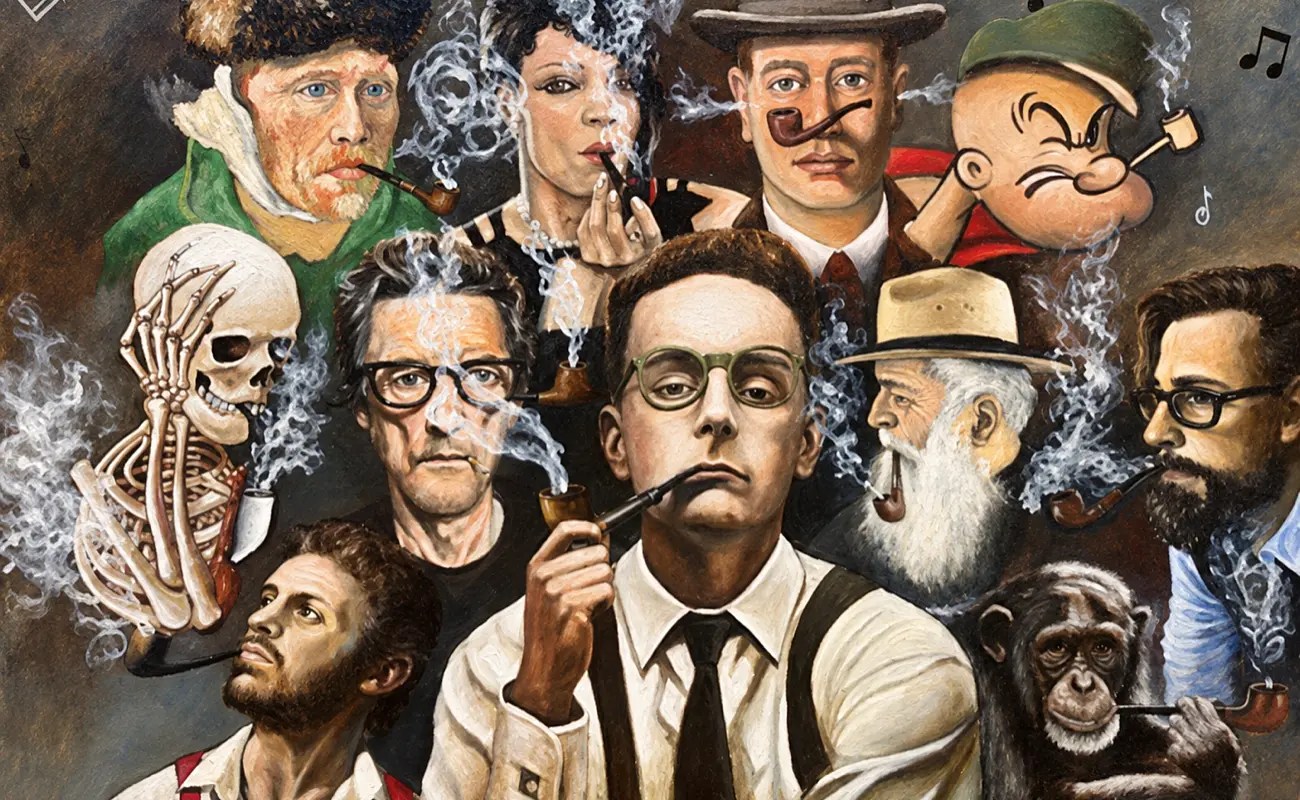
Surrealism gives Van Hullebusch a way to redirect the skills developed through figurative observation. René Magritte has been a major influence since his final years at art school, particularly in the use of recognizable objects within relationships that contradict ordinary expectation. Van Hullebusch does not need to dissolve form or abandon realism to create uncertainty. Instead, he begins with things viewers can identify, then changes their context, scale, function, or connection to one another. The result is an image that remains readable at first glance while becoming increasingly difficult to explain.
This strategy is especially effective when the visual elements carry strong cultural associations. A formally dressed figure whose face is replaced by a QR code turns a familiar human presence into a question about identity, technology, and legibility. The figure remains intact enough to seem plausible, yet the substitution interrupts the expectation of psychological access. A face normally promises individuality, emotion, and recognition. The code offers another system of information entirely, one designed to be scanned rather than understood through expression. The contradiction gives the image both immediacy and unease.
Elsewhere, skulls appear among fish beneath the sea, bringing mortality into an environment associated with movement and life. Such combinations work because Van Hullebusch preserves the visual credibility of their individual components. The impossible encounter is presented with enough clarity to feel temporarily convincing. That tension between realism and contradiction is central to his surreal language. Instead of illustrating dreams as vague or formless experiences, he constructs situations with concrete objects and recognizable bodies, allowing symbolism to emerge from their collision. The viewer is invited to read the image, but no single interpretation is allowed to settle completely.

Ceci n’est pas un visage
Life in the Depths of the Sea
Images Under Pressure
The quieter side of Van Hullebusch’s practice reveals how much of his surreal work depends on conventional observational skill. Monochrome studies of draped figures emphasize folds, weight, silhouette, and tonal modelling rather than symbolic narrative. Fabric gathers around the body, concealing some forms while defining others through tension and shadow. These works are restrained in comparison with his more saturated paintings, but they clarify the discipline behind them. The image develops through measured looking, and the body is understood through structure rather than theatrical effect.
Color changes the emotional register dramatically in other works. Blues, greens, reds, and oranges create a more emphatic pictorial space in which figures, animals, objects, and environmental signs can take on an almost emblematic force. Van Hullebusch often favors clear contours and compositions that place symbolic elements in direct confrontation. His latest work, Climate!!! The World Is Going Haywire, pushes this tendency toward an openly contemporary subject. A cubic Earth surrounded by signs of environmental catastrophe turns planetary instability into a blunt visual impossibility, giving ecological anxiety a form that is deliberately strange and immediately accessible.
Serious themes frequently coexist with wit. Memento mori imagery, environmental vulnerability, obscured identity, and human fragility appear beside absurd substitutions and unexpected visual quotations. This prevents the paintings from becoming purely illustrative statements about social issues. Humor and strangeness complicate their message, creating a pause between recognition and interpretation. Van Hullebusch appears interested in that pause. A viewer may first respond to the oddity of an image, then notice the anxiety underneath it. The paintings use surreal disruption not to hide their subjects, but to make familiar concerns appear newly unstable.

Climate!! The World Is Going Haywire!
Leo Van Hullebusch: Craft as a Living Practice
Van Hullebusch’s technical breadth is inseparable from his belief that artistic learning remains unfinished. Oil is his primary painting medium, yet his practice continues to move among watercolor, acrylic, Chinese ink, pastel, charcoal, and pencil. The differences matter because each material establishes its own pace and resistance. A brush loaded with ink demands decisiveness, watercolor depends on transparency and timing, and oil permits slower layering and adjustment. Moving between them keeps his approach flexible while reinforcing the underlying habits of drawing, composition, and close observation.
His experience also extends beyond conventional easel painting. Decorative work on historical musical instruments connects painting with objects shaped by craft, function, and inherited visual traditions. Restoration studies similarly placed him in contact with artworks as material constructions rather than images alone. These experiences help explain the physical attentiveness visible across his practice. Even when the subject becomes surreal, the work remains concerned with how a surface carries color, how a contour holds a form, and how recognizable objects can retain enough visual solidity to support an impossible situation.
That process continues through teaching, group participation, and renewed specialization. Van Hullebusch provides painting instruction, has served on the boards of several painting groups, and continues to attend art school while focusing increasingly on surrealism. He describes beginning new subjects with the same sense of forward motion that has characterized decades of study. The important shift is not away from his figurative foundation but deeper into what it can make possible. Careful observation remains the starting point, while surrealism gives him permission to test how far the visible world can be reorganized before it becomes something else.