“My current works are a metaphor between past and future, between reality and illusion.”
Beyond the Surface
Geeepsy has built a practice around what cannot be fully seen. The French artist, curator, and photographer, born Godefroy Zwygart, now concentrates primarily on abstract painting from Sanya, China, where he also runs a small gallery and art exchange space. Across works that move from restrained monochrome to intense color, his recurring concerns remain remarkably consistent: concealment and revelation, structure and fluidity, reality and illusion. Windows, doors, and walls appear as persistent symbols, while geometry provides another language for testing boundaries. Rather than fixing meaning, Geeepsy wants the image to remain open enough for viewers to bring their own emotions and interpretations to it.
His route to painting began long before it became his principal medium. Geeepsy started drawing at a young age and studied photography from 16, looking closely at Henri Cartier-Bresson, David Hamilton, and Helmut Newton. After working with photographers in Paris, he moved to Taiwan and spent roughly a decade in magazine publishing and fashion as a photographer and editor-in-chief. His commercial career included assignments for magazines, brands, artists, and celebrities, with clients cited in his biography including Toyota, Carven, Dior, L’Oréal, Cartier, Make Up For Ever, and Bluebell. Alongside that professional work, he continued making personal art, eventually concentrating on conceptual projects and fine-art nude photography.
That parallel development helps explain the breadth of his current visual thinking. Photography trained his attention on framing, surfaces, bodies, and what a composition chooses to disclose. Painting later offered a different kind of freedom, one less dependent on material representation. Geeepsy describes art as a silent form of communication and painting as an entry into an imaginary space without predetermined shapes, colors, forms, or rules. His motto, “No school, no master, no rule,” captures that resistance to a single doctrine. Yet freedom in his work does not mean randomness. He seeks aesthetic balance and emotional resonance, even when the image emerges through intuition rather than a fixed plan.

Geeepsy: Between Geometry and Fluidity
Construction and deconstruction sit at the center of Geeepsy’s painting. Some works begin with a precise concept, while others develop by following the movement of the process itself. His recent paintings frequently set natural fluidity against geometric rigidity, creating friction between forms that appear to move freely and structures that impose order. This interest connects directly to his fascination with geometry, but also to his recurring images of doors, windows, and walls. For Geeepsy, these architectural elements are not simply objects. They suggest barriers, thresholds, and mysteries that remain concealed on the other side, turning visual limits into invitations to imagine.
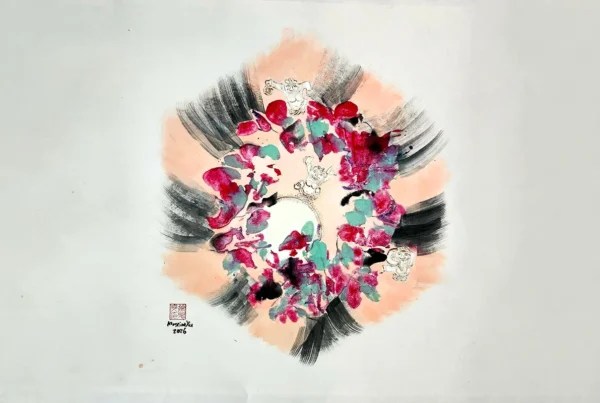
Years spent living in China have brought another set of ideas and materials into that language. Chinese culture and Feng Shui have become important influences, alongside calligraphy and traditional calligraphy paper. In works such as UNVEILED, Geeepsy combines acrylic and oil backgrounds before applying calligraphy paper over the painted surface. He then draws or paints on the paper and cuts selected areas away. Portions of the underlying image are exposed directly, while others remain perceptible through the paper’s transparency. The result makes concealment physically present within the construction of the work rather than treating it only as a symbolic theme.
This layered method allows opposing conditions to occupy the same surface. What is covered is not necessarily absent, and what is visible does not necessarily provide the whole picture. Such tensions echo Geeepsy’s broader interest in Feng Shui and in relationships between seemingly contrary forces. His paintings may be highly polychromatic or reduced toward monochrome, but color serves the larger search for equilibrium rather than functioning as a fixed signature. His training has continued alongside this evolution: he studied through MoMA’s “Abstract Painting” program, pursued Arts & Culture Strategy studies with the University of Pennsylvania, and completed UK training focused on art management on superyachts.

Desert Sun and the Life Beneath
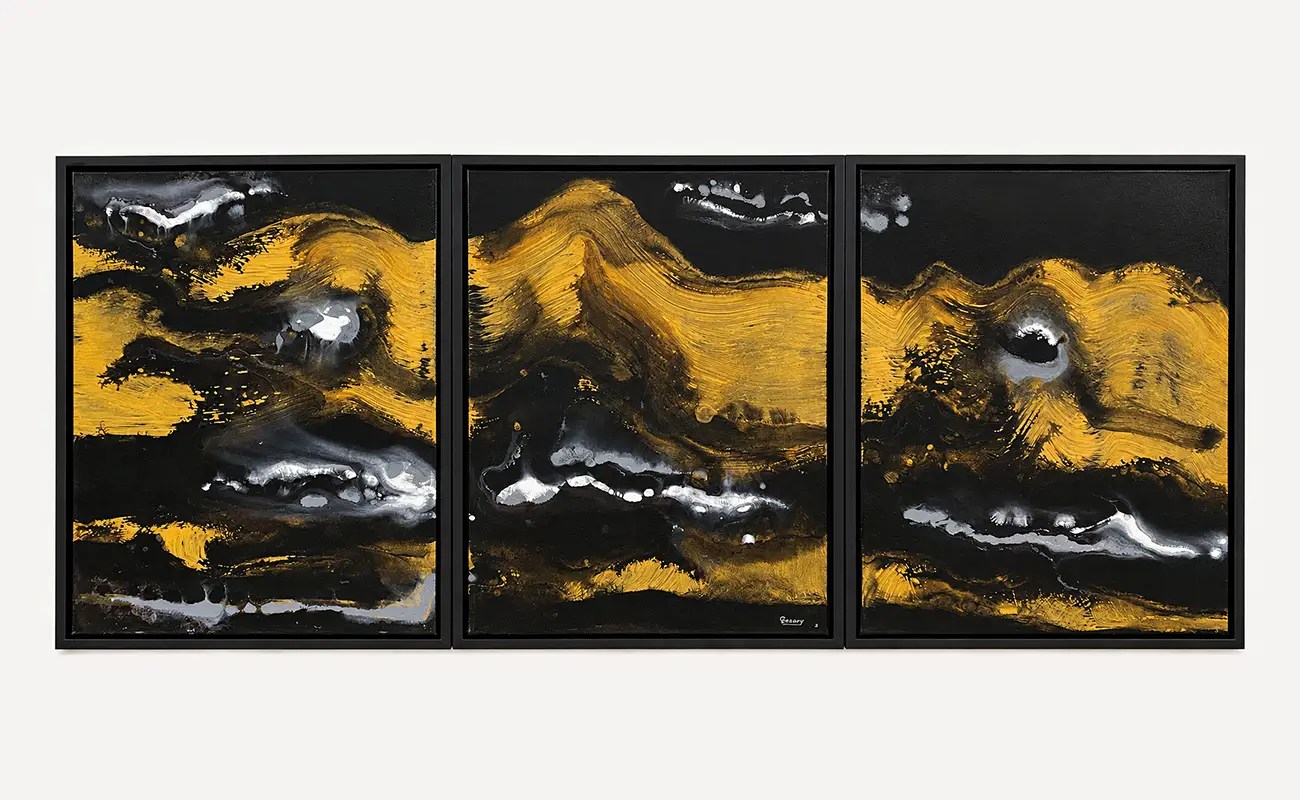
One painting brings Geeepsy’s concern with hidden forces into especially concentrated form. Desert Sun examines the visible and concealed through Yin and Yang, connecting those oppositions to life, death, and rebirth. The work is conceived as a meditation on aridity and endurance, but its desert is not simply an image of emptiness. It is a place where exposure and transformation coexist with unseen continuity. The painting asks the viewer to consider what survives beneath an exhausted surface and, more broadly, how appearances can obscure what is essential.
The upper portion belongs to Yang. It represents what is visible, searing, and spent. The sun is not presented as a generous source of vitality; instead, it appears consumed within a bleached sky. Heat becomes an annihilating force that dries everything it reaches. Below, the logic reverses. The lower portion belongs to Yin, associated here with the occult, submerged, and tenacious. Beneath the desiccated land, water continues to move outside the range of sight. Where the surface suggests abandonment, the earth still contains the possibility of persistence and renewal.
Desert Sun therefore extends beyond a simple contrast of light and darkness. Geeepsy describes it as a dialogue between mind and body as well as between what can and cannot be seen. Its significance lies in the demand to look past immediate appearances for the forces operating underneath. That proposition closely matches the artist’s attraction to thresholds and concealed spaces elsewhere in his practice. A wall may block the eye, a sheet of calligraphy paper may partially veil a painted ground, and a scorched landscape may appear lifeless, yet each condition leaves open the possibility that another reality remains active beyond direct perception.

Geeepsy: Expanding the Field
Geeepsy’s studio routine combines regularity with a practice that values unpredictability. He typically goes to the gym in the morning and paints in the afternoon, while substantial time is also devoted to preparing collaborations, exhibitions, and art fairs. His work as a curator and representative of other artists keeps his daily activity connected to a wider cultural network rather than confined to his own production. Based in Sanya since 2010, according to his biographical notes, he has developed a substantial profile in China, Taiwan, and Hong Kong while seeking to extend his presence further across Asia and in Western art contexts.
His career has included exhibitions in cities and regions across Europe and Asia, among them Paris, Hong Kong, Taipei, Hungary, Bali, Shanghai, Hangzhou, Sanya, Foshan, Shenzhen, and Wuxi. His works are held by private collectors and museums. Recognition in China has also become part of his biography. In 2019, he received the Chinese Government Friendship Award, and in 2020 he was granted Chinese permanent residency. He was inducted into the Sanya Talent Walk of Fame in 2023, received an Excellence Award at the 2024 ART Sanya Painting Competition, and was featured in Current Masters 7 by Worldwide Art Books in 2025. In 2026, he received a Creative Award at a national painting competition in China.

Even while painting now occupies the center of his practice, Geeepsy continues to revisit photography rather than treating it as a closed chapter. Recent experiments involve printing older photographs on canvas and adding bright painted dashes across them, bringing two periods of his work into direct contact. He has also begun making series of small abstract paintings intended to make collecting his work accessible to a broader audience. These developments preserve the openness that has guided his practice from photography toward abstraction: different techniques remain available, older images can be reactivated, and the finished work is not asked to dictate a single reading. The viewer is left at the threshold, where Geeepsy prefers the encounter to begin.