“Paper cutting became my primary mode of expression, serving as my song, dance, and prayer.”

A Life Cut Into Paper
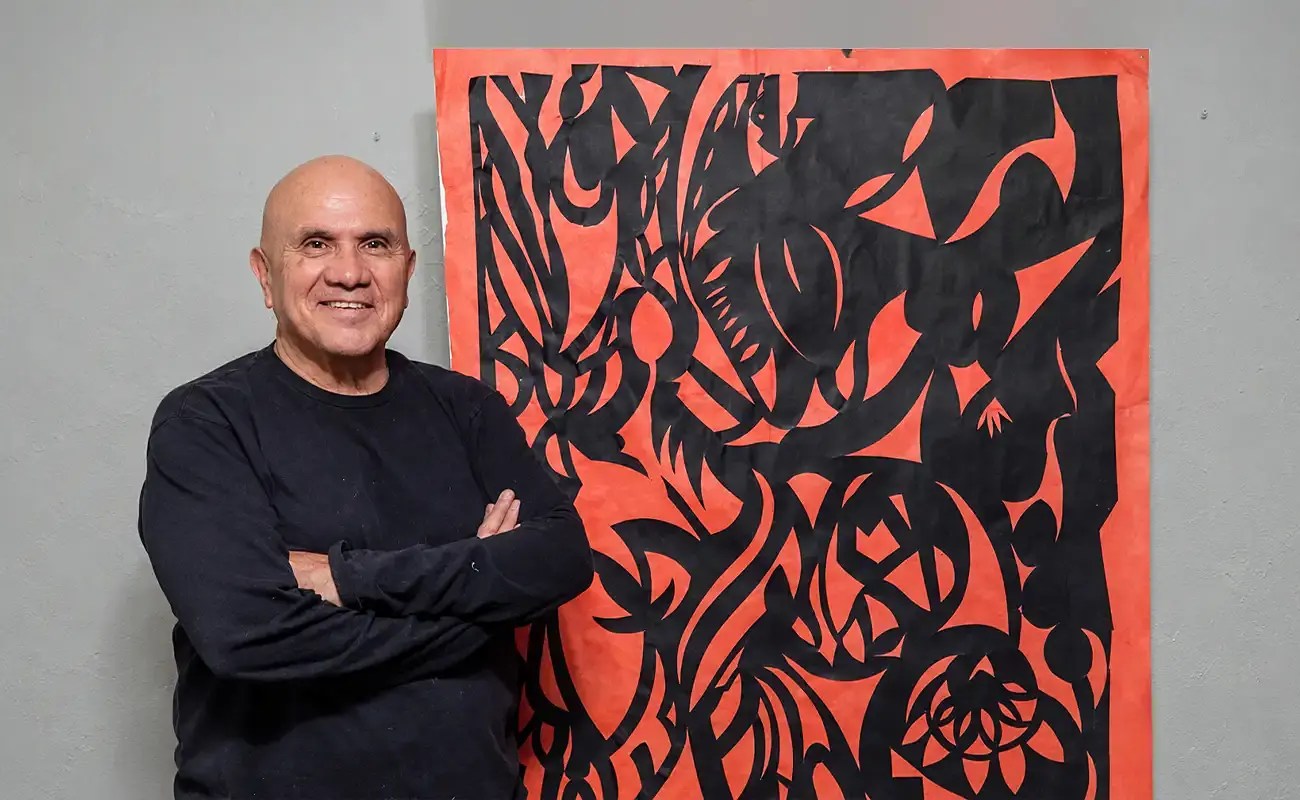
For Tlacaelel Fuentes, paper carries the force of memory, movement, and cultural continuity. His cut paper practice draws on Mexican papel picado while extending its pierced surfaces and rhythmic repetition into a personal visual language shaped by abstraction, portraiture, theatrical composition, and Southwestern references. Across decades of work, he has treated the removal of material as an active form of drawing. The cut edge becomes line, surviving paper becomes mass, and each opening admits light as part of the image. This balance between restraint and abundance gives his compositions their distinctive energy, allowing figures, symbols, and ornament to shift continually between presence and absence.
That relationship with paper began when he was five. During a kindergarten exercise with colored paper and scissors, a teacher opened a cabinet stacked with sheets in vivid hues. The sight stayed with him, turning an ordinary classroom material into the basis of a lifelong discipline. Paper cutting eventually became, in his words, his “song, dance, and prayer.” The phrase captures how fully the practice connects physical action, visual thought, and personal devotion. His daily studio routine now centers on cutting and framing, while his compositions have moved from simpler geometric structures toward more dynamic explorations of movement, equilibrium, and the complexities of human experience.
His name reflects a similarly deliberate process of cultural and personal definition. Born Patrick Trujillo, he changed Patrick to Patricio in recognition of his Chicano heritage. Fellow artist and poet Cecilio “Xilo” Garcia Camarillo later suggested Tlacaelel, comparing Fuentes’s commitment to supporting other creatives with the historical figure he describes as an architect of Aztec culture who helped create conditions in which artisans could sustain their crafts. Fuentes also adopted his mother’s surname, Fuentes, following Mexican naming traditions and honoring his family lineage. The full moniker, Patricio Tlacaelel Trujillo y Fuentes, binds heritage, family, art, and service into a name he carries with pride.

Tlacaelel Fuentes: Choreographing Positive and Negative Space
Fuentes’s visual vocabulary is rooted in papel picado, the traditional Mexican practice of cutting or chiseling tissue paper into decorative designs seen throughout community celebrations. He connects this lineage with artists such as José Guadalupe Posada, yet his own work moves beyond traditional frameworks. Pierced surfaces, symmetry, repetition, and decorative rhythm remain important, but they support compositions that can incorporate large scale abstraction, portraiture, cultural symbolism, and complex spatial construction. Sweeping curves, circles, crescents, grids, botanical forms, and suggestions of human or animal figures interlock so that an image can appear recognizable in one instant and dissolve into ornament in the next.
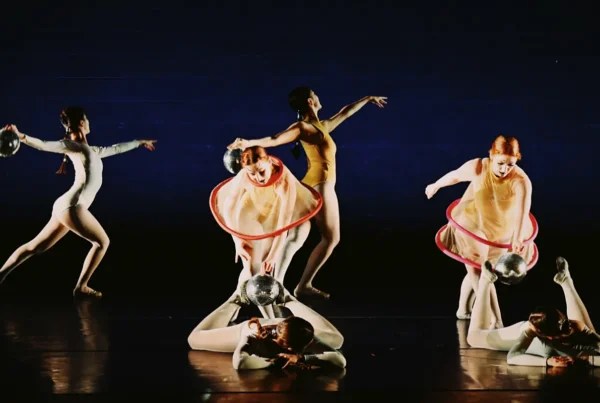
Movement is fundamental to that instability. Fuentes trained in New York City with modern dance teachers Paul Sanasardo, Martha Graham, and May O’Donnell, and the influence is visible in the way forms seem to pivot, sweep, and counterbalance across the surface. Curves can read like bodily gestures, repeated shapes establish visual beats, and even compositions built around grids or bilateral symmetry resist complete stillness. Rather than treating the sheet as a fixed field, he organizes it with the sensitivity of someone attentive to choreography, weight, timing, and the tension between a body and the space surrounding it.
Professional theater further shaped his sense of scale and staging. His experience with El Teatro Campesino, La Compania de Teatro de Albuquerque, and one man shows contributed to compositions in which silhouettes, framing devices, and strong contrasts appear to perform within bounded space. A collaboration with photographer Oscar Lozoya added another layer, sharpening Fuentes’s attention to tone, contrast, and gradations between light and shadow. These disciplines do not sit beside the paper cuts as separate chapters. They converge in the work, where choreography guides rhythm, theater informs dramatic arrangement, and photography strengthens the expressive relationship between darkness and exposed paper.

When Color Becomes Architecture
Color gives Fuentes two distinct registers of expression. In predominantly black and white works, severe contrast creates a graphic intensity close to shadow theater. Black can operate at once as contour, atmosphere, and solid mass, while untouched or opened areas function as active light. This economy makes every cut consequential. A single opening can separate figure from ground, redirect the eye, or transform a dense silhouette into a porous structure. The resulting images demonstrate how absence is not merely what has been removed. It is one of the central visual materials through which the composition gains clarity, rhythm, and psychological charge.
His polychrome works generate a different sensation. Saturated reds, yellows, turquoise blues, greens, and oranges recall stained glass, festival decoration, and Southwestern light. Ventana Rosa (Rose Window) is a key example. The intricate cut paper work was conceived to evoke the architectural grandeur of traditional stained glass while retaining a strong Southwestern aesthetic. Its circular, window like structure organizes radiant color around a firm central axis. A yellow cross references the Zia symbol, while stylized formline figures and red and green accents connect the composition to the cultural heritage of the region.
The history of Ventana Rosa also marks an important institutional milestone. The Millicent Rogers Museum in Taos, New Mexico invited Fuentes to curate an exhibition focused on Chicano artists in New Mexico from the 1970s to the present. He included Ventana Rosa in that exhibition, and the museum later acquired the work for its permanent collection. The acquisition places a personally significant piece within an institution connected to the region that informs its imagery. Fuentes is also represented by Michael Gorman Gallery in Taos and Cruz Gallery in Española, New Mexico, extending the public presence of a practice that has appeared in galleries, museums, art fairs, fine dining establishments, and print and digital publications.

Tlacaelel Fuentes: A Practice Built for Continuance
Fuentes maintains a daily studio practice, continuing to cut paper, frame finished works, and broaden the audience for his art. The constancy of that routine reflects a relationship with the medium that began in childhood but has never remained static. Over time, basic geometry has given way to increasingly animated compositions concerned with balance, human experience, cultural inheritance, transformation, nature, ceremony, and interconnectedness. Recognizable signs and bodily forms are often absorbed into larger ornamental systems rather than fixed into straightforward illustration, leaving viewers to move between symbol, silhouette, pattern, and open space.
That long development continues through a busy period in 2026. Fuentes lists the New Mexico State Fair in Albuquerque, running September 10 through 20, among his upcoming highlights. In September, his work is also scheduled for a full page showcase in ArtNews’ annual “Top 200” collectors issue, placing his portfolio before an international readership of collectors, galleries, and institutions. From October 7 through 10, he is scheduled to show at SPECTRUM Chicago, sponsored by Redwood Art Group and hosted at The Mart. Together, these appearances extend a career grounded in the studio into new exhibition and publishing contexts.
Yet the clearest measure of Fuentes’s commitment is not a calendar of appearances but his description of how long he intends to work. He says he will keep cutting paper until, “like a little church mouse, they pick me up by the tail and toss me away.” The humor carries a serious conviction. Paper has accompanied him from a childhood encounter with a cabinet of colored sheets to museum collections and gallery representation, while absorbing the lessons of dance, theater, photography, and Chicano cultural memory. In his hands, cutting remains both a technical discipline and a way of thinking through image, architecture, movement, and light.