“For more than fifty years, I have created in silence. Now the world will see what color can say.”
Color, Presence, and the Human Figure
For more than five decades, Calvin Jefferson (@TRUSTAIIQ) has returned to the human figure as a site of identity, emotion, and recognition. The visual artist, Founder and CEO of TRUST AI IQ, author of Born to Draw: Little Rock Dreams, healthcare professional, entrepreneur, and United States Navy veteran began drawing as a child in Little Rock, Arkansas, sustaining an artistic practice alongside the many other roles that shaped his life. Across that long trajectory, portraiture became more than an exercise in likeness. It offered Dr. Jefferson a way to consider perseverance, dignity, cultural memory, and the inner life that can register through a face, a posture, or the relationship between a figure and its surroundings.
His visual language moves between observational realism, expressive color, geometric abstraction, and stylized figuration. Naturalistic passages can emphasize modeled skin, concentrated gazes, and tonal contrast, while other works simplify the body into bold contours and saturated fields of red, blue, yellow, green, and black. Mosaic-like fragmentation and Cubist spatial construction further expand his approach to portraiture. These shifts do not pull the work away from its central concerns. Instead, they offer Dr. Jefferson multiple ways to ask how a person can be pictured without reducing that person to appearance alone.
That attention to humanity is closely connected to Dr. Jefferson’s lived experience. Growing up in Little Rock, serving in the Navy, and working in healthcare all contributed to the way he observes people. Dr. Jefferson has earned a Doctor of Health Science, an MBA in Healthcare Administration, and a Bachelor of Science in Health Administration. He describes learning to look beyond surfaces toward the histories, emotions, and dignity held within an individual. The result is a practice grounded in close looking but directed toward something less easily measured: the possibility that an image can make its subject feel fully present and worthy of sustained attention.
Dr. Jefferson’s portrait of President Bill Clinton is held in the permanent collection of the Clinton Presidential Library, extending the institutional presence of his portraiture and its engagement with recognizable figures.

President Bill Clinton Portrait
Endangered Species
Pastel portrait of Snoop Dogg, 1996
Dr. Calvin Jefferson: Building Chromatic Woman™
The Chromatic Woman™ collection brings Dr. Jefferson’s interests into a sustained body of portraits centered on women. He describes the series as an exploration of beauty, strength, intelligence, vulnerability, complexity, individuality, and cultural legacy, with particular attention to women whose strength is not always adequately recognized or celebrated. Rather than treating these qualities as abstract themes, he locates them in expressions, gestures, poses, clothing, ornament, and the visual environments surrounding each figure. Women occupy the compositions with a sense of weight and centrality, becoming the unquestioned focus of the image.
Many works pair seated or reclining figures with textiles, flowers, jewelry, architecture, landscape, calligraphy, and ornamental pattern. These components function as more than decorative scenery. They help establish cultural identity and inheritance, allowing difference to emerge through dress, pattern, color, and symbolic setting while a consistent interest in the figure holds the collection together. Closed eyes, inclined heads, relaxed hands, and curved bodies recur throughout the series, creating moments that suggest rest, contemplation, dreaming, or self-possession rather than outward performance.
Dr. Jefferson’s recurring chair can read almost like a stage or throne, reinforcing the physical and psychological presence of the women it supports. This balance between individualized detail and broader symbolic resonance gives the collection much of its character. The figures remain connected to specific visual markers while also participating in a shared language of dignity, sensuality, resilience, and repose. Dr. Jefferson’s stated ambition is not simply to celebrate women, but to invite reflection on what it means to see beauty, strength, vulnerability, and identity with sustained attention.

Chromatic Woman™: Korean Woman
Chromatic Woman™: Saudi Arabian Woman
When Color Carries Memory
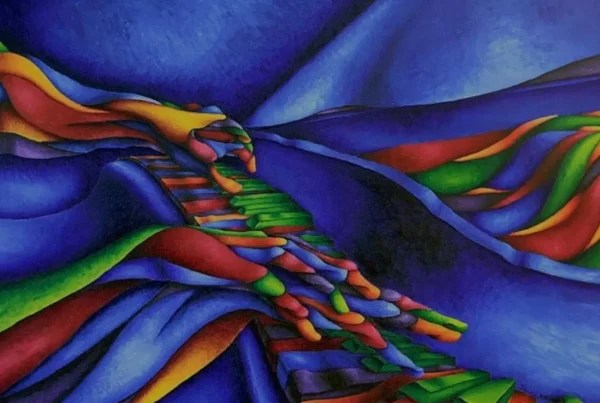
Color is not an accessory in Dr. Jefferson’s practice. He treats it as a visual language capable of carrying identity, energy, memory, emotion, and human connection. Highly saturated palettes often place warm reds and golds against deep blues, greens, and blacks, while strong contours organize the figure and flatten conventional perspective. Pattern introduces another rhythm through flowers, geometric ornament, fabric, latticework, and landscape. The resulting compositions can evoke the visual intensity of stained glass, textile design, poster art, and decorative modernism without losing their focus on human presence.
His day-to-day process begins before those layers accumulate. An expression, pose, memory, or emotional idea may provide the initial spark. Dr. Jefferson studies the subject carefully, then considers what the colors themselves should communicate. Tone, contrast, texture, and detail are built progressively, with the image allowed to develop naturally rather than being forced into a predetermined conclusion. Throughout that process, he keeps the emotional presence of the subject at the center, using formal decisions to support rather than overwhelm the person depicted.
The method reflects a larger continuity across his work. Technique can shift considerably, from softer representational modeling to broad chromatic planes or fractured structures, yet the underlying purpose remains consistent. Dr. Jefferson’s portraits use color and form to make identity visible without treating it as fixed or superficial. His interest lies in the ways visual choices can hold cultural recognition, personal history, and emotional accessibility at once. Chromatic intensity becomes a means of attention, giving the figure a space in which presence can be asserted rather than generalized.
That relationship between visual expression and other creative forms also extends into Dr. Jefferson’s work in music. The Color of Man, one of his artworks, currently serves as the cover artwork for the music release of the same name by Poetic & Creative. Original music is also connected to the Chromatic Woman™ series, extending its exploration of identity, color, and human experience beyond the visual field. Together, these projects reveal an interdisciplinary dimension to Dr. Jefferson’s practice, with visual art and music functioning as related forms of cultural and emotional expression.
Listen: The Color of Man on Apple Music
Chromatic Woman™ music:
YouTube Music
Pandora

Chromatic Woman™: Chinese Woman
The Color of Man
Dr. Calvin Jefferson: Endangered Species and What Comes Next
A key work in Dr. Jefferson’s development is Endangered Species, a pastel portrait of Calvin Broadus, professionally known as Snoop Dogg, created in 1996 and held in the permanent collection of the University of Arkansas at Little Rock. Dr. Jefferson identifies the piece as particularly meaningful because it marks an important stage in his growth as an artist and reflects a longstanding concern with identity, humanity, and representation. Its inclusion in the university’s permanent collection gave the work an enduring institutional home. For Dr. Jefferson, that placement also affirmed an artistic voice he had been developing since childhood, connecting an early passion for drawing with a mature commitment to portraiture.
Pastel offered qualities that suited the work’s emotional and representational aims. Through layered color, Dr. Jefferson could create depth and softness while retaining intensity, balancing realism with a more expressive chromatic approach. Those qualities continue to inform his work today, even as his visual vocabulary has expanded. Endangered Species therefore occupies an important position within his broader practice: it shows that the questions animating Chromatic Woman did not arrive suddenly, but grew from a sustained interest in visibility, representation, and the emotional force of the human subject.
Dr. Jefferson now intends to expand Chromatic Woman into a major exhibition accompanied by a publication. Bringing the portraits together would allow the collection to operate as a unified visual experience, placing individual works in conversation around beauty, identity, strength, vulnerability, and cultural memory. The project also extends the conviction that has guided his practice for decades: people deserve to be seen with care. After more than fifty years of making art, Dr. Jefferson is positioning color, portraiture, and cultural storytelling as instruments for that recognition, asking viewers to consider not only whom they see, but how deeply they are willing to look.
Artwork © Dr. Calvin Jefferson. All rights reserved.